

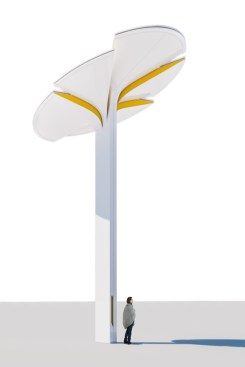
Smart energy startup Totem Power wants to change the way cities and residences function. In collaboration with cross-disciplinary design studio AE Superlab in Brooklyn, the Bedford, N.Y.–based company has created Totem, a multi-platform service that is able to provide uninterrupted power even during emergency conditions when electricity is sparse, or completely unavailable. The product’s minimalist aesthetic is intended to accentuate urban landscapes, combining form and function in one elegant package. ARCHITECT spoke with Totem Power CEO Brian Lakamp via email about this platform, which is expected to go live in summer 2017.
ARCHITECT: How does Totem work?
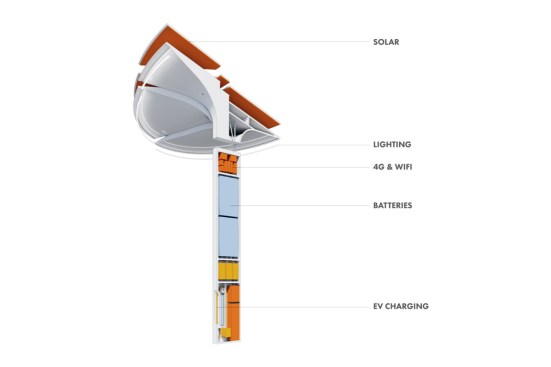
Brian Lakamp: Totem brings together five elements in a unified, smart city platform: a solar array on top of the canopy of each unit; lithium-ion battery storage in the column; communication nodes for Wi-Fi and 4G connectivity; an electric vehicle charging module; and LED lighting fixtures under the canopy that will incorporate ambient light sensors to deploy illumination when necessary, at optimized levels of brightness. It will serve as a resilient utility node for the properties and communities of tomorrow.

Courtesy Totem Power
How did the idea for Totem come about?
Totem started with my personal investigation into solar panels for my home, and the realization of how they are generally designed to be hidden on rooftops or in the back of buildings while only serving a point function instead of being rolled into an integrated system. I saw an opportunity to rethink the product with a commitment to design.
Courtesy Totem Power
How much energy is Totem able to generate and store?
The Totem has a 5-kilowatt solar array atop its canopy and 44 kilowatt-hours of battery storage within the column.
What services and functions can Totem provide?
Totem is fundamentally designed as an extensible, resilient platform to power services for the intelligent cities of tomorrow. With its core built around energy storage, Totem enables emergency resiliency for critical services. Specifically, the communications nodes housed on the unit are capable of being powered by the on-board energy storage, even in the event of natural disaster or wider network disruption. Totems are also designed to better integrate renewable energy production into the grid, by storing energy from nearby solar arrays, or by feeding stored energy from the unit back into the grid when needed.
Courtesy Totem Power
What types of areas would benefit from Totem?
Totem is meant to bring smart utility out of the shadows for the next generation of communities and companies. We envision it becoming a part of city and residential streets, corporate and school campuses, retail establishments, public parks, and any other shared space that stands to benefit from advanced energy, communications, and transportation functions.
Where have you tested Totem so far?
At this stage we’re announcing the design and functionality of Totem. We are engaged in a number of conversations to build partnerships, and these will be covered in future announcements.

Courtesy Totem Power
How can this technology improve cities and neighborhoods?

Courtesy Totem Power
Beyond the primary technological capabilities, Totem also provides a foundation for a long road map of smart city services and intelligence. With our commitment to design, we’re also engaging the public in a conversation about energy and smart services to breed awareness, understanding and innovation.
What distinguishes Totem from other smart-city infrastructure?
We are committed to design, and are deploying a platform—not a point utility. We want Totem to become a limitless technical platform for today’s and tomorrow’s critical services, delivered in a visually-stunning form.
This interview has been edited for clarity.