The miles of tiles on display at the annual Cevisama trade show, to be held next week in Valencia, Spain, will primarily take the form of thin slabs used for interior finishes and exterior cladding. But what if that material could be put to use in structural assemblies?
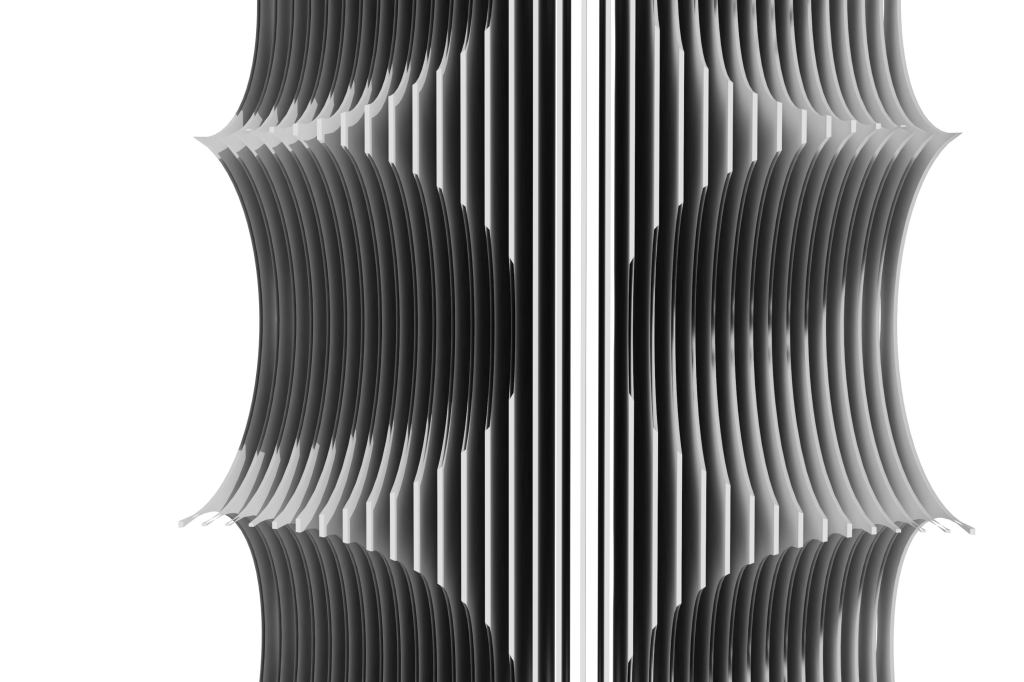
That’s the question posed by Protoceramics, an installation from the Material Processes and Systems Group at Harvard’s Graduate School of Design led by director Martin Bechthold in collaboration with the Spanish Association of Manufacturers of Ceramic Tile. Three, full-scale columnar prototypes will visualize different methods—cutting, folding, and bending—of manipulating the material and the structural and mechanical properties that result.
Each column measures 3.6 meters (9.8 feet) tall and is made from 3mm-thick (0.12 inch-thick) ceramic tiles. To show the possibilities derived from the cutting method, the group used a CNC water jet to cut the tiles, which are then vertically layered to form a rigid column. To explore folding (top image), the team used the flexibility afforded by the tiles’ mesh backing to create large-scale 3D geometries that get their strength from a mix of patterning, stiffened edges, and the inclusion of rigid frames. The team found that bending the material (below), a process they admit in the project’s description to be seemingly antithetical to such a brittle substance, actually made it stronger through enhanced stiffness, allowing for “unexpected material formations that defy conventional expectations in ceramic design,” they write.
The installation will include small-scale, 3D printed models of assemblies showing other fabrication possibilities as well as an exhibition catalog that details the group’s topical research.