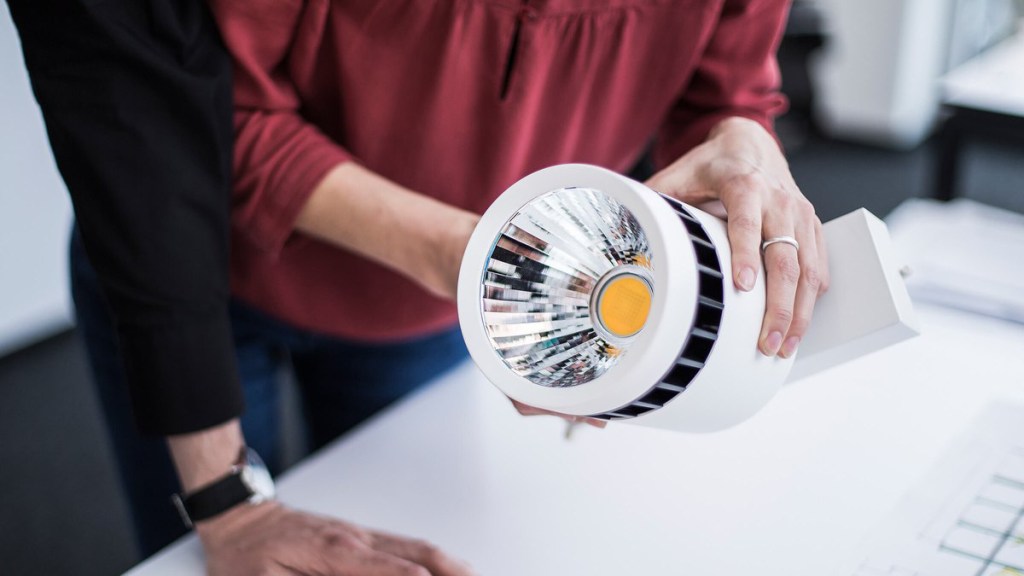
Within a period of just a few years the LED has become the dominant electric light source and has taken over in nearly all fields of lighting. We have witnessed a disruptive change which has made any previous technology obsolete. How much further will this trend go?
Irresistible benefits
The technical and physical properties that qualify the LED for so many tasks are:
- very wide range of light colors.
- light can be superbly controlled.
- extremely high switching resistance.
- resistant to low temperatures, impact and vibration
- electrical activation and control is excellent.
- many possibilities for the design and shape of lamps and luminaires.
- long life cycle.
- high luminous efficacy.
On the other hand, the LED has several basic drawbacks. The main one is that light generation deteriorates as the temperature rises. There are hardly any LED luminaires which that are suitable for environments above 140° F, and above 212° F cooling becomes uneconomical. A xenon short arc lamp reaches 500 000 lumens over a discharge distance of just a few millimetres—such a high power density is fundamentally impossible with LED.
Some like it hot – but not LED
A niche for conventional specialist lamps is in applications with high ambient temperatures or extremely high luminance. The LED will dominate everywhere else—quite rightly, too, considering the fragile glass lamps with toxic heavy metals in conventional technology. Nevertheless, I would wish for yet another niche beyond the omnipresent LED, and this in the interest of health.
There are concerns about potential health risks arising from certain properties of LED light. First of all, let us consider the blue peak in the spectrum of white LEDs, typically between 440 nanometers to 460 nanometers. Light within this range of the visible light spectrum has an influence on the melanopic photoreceptors of humans.
Light on prescription?
Yet another problem is the possible flickering of most LEDs. It has been suggested that this may lead to headaches, migraine attacks, fatigue, or a general reduction in visual performance. Daylight, and even incandescent lamps, do not flicker at all. Flicker-free LEDs are technologically possible but at a higher price.
Lastly, the infrared part of the spectrum is missing. In many applications this is specifically not wished for, such as in museums or in the illumination of heat-sensitive products. However, whenever really warm light is desired, then it should be possible to obtain this lawfully.
Light is a form of nourishment
Light should not only be seen as technically generated radiation but also as a form of nourishment. Therefore, we certainly should not compare its efficiency, as we do, with washing machines and refrigerators. Think this through logically: just as in the food industry, electric light was optimized to the extent that it resembled natural light with the highest possible light output. The next step was light which “tasted” the same as natural light, having a comparable colour rendition. However, as we know from industrial foods, not everything that looks and tastes the same, is just as healthy. We need to deepen our knowledge of light and health.
The LED will move forward and, within lighting technology, make an important contribution to energy conservation. Conventional light sources will survive in small niches. I hope and wish for the profession of the lighting designer that thermal radiators, in the sense of technically highly developed incandescent lamps, will still continue to be available for residential lighting.