
HIGH INTENSITY DISCHARGE (HID) Ongoing improvements and product line expansions of ceramic metal halide lamps are probably the most important HID developments. Ranging from 20W MR16 to 400W E28 and E37 lamps, the superior color and high efficacy of ceramic lamps continues to impress. The latest products include compact lamps at 210W and 315W that have high lumen maintenance and dimming, making them ideal for new indoor and exterior luminaires where point sources are needed.
An important innovation is the self-ballasted low-wattage metal halide PAR lamp. These lamps, which fit directly into medium base sockets in tracklighting gear, replace tungsten lamps and can reduce display lighting power by 50 to 67 percent.
Among metal halide ballasts, three major developments stand out:
In another exciting development, plasma HID lamps have been introduced that achieve 20,000 lumens or more from a source that is about the size of a large LED. These are induction lamps that use microwaves to excite metal halide chemicals inside of a compact vessel, with the potential for creating an incredibly small luminaire with superior efficiency. There is also the promise of very low cost. Perhaps this source will become the perfect companion to LED sources when large lumen packages are needed. These sources have already moved into professional video projectors and theatrical lighting, so architectural lighting is imminent. Limitations are similar to other metal halide lamps, such as limited dimming range, warm-up and re-strike time, and minor color issues.
LED Let’s face it, this is where most of R&D funding goes, so it should be no surprise that LED products are now being introduced at about 10 times the rate of all other light sources combined. The promise of solid-state lighting—both LED and OLED—remains outstanding. But with solid-state lighting changing so rapidly, constant attention to new developments is essential. For this reason, a separate LED discussion will appear in the next issue of A|L LED, in conjunction with the Sept./Oct. 2009 issue.
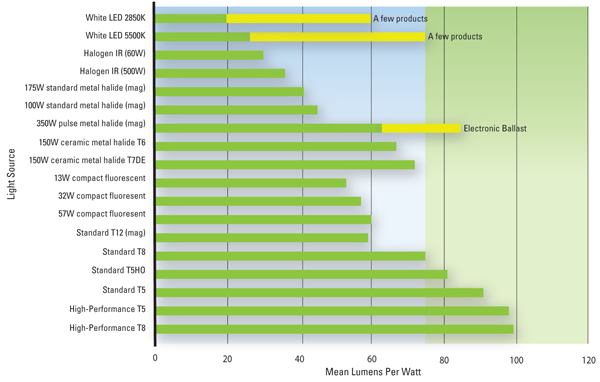
SUMMARY While solid-state systems now add to the lighting designer’s choices, developments in conventional lighting are decreasing rapidly. However, solid-state lighting must be carefully evaluated on a case-by-case basis, as the cost per lumen-hour is still three to five times that of fluorescent lighting. In other words, don’t throw away those lamp catalogs just yet.