
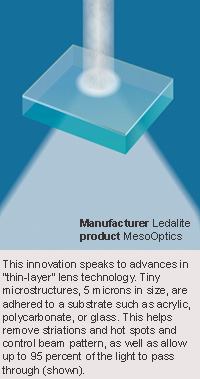
Luminaires are now capable of feats designers once thought an R&D pipe dream, owing to the contributions of, for example, high-reflectivity paint and metal, and thin-layer lenses.
» Luminaire design is governed by physics. Perhaps the most important principle is reflection, which allows for directional redistribution of light. Sometimes light distribution is further affected by refraction, the bending of light rays exhibited by a lens; or by diffusion, the purposeful scattering of light through a translucent material. Over the years, advances in materials science have evolved to such an extent, it is as if the governing laws of physics had been rewritten, enabling better control of light and a new generation of energy-efficient luminaire design.
ULTRA-REFLECTIVITY
Reflecting surfaces gather the light inside a luminaire and redistribute it in useful directions. Other reflecting surfaces, such as louvers, further redirect the light as it leaves the fixture. The reflectivity of a luminaire