
This post is part of a monthly series that explores the historical applications of building materials and systems through resources from the Building Technology Heritage Library (BTHL), an online collection of AEC catalogs, brochures, trade publications, and more. The BTHL is a project of the Association for Preservation Technology, an international building preservation organization. Read more about the archive here.
In fiction and fantasy, carpets and rugs have historically been given magical powers of flight—whisking protagonists to faraway lands or away from danger. But in reality, floor coverings serve much more functional purposes: They insulate, provide comfort underfoot, dampen unwanted noise, and offer decorative options for interiors.
Below, the BTHL documents available carpeting and rugs for residential applications throughout the 20th century.
Telfer’s Good Carpets and Rugs, Telfer Carpet Co., Des Moines, Iowa, c. 1900
This early catalog offered carpets, rugs, curtains, and linoleum flooring for residential applications. To achieve wall-to-wall coverage, Telfer’s sewed 27” wide strips of carpet or rug with border patterns.
The James Dunlap Carpet Co., Philadelphia, 1906
This catalog features 66 pages of rug patterns, often depicting traditional floral and geometric motifs.
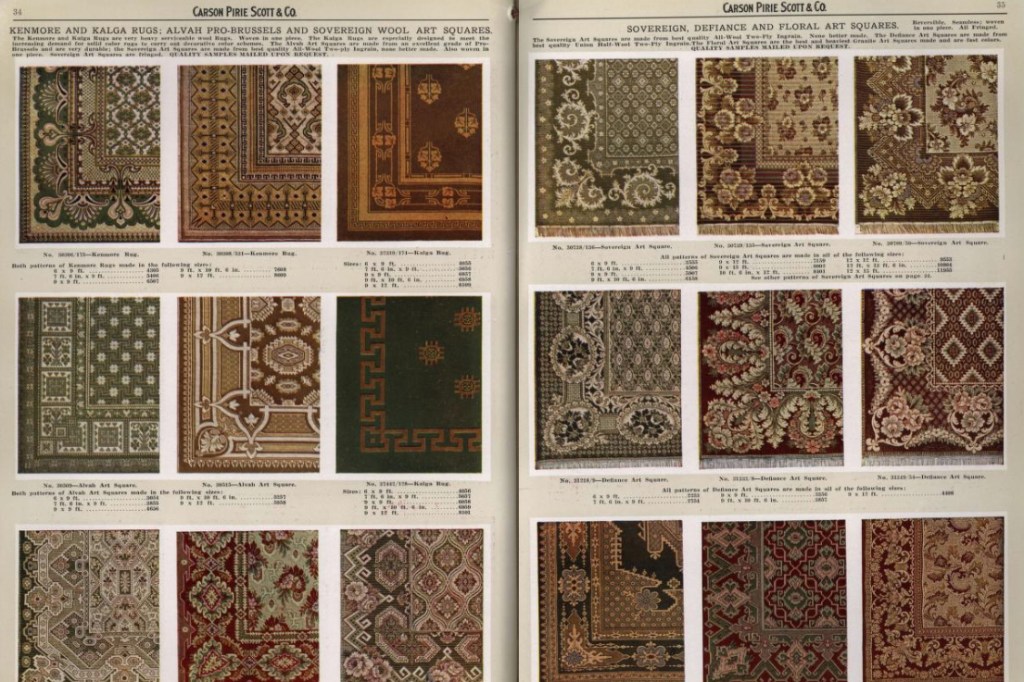
Pattern Book “C”, Carson Pirie Scott & Co., Chicago, 1913
Founded in 1854 as a department store, Carson Pirie Scott & Co. sold various floor covering options, including rugs, cut carpets, and linoleum. There are several patterns of grass rugs made of twisted prairie grass that the company bills as “suitable for porches, kitchens, summer houses and cottages.”
Let Hartman Feather Your Nest, Hartman Furniture and Carpet, Chicago, 1922
This exhaustive publication offers everything from baby carriages to fencing, as well as carpets and rugs made of prairie grass, wool, and velvet.
Floor Coverings, Mohawk Carpet Mills, Amsterdam, N.Y., 1929
At the time, the Mohawk Co. claimed to be the only U.S. carpet manufacturer “producing every accepted modern weave—Chenille, Wilton, Axminster, Velvet, and Tapestry.” This catalog features more than 80 patterns in both traditional and modern designs.
International Hooked Floor Coverings, Firth Carpet Co., New York, c. 1930
Firth Carpet Co. provides whimsical, at times dramatic, descriptions of the company’s international search for unique “hooked” rugs. Each design is accompanied with the narrative of its discovery.
Columbia Book of Yarn Rugs, Wm. H. Horstmann Co., Philadelphia, 1936
Wm. H. Horstmann Co. sold yarn rug frames, patterns, needles, and yarn for buyers to knit their own rug. “This book shows attractive rugs which may be made economically, easily, and quickly by the new Columbia method of yarn making rugs,” according to the catalog. Available patterns feature animals, plants, tribal motifs, and geometric designs.
Woven Floor Covering: Retail Sales Manual, Mohawk Carpet Mills, Amsterdam, N.Y., 1949
This retail manual, intended to serve as a textbook for Mohawk Carpet Mills’ sales team, provided an overview of the wool-making and carpet weaving processes.
1951 Rug-Selector, Gordon Mackay and Co., Toronto, 1951
This catalog contains traditional carpets and linoleum floor coverings from a variety of manufacturers, as well as ads for carpet pads to lay underneath wall-to-wall carpet, a mid-20th century innovation.
Olson Reversible Rugs with Twice the Wear, Olson Rug Co., Chicago, 1962
The Olson Rug Co. claimed to be the “world’s largest and oldest rug and carpet weaver dealing directly with American homes.” This catalog features reversible broadloom rugs and carpets in uniform colors.