People spend a lot of time looking at the screens on computers, televisions, phones, and tablets. According to a 2009 Council for Research Excellence study, adults look at screens for about 8.5 hours per day, or roughly half of waking hours, which has most certainly increased in the five years since the study.
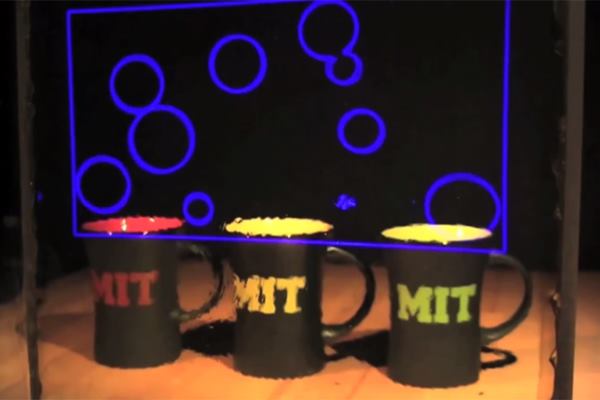
A recent innovation by MIT scientists offers a new model for 2D interfaces that allow us not just to look at screens, but see through them. The new clear screens, which the researchers call “transparent scattering displays,” are made of see-through material impregnated with nanoparticles. As light is projected, these particles scatter only selected wavelengths of the illumination, capturing the intended information while allowing the remaining light to pass through unaffected and rendering the rest of the surface transparent.
Depictions of transparent screens populate Hollywood fantasies such as Minority Report (2002) or Avatar (2009), and project an image of the desired, yet intangible, interface of the future. However, the researchers declare that these screens “are simple to manufacture, of low cost, scalable to large sizes, and have wide viewing angles,” so these movie fantasies may actually arrive soon, and transform the visual potential of windows, storefront displays, walls, and windshields.
Transparent screens will raise many questions related to hardware and design, such as how to create unobstructed views or ensure clear visibility with varying backgrounds. Although the new devices may not reduce our screen time, at least we will be more conscious of the world beyond our displays.
Blaine Brownell, AIA, is a regularly featured columnist whose stories appear on this website each week. His views and conclusions are not necessarily those of ARCHITECT magazine nor of the American Institute of Architects.