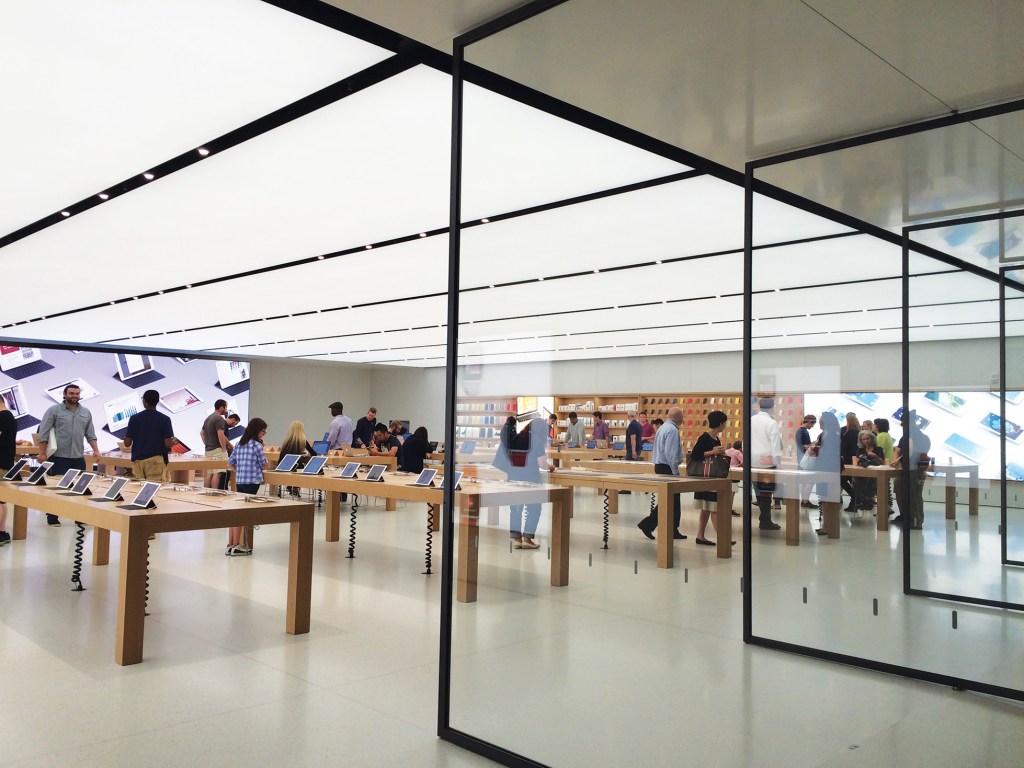
This past December, Apple obtained a patent for a ceiling lighting system that the company has already started to unveil worldwide as part of an update to the design vocabulary for its “next-generation” retail locations. The Brussels store, which opened in September 2015, was the first to debut the new ceiling. Closer to home, it can be seen in the Chestnut Hill, Mass., location (below). U.S. Patent No 9,217,247 details a wall-to-wall illuminated ceiling panel system with intermittent linear light tracks for small-aperture fixture heads. In a Dec. 20, 2015, “60 Minutes” segment with Charlie Rose, Apple’s senior vice president, retail and online stores, Angela Ahrendts, noted that the company feels this uniform illumination strategy creates a better retail atmosphere and, in turn, a better customer experience. It’s all part of the new store concept envisioned by Jonathan Ive, who in May 2015 became chief design officer of Apple’s design department in addition to leading the company’s hardware and software divisions.
Rather than treat the ceilings of its new stores as a conventional opaque surface dotted with points of light, Apple is adopting another lighting solution: the luminous ceiling. The concept is not new. One of the most famous is the ceiling that lighting designer Richard Kelly and architects Ludwig Mies van der Rohe and Philip Johnson developed in partnership with lighting manufacturer Lightolier in 1957 for the Seagram Building in New York.
The extent to which obtaining the patent is an indication of whether Apple is, or is not, dipping its toe into architectural lighting remains to be seen. Nonetheless, the patent should be on the lighting design community’s radar, for it does raise significant questions about whether a lighting detail (or for that matter an architectural or building-construction detail) is something that should be patented. It’s not the first time Apple has obtained an architectural patent. In October 2013 it obtained one for the curved glass stairs in its retail locations, and earlier that year the company trademarked its store designs. Basic construction methodologies live in the public domain, and a luminous ceiling is an often-used lighting strategy. Now that Apple has a patent for its luminous ceiling, do lighting designers and architects expose themselves to some type of risk if they implement a luminous ceiling strategy? And, by extension, what risk might there be for lighting manufacturers or a lighting components company whose products are part of an overall ceiling lighting system?
Of course, there have been numerous patent infringement cases among manufacturers, as they jockey to protect their products’ technology platforms. As the industry has transitioned to LEDs, these product-specific lawsuits are occurring with significant frequency. One way the industry has addressed this is through licensing programs, the most notable being Philips’ EnabLED Licensing Program for LED Luminaires and Retrofit Bulbs launched in 2008.
For designers, it’s an interesting issue of precedent and how we go about protecting authorship. In thinking about who owns a design, the question is: Where do you draw the line? Is it about a technical solution, a design concept, an aesthetic look? It’s certainly something to think about as lighting becomes the delivery platform for connected technologies and nonlighting companies enter the lighting market. •