
Wallwashing and Wall Grazing

Fixture placement is the key factor for this nuanced lighting technique.

1 MIN READ

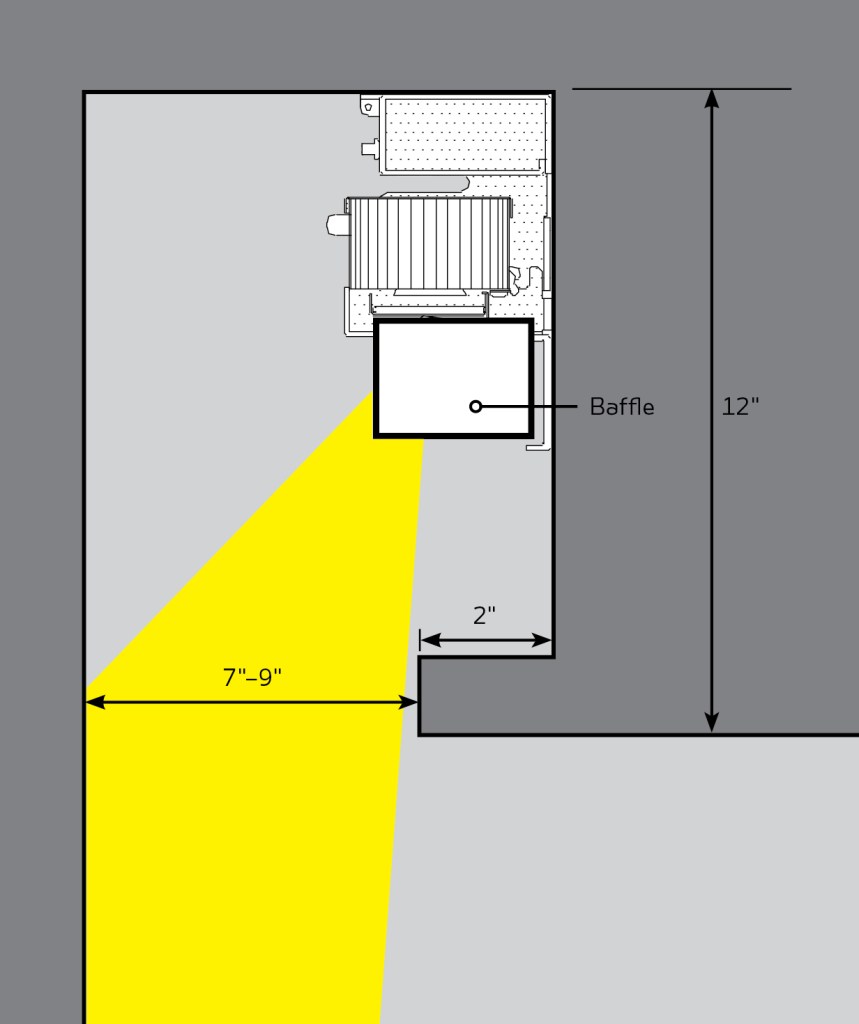
Illuminating a wall can be done in one of two ways: wallwashing or wall grazing. The distinction between these two core lighting details is the fixture’s distance from the wall surface. In a wallwash detail, the luminaire is typically a minimum of 12 inches away from the wall plane, allowing for an even application of light that gives the wall texture a flat appearance. In a wall grazing detail, the fixture is positioned very close to the wall (no further away than 12 inches) in order to highlight and bring out the wall texture. The overall height of the wall informs the luminaire’s distance from the wall.


Things to consider for wall lighting:
1. The human eye has an easier time deciphering vertical surfaces than horizontal surfaces.
2. Illuminated vertical surfaces are most successful as an indirect lighting solution when the surface has a light-colored, matte finish.
3. Dark colors and specular surfaces, such as polished stone, are difficult to illuminate.
4. Illuminated walls can be a source of glare.

References
J.E. Flynn and S.M. Mills, Architectural Lighting Graphics, Van Nostrand Reinhold, New York, 1962, p. 182–183
M. David Egan and Victor Olgyay, Architectural Lighting, Second Edition, McGraw Hill, p. 226–227

Mark Karlen and James Benya, Lighting Design Basics, John Wiley & Sons, 2004, p. 59

About the Author

Elizabeth Donoff

Elizabeth Donoff is Editor-at-Large of Architectural Lighting (AL). She served as Editor-in-Chief from 2006 to 2017. She joined the editorial team in 2003 and is a leading voice in the lighting community speaking at industry events such as Lightfair and the International Association of Lighting Designers Annual Enlighten Conference, and has twice served as a judge for the Illuminating Engineering Society New York City Section’s (IESNYC) Lumen Award program. In 2009, she received the Brilliance Award from the IESNYC for dedicated service and contribution to the New York City lighting community. Over the past 11 years, under her editorial direction, Architectural Lighting has received a number of prestigious B2B journalism awards. In 2017, Architectural Lighting was a Top Ten Finalist for Magazine of the Year from the American Society of Business Publication Editors' AZBEE Awards. In 2016, Donoff received the Jesse H. Neal Award for her Editor’s Comments in the category of Best Commentary/Blog, and in 2015, AL received a Jesse H. Neal Award for Best Media Brand (Overall Editorial Excellence).Prior to her entry into design journalism, Donoff worked in New York City architectural offices including FXFowle where she was part of the project teams for the Reuters Building at Three Times Square and the New York Times Headquarters. She is a graduate of Bates College in Lewiston, Me., and she earned her Master of Architecture degree from the School of Architecture at Washington University in St. Louis.

No recommended contents to display.

Upcoming Events

  • Design Smarter: Leveraging GIS, BIM, and Open Data for Better Site Selection & Collaboration

    Live Webinar

    Register for Free
  • Slate Reimagined: The Surprising Advantages of Slate Rainscreen Cladding

    Webinar

    Register Now
  • The State of Residential Design Today: Innovations and Insights from RADA-Winning Architects

    Webinar

    Register for Free
All Events