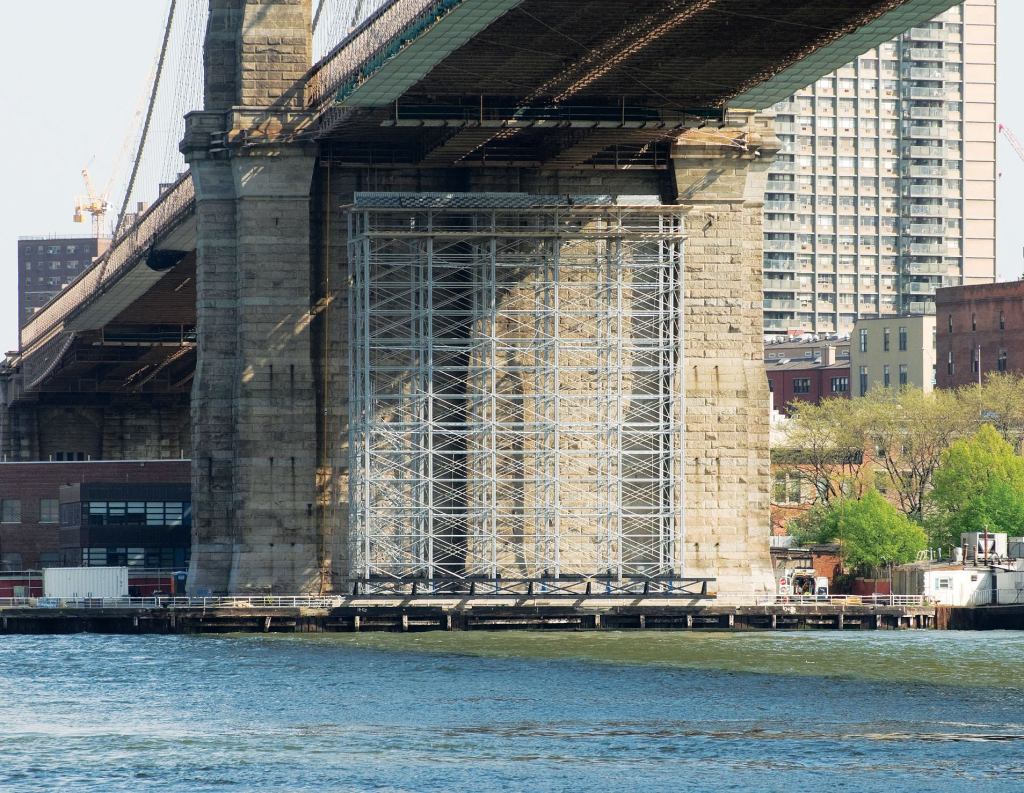
CHALLENGE Water, given its properties, normally flows in a horizontal direction. There are occasions, though, when land formations force water to move vertically. New York Harbor, an intensively active water area, because of natural crosscurrents and steady boat traffic, is not where one would normally expect to see a vertical flow of water. But from mid-June to mid-October 2008, artist Olafur Eliasson’s public art installation “The New York City Waterfalls” is challenging New Yorkers to revisit the city’s waterfront and reconsider what represents a natural versus man-made setting.
SOLUTION Commissioned by the Public Art Fund and enlisting the talents and cooperation of more than 200 individuals and multiple city and state agencies, the waterfalls occupy four sites—the Brooklyn Bridge anchorage, Pier 35, Brooklyn Piers 4 and 5, and Governors Island. Using urban infrastructure—scaffolding, pumps, and pipes—to recreate a natural phenomena, the real magic of the waterfalls is their transformation as they respond to light, temperature, and wind. An ongoing monitoring process maintains a diligent watch for this feat of engineering not readily apparent to the naked eye.
Illuminating the waterfalls required ingenuity equal to the construction of the structures and the flow of water. The water is gathered from the East River, collects into intake filter pools covered with mesh to protect aquatic life, and is then pumped through pipes to the top of the scaffolding over a metal trough, or weir, returning the water to the river. “Olafur wanted the water to appear as if it were being lit by moonlight,” explains Michael Mehl, director of lighting at New York-based engineering firm JB&B.
Light-emitting diodes (LEDs) were used not for their long-life or low heat output, but rather because of the fixture’s compactness, which enabled it to be tucked underneath the weir, providing even illumination for the 80-foot-wide span of falling water. “We had one shot at the mock-up to convince the team LEDs were the way to go,” Mehl says.
The custom fixture blends cool and warm LEDs to simulate moonlight. The LEDs are positioned in a continuous but staggered array with a 15-degree optical distribution that is aimed behind the water to graze its cascade. A custom baffle reduces the fixture’s visible brightness. The controls and power sources are located in a mechanical shed at the base of each waterfall.
The New York City Waterfalls is not your common artwork; it is an experience with daily interaction to the immediate surrounds, city infrastructure, and people. Creating a unique spectacle, it celebrates the city and its link to its natural past.
Project The New York City Waterfalls, New York
Design Team Olafur Eliasson, Berlin (artist); Public Art Fund in conjunction with the City of New York (clients); Tishman Construction, New York (construction manager); JB&B, New York (MEP engineering, water and lighting design)
Photographers Bernstein Associates, New York; Julienne Schaer, New York
Project Sites Brooklyn Bridge anchorage, Pier 35, Brooklyn Piers 4 and 5, and Governors Island. Waterfalls are 90 feet to 120 feet tall.
Manufacturer Boca Flasher