




Photo: Jennifer Lash
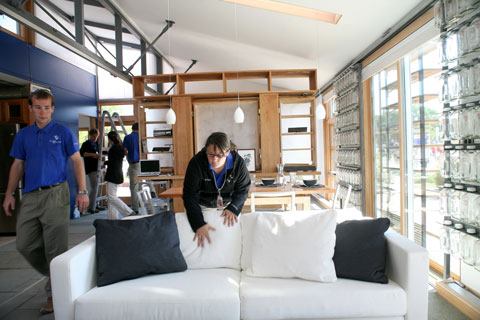
Technische Universitat Darmstadt, winner of the overall competit…
Lighting Control
Overall the jury thought students had a good understanding of daylighting and its consequences, but control strategies and the integration of this technology was, in their opinion, the weakest element of the lighting designs.The jurors say some teams used control systems well. Darmstadt’s system was sophisticated, Stashik says, and the team knew it well. The home “was very creative, very simple,” Miller recalls. “The balance of light was good. Something was not too bright, not too dim. It felt like everything was just right.”
One of the goals in Maryland’s lighting scheme was flexibility, team member Kucia explains, because the team’s target audience was the retiring baby boomer. This led to the use of a system that was easy to operate with “the ability to dim a large variety of fixtures,” Kucia says. During judging, the jurors were impressed with how well-versed Maryland was with its control system.
Montreal also used a control system, which would allow owners to set multiple zones of the home to their own preference, Dror says. However, the jurors found this particular system too complicated, as some of the team members had trouble explaining and using it during judging, Clanton recalls.
LED Effects
Many of the teams said they initially had intended to use light-emitting diodes (LEDs) throughout their homes, but when they tried to incorporate this technology, they realized LEDs did not offer them the effects they wanted.
Montreal “considered going with LEDs, but the lighting quality was not as coherent,” Dror says. However, one place the team succeeded with LEDs was the bathroom–nightlights with red LEDs were used there so as not to disturb a person’s circadian cycle, which the jurors saw as a thoughtful touch.
MorningStar, Penn State’s home, had color-changing LED strip fixtures mounted inside translucent clerestories, which offered “just the right amount of color without being overdone,” Miller says. According to Yena Han, the team’s lighting project manager, the color sequences of the LEDs represent weather conditions and are determined by data from AccuWeather. For example, flashing blue LEDs could indicate that a storm is approaching. “It’s intended to be another way of helping the occupant interact with the house to operate it as efficiently as possible,” Han explains.
The jurors felt Darmstadt used LEDs wisely and in appropriate places, such as to backlight niches throughout the home and to illuminate shelves. “We integrated LEDs into Plexiglas shelves,” explains Barbara Gehrung, a member of Darmstadt’s project management team. “It’s a storage space, but the LEDs turn it into a sort of light sculpture.”
“It was a very common theme that teams were disappointed with LEDs,” Clanton says. “The biggest lesson learned…was that LEDs in many cases just aren’t there [for use throughout an entire project], but they’re ideal for other lighting,” such as the exterior, where jurors thought LEDs offered beautiful effects.
Gracious Winners
Teams received trophies for each of the 10 contests during an awards reception held at the end of the decathlon. The Darmstadt team accepted the trophy for the lighting contest–and immediately gave it to the team from Maryland.”Darmstadt said Maryland was an excellent competitor throughout…and because they won the subjective component of the lighting contest–the part of the contest which, in Darmstadt’s opinion, really mattered–Maryland is the team that really deserved the trophy,” recalls Sheila Hayter, a senior engineer at the National Renewable Energy Laboratory and a Solar Decathlon subjective judging coordinator. “It was great seeing such good sportsmanship among the teams.”
Stashik, who also was on the lighting jury in 2005, says teams took it up a notch this year with better thought-out homes. “The enthusiasm of the students in every house was so great,” she says. “It gives you a sense of how much effort goes into this. It’s a wonderful opportunity for them and a great way to teach all of us.”
