


Cree's green XLamp XR-E is said to be 70 percent brighter than t…
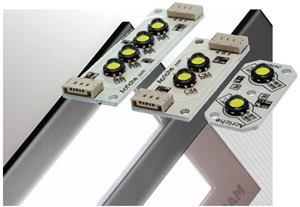
Acriche, the world’s first semiconductor lighting source for AC power outlets according to its manufacturer, Seoul Semiconductor, features a near-daylight quality warm white with 42 lumens per watt (lm/W). The manufacturer states that Acriche offers power efficiency compared with incandescent and halogen lamps and is ahead of fluorescent lamps in terms of lifespan, power usage, and convenience. The warm white Acriche with 42 lm/W is, according to Seoul Semiconductor, 20 percent more efficient than a conventional warm white DC LED with a luminous efficacy of almost 35 lm/W. The product is said to have a 35,000-hour lifespan and does not contain environmentally harmful substances such as mercury, nitrogen, or lead.
Lexedis Lighting, an Austria–based startup company of the Zumtobel Group focusing on LED products, recently introduced powerXED, a digital light source with a power emitter capable of delivering up to 60 lumens for cool white at a rated current of 350mA, according to the manufacturer. With a color rendering index (CRI) of up to 90 in the warm white range, powerXED is applicable for retail, medical buildings, and façade lighting applications and is expected, Lexedis says, to meet the high-performance light source requirements of architects, lighting designers, and lighting engineers by exceeding the CRI of 70 to 80 that is prevalent in fluorescent lighting. Boasting a life expectancy of more than 50,000 hours, powerXED is available in four correlated color temperatures in the white light range: 3000K, 4200K, 5700K, and 6500K.
A number of prototypes in development aim to push LED technology even further. Osram Opto Semiconductors has crafted a transparent white organic light-emitting diode (OLED) prototype that is said to have a luminous efficiency of more than 20 lm/W at a brightness of 1,000 candelas per square meter (cd/m2). The OLED tile is transparent whether powered on or off. Currently its transparency is rated at 55 percent, however, as product development continues, Osram is pushing for it to reach 75 percent.
Another prototype, from Morrisville, North Carolina–based LED Lighting Fixtures (LLF), claims it “shatters [the] world record for energy efficiency” with its PAR38 self-ballasted lamp, producing 659 lumens at 5.8W of wall-plug power, resulting in 113.6 lm/W. This prototype, which LLF plans to release in the next two years, recently underwent steady-state testing by the National Institute of Standards and Technology and used Cree XLamp and Osram Golden Dragon LED products as the diode source. The testing found that the LLF prototype had a CRI of just over 90 and would use less than 9 percent and 30 percent of the energy consumed by incandescent and fluorescent sources, respectively.
While many consider LEDs to be the lighting source of the future, the technology still has a long way to go. But with the current research and advances, in addition to what we can expect in the coming years, LEDs likely will become a cost-effective, energy-efficient light source suitable for a wide range of architectural lighting applications. With more accurate testing methods, the gap between claim and performance will be closed.
