
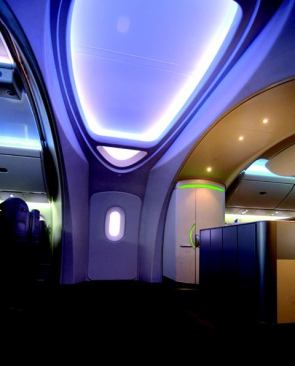
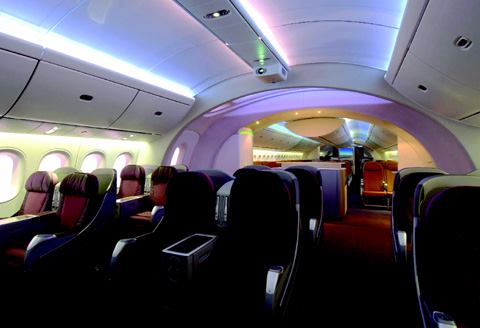
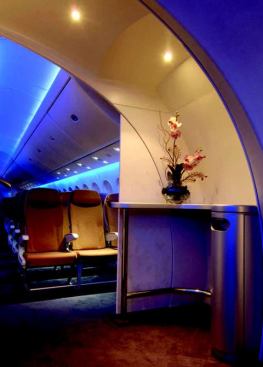
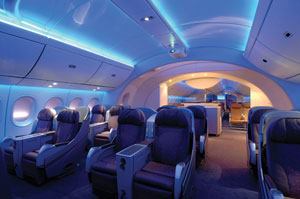
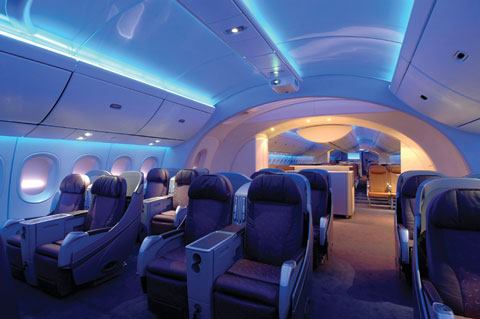
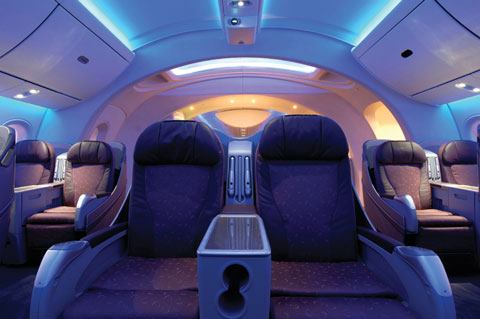
Starting at the entryway, vaulted arches appear repeatedly throu…
Perhaps most central to this theme is the airplane’s main lighting feature, a “simulated sky” created by arrays of RGB LEDs and designed to provide a more restful environment. This sky-like ceiling treatment continues throughout the entire cabin and imparts “a subtle yet persuasive sense of having the sky overhead,” says Emery. Throughout the duration of any flight, the ceiling can be set to a bright daylight scene or a peaceful nighttime presence, with the flight attendants in control of any number of preprogrammed scenarios.
The airplane’s windows also play a significant role in the open, spacious feel of the cabin. Again consulting with travelers to gauge their reactions to various window options, Boeing found that passengers prefer larger windows. At 65 percent larger than those in competing airplanes, the windows on the Boeing aircraft, which measure 11 inches wide by 18 1/2 inches tall, enhance the cabin’s airy atmosphere, allow natural light to flood the space, and offer passengers a view to the horizon from any seat on board, thus “reinforcing their connection to the flying experience,” explains Dowd. But that’s not all. Electrochromic technology eliminates the need for traditional pull-down shades. Using electricity to darken an electrically conductive medium between two layers of glass, the technology allows passengers to “dim” the window while maintaining high vision clarity at all transmittance levels, sustaining views to the passing terrain and reducing glare—all at the touch of a button located on the cabin wall and centered under the window itself.
From a vaulted ceiling moonlighting as sky to tunable windows, passengers’ other cabin frustrations have also been addressed through a suite of new technologies. These include the cabin’s air circulation system, pressurized to a lower altitude (down to 6,000 feet from 8,000 feet) to provide more moisture in the air; sensors on the aircraft’s nose that enable the control surfaces (such as the rudder and spoiler) of the airplane to respond to turbulence and adjust for a smoother ride; and a new gaseous filtration technology that offers increased humidity and cleaner air.
For Boeing, which has sold 567 planes to 44 customers—the majority of which are airlines, though some are other entities such as leasing customers—to date, the 787 Dreamliner may be the answer to travelers’ woes. And with an aircraft that offers substantial improvement in cabin comfort, perhaps travelers will now want to remain awake, gazing at the sky above or taking in the expansive view outside.
DETAILS
PROJECT Boeing Commercial Airplanes’ 787 Dreamliner
INTERIOR/LIGHTING DESIGN Boeing Commercial Airplanes, Seattle; Teague, Seattle
PHOTOGRAPHS Jim Coley, the Boeing Company except where noted
MANUFACTURER Diehl Luftfahrt Elektronik PPG Aerospace Securaplane
APPLICATION Main cabin lighting Electrochromic windows
Wireless emergency lighting system