1
of 5


Ian Allen
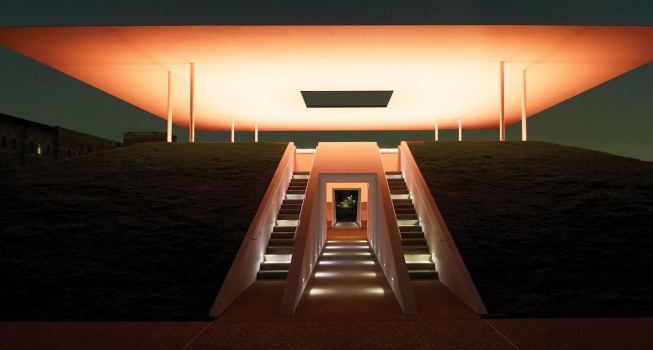
At night, a vivid wash of colored light, in this instance magent…

Ian Allen
At night, a vivid wash of colored light, in this instance magent…
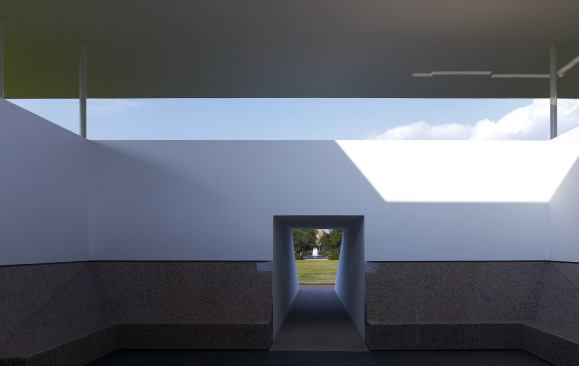
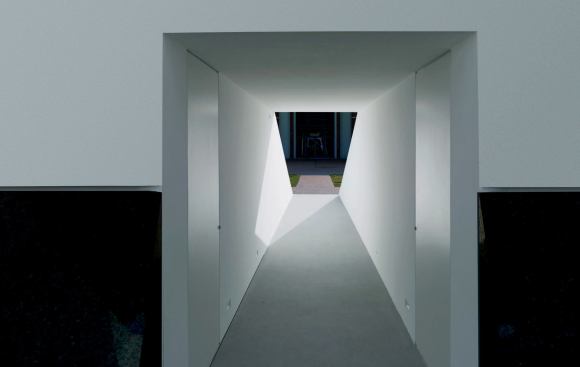
The enigmatic form of Twilight Epiphany appears to emerge directly out of the ground as a truncated pyramid, conjuring impressions of mysterious architectural monuments built by earlier skywatching societies. Four grass-covered berms make up the exterior walls, each sloping at a consistent 19 degrees to a height of 12 feet, and terminating at an intermediary level. Eight slender steel columns, set in pairs at each corner, rise above the tops of the berms to support a 72-foot-square canopy, which appears to hover over two levels of open-air seating. At the center of the roof is a 14-foot-square aperture—the focal point of the skyspace. Viewers observe the sky and their surroundings from seating that is aligned on the four sides of the pavilion’s two levels. On the lower level, granite benches seat 44 people; on the upper level, cast-concrete benches seat 76 people.
From outside, one might mistake the structure—a hybrid of minimalist architecture and earth work—as being the principal art object, especially when flashes of brilliant light emanate from the object at dawn and dusk. The computerized displays illuminate the surrounding quadrangle and draw onlookers from across the campus. Yet from both the berm-concealed atrium and the parapet-level viewing area, the entire design scheme becomes clear: In the minutes before sunrise and sunset, 244 synchronized LED fixtures, located in a recessed trough in the parapet handrail wall, throw vivid colors across the white surfaces of the atrium’s walls and ceiling, and occupants are transfixed by the mesmerizing light show and its effect on their view of the sky above.
Turrell consulted with long-time colleague Matthew Schreiber, of Baltic Studio in Brooklyn, who oversees the technical details and installation of Turrell’s work. And, as with several previous skyspaces, the team asked the German company Feno to develop the LED fixtures. (Turrell’s first use of LEDs in a skyspace was with Tending, (Blue) at the Nasher Sculpture Center in Dallas, which opened in 2003. The LED fixtures emit four colors (royal blue, true green, super red, and warm white), and they afford Turrell the high level of color control that he desires.
Turrell’s addition of an audio component enhances the hypnotic atmospherics of Twilight Epiphany. Unique among his many skyspaces, audio was essential to the program for this project, due to its being located just a few feet away from Rice’s Shepherd School of Music. Turrell has embedded 12 audio speakers in the atrium’s smooth interior walls to broadcast musical works, some of which will be composed by Shepherd School of Music faculty and students, to accompany the light shows. Arup, the acoustic consultant, tuned the project for both live performances and digital playback.
With Twilight Epiphany, Turrell has extended the range of his earlier skyspaces. Here, he and his design team have seamlessly brought together myriad elements—light and sound, art and architecture, age-old archetypes and state-of-the-art technology—to evoke humankind’s eternal yearning for communion with the cosmos.
Stephen Sharpe served as executive editor of Texas Architect magazine from 2000 to earlier this year. He lives in Austin, Texas, and writes about architecture.
No recommended contents to display.