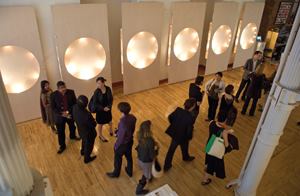
Combining illumination with movement, Motorlight, London-based Jake Dyson Studio’s first foray into luminaire design, was on view this past May in New York City, during the International Contemporary Furniture Fair (ICFF). Billed as the “world’s first variable angle uplight,” the fixture is available in both a floor and wall sconce model; it provides a fluid cycle of ambient to spot lighting due to the luminaire’s motor function. “There have only been a few choices when it comes to how light can be directed—either linearly or as a focused beam,” explains Dyson, son of inventor James Dyson. “I wanted to create something that would offer variable lighting conditions in a single unit.”
Motorlight Floor, the first incarnation of the Motorlight idea, stands approximately 14 inches tall (expanding to 17 inches), uses a 100W halogen source, and is manually operated with a pause option that allows the light to be fixed or dimmed. Measuring approximately 8-inches-tall by 4-inches-wide, Motorlight Wall, the second-generation iteration, is remote-controlled, fully DMX-programmable, and uses a 75W halogen lamp, but is outfitted to incorporate solid-state lighting as LED technology advances. A single remote can control up to 30 fixtures. Dyson and his team spent months working on an intricate motorized shutter for the fixture that allows the beam angle to change from 10 to 120 degrees during a 45 second cycle. A special gasket ensures fluid and uninterrupted movement so there is no “light shake.”
As part of Motorlight’s U.S. launch at the Pomegranate Gallery (above) during ICFF, Dyson teamed with interactive light artist Jason Bruges to create the installation Focal Shift, a series of six birch plywood wall panels approximately 3 feet wide and 10 feet high, housing six concealed Motorlight Wall fixtures. With only the light and beam angles visible across the wood surface, gallery visitors watched a dynamic play of light and shadow. Offering a different kind of illumination and user interface, Motorlight gives new meaning to interactive design.