
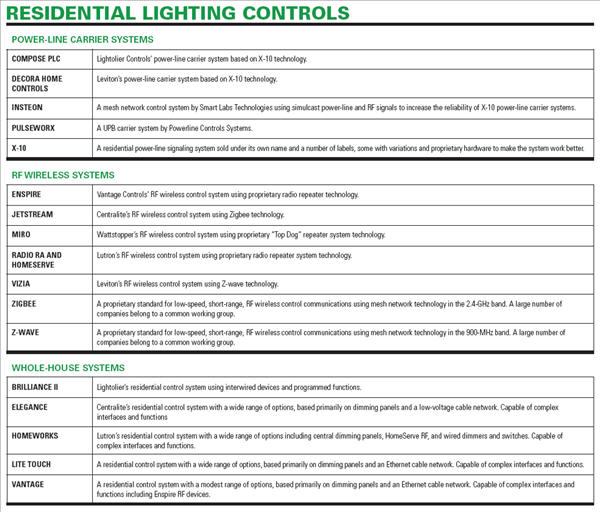
SYSTEM TYPE: WIRED OR WIRELESS The top of the line residential control systems offer a high level of integration and customization, making them the system of choice for new high-end homes. A central processor allows programming and communications functions including powerful whole-house commands. Most of these systems have dimming cabinets distributed throughout the home, and each lighting group is home run wired back to the dimming panel. Low-voltage wiring connects control stations and interfaces to audio and HVAC control systems. These systems often are furnished and installed by specially trained low-voltage contractors, many of whom also install other communications and home entertainment electronics.
But these systems call for significantly different wiring of the home. If central dimming cabinets are used, power wires from each controlled group of lights must home run to the dimmer cabinet, adding considerable material and labor cost and creating areas of congested wiring. It is not uncommon to see large homes with rooms devoted to dimming cabinets and related equipment.
Wireless systems have the principal advantage of using conventional residential wiring. The electrical contractor wires the home as if manual switches were being used. But instead of low-voltage control wires, lighting system communications are either radio frequency (RF)–based, like Wi-Fi, or use power-line signaling. Regardless of whether the project is a new home, a remodel, or an addition, a complete system can be installed. Wireless options include:
CHOOSING A SYSTEM Cost usually will be the dominant issue. Good dimmers and switches don’t add a lot of expense to a home lighting system, and a few scene controllers in key rooms are a good choice for budget-driven projects.
For a modest cost increase, start adding wireless functions. Some of the most popular include “path of light” designs that control hallways and rooms on the path from entrance door to kitchen, and “panic” scenes that activate key indoor and outdoor lights in emergencies.
LOOKING FORWARD Thinking ahead, the collapse of housing prices doesn’t necessarily change the lighting market. In fact, there is a good chance that people will stop flipping homes and actually live in and update them. Better lighting and controls are comparatively high-benefit, low-cost improvements that anyone can make. Moreover, new LED lighting systems are sure to encourage even better whole-house lighting controls. Just a few years ago, whole-house controls were only for the very rich, but it is possible that solid-state lighting will serve as a catalyst to make them practical in every home.