
Home Depot Launches CFL Recycling Program

2 MIN READ
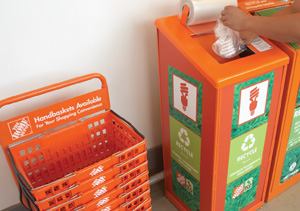
Home Depot, the largest retailer of light bulbs in the United States, has launched a compact fluorescent light (CFL) bulb recycling program in all 1,973 of its U.S. locations. In 2007, Home Depot sold more than 75 million CFLs. Consumers can bring spent, unbroken CFLs to their local Home Depot and sales personnel will deposit the used lamps into specially marked containers. A national environmental management company will oversee the packing, transporting, and recycling of the lamps.

Home Depot

Home Depot, the largest retailer of light bulbs in the United States, has launched a compact fluorescent light (CFL) bulb recycling program in all 1,973 of its U.S. locations. In 2007, Home Depot sold more than 75 million CFLs. Consumers can bring spent, unbroken CFLs to their local Home Depot and sales personnel will deposit the used lamps into specially marked containers. A national environmental management company will oversee the packing, transporting, and recycling of the lamps.

Home Depot, the largest home improvement retailer worldwide, also is the largest retailer of light bulbs in the United States. Compact fluorescent light (CFL) bulbs have made up a significant portion of those sales. In 2007, Home Depot sold more than 75 million CFLs and grossed more than $77 billion in sales, but the big box retailer long has been criticized for not seeing the full consumer cycle through by offering a recycling program to support its sale of CFL products. That is no longer the case. On June 24, 2008, the company launched a new initiative, a national in-store CFL recycling program at all 1,973 of its locations in the U.S. This is the first recycling program of its kind offered by a retailer of this size in the country. “We waited to implement the program until we were sure that it could be seen through properly,” says Jorge Fernandez, merchant for light bulbs at Home Depot, who also is responsible for all light bulb purchases for consumer sales for the company nationwide. Home Depot is no stranger to CFL recycling programs; a similar initiative has been under way in Canada since November 2007.

The new U.S. program is a free service that allows consumers to bring in any expired CFLs, so long as they are unbroken, to a Home Depot location. Customers present the CFLs to store personnel at the returns desk, who then deposit the spent lamps into designated containers that are located at the back of the store out of consumer view. Home Depot has contracted with a national environmental management company who will oversee the packing, transporting, and recycling of the lamps.

In keeping with the company’s commitment to sustainable initiatives, Home Depot also has started an in-store energy conservation program to convert its light fixture showrooms and display light fixtures from incandescent lamps to CFLs by fall 2008. The expected energy savings for the retailer is estimated at close to $16 million annually.

All of these environmentally focused steps are part of Home Depot’s larger Eco Options program. Launched in April 2007, the classification program enables consumers to select products that have a reduced environmental impact. Energy Star, the program administered by the Environmental Protection Agency and the Department of Energy, estimates that if each household were to switch one incandescent light bulb to a CFL, the United States would save more than $600 million in annual energy costs.

In addition to the sale of major brand-name light bulbs, Home Depot has its own proprietary line of CFLs called n:vision, manufactured by Technical Consumer Products. For more information on all of Home Depot’s sustainable initiatives, go to homedepot.com/ecooptions.

About the Author

Elizabeth Donoff

Elizabeth Donoff is Editor-at-Large of Architectural Lighting (AL). She served as Editor-in-Chief from 2006 to 2017. She joined the editorial team in 2003 and is a leading voice in the lighting community speaking at industry events such as Lightfair and the International Association of Lighting Designers Annual Enlighten Conference, and has twice served as a judge for the Illuminating Engineering Society New York City Section’s (IESNYC) Lumen Award program. In 2009, she received the Brilliance Award from the IESNYC for dedicated service and contribution to the New York City lighting community. Over the past 11 years, under her editorial direction, Architectural Lighting has received a number of prestigious B2B journalism awards. In 2017, Architectural Lighting was a Top Ten Finalist for Magazine of the Year from the American Society of Business Publication Editors' AZBEE Awards. In 2016, Donoff received the Jesse H. Neal Award for her Editor’s Comments in the category of Best Commentary/Blog, and in 2015, AL received a Jesse H. Neal Award for Best Media Brand (Overall Editorial Excellence).Prior to her entry into design journalism, Donoff worked in New York City architectural offices including FXFowle where she was part of the project teams for the Reuters Building at Three Times Square and the New York Times Headquarters. She is a graduate of Bates College in Lewiston, Me., and she earned her Master of Architecture degree from the School of Architecture at Washington University in St. Louis.

No recommended contents to display.

Upcoming Events

  • Design Smarter: Leveraging GIS, BIM, and Open Data for Better Site Selection & Collaboration

    Live Webinar

    Register for Free
  • Slate Reimagined: The Surprising Advantages of Slate Rainscreen Cladding

    Webinar

    Register Now
  • The State of Residential Design Today: Innovations and Insights from RADA-Winning Architects

    Webinar

    Register for Free
All Events