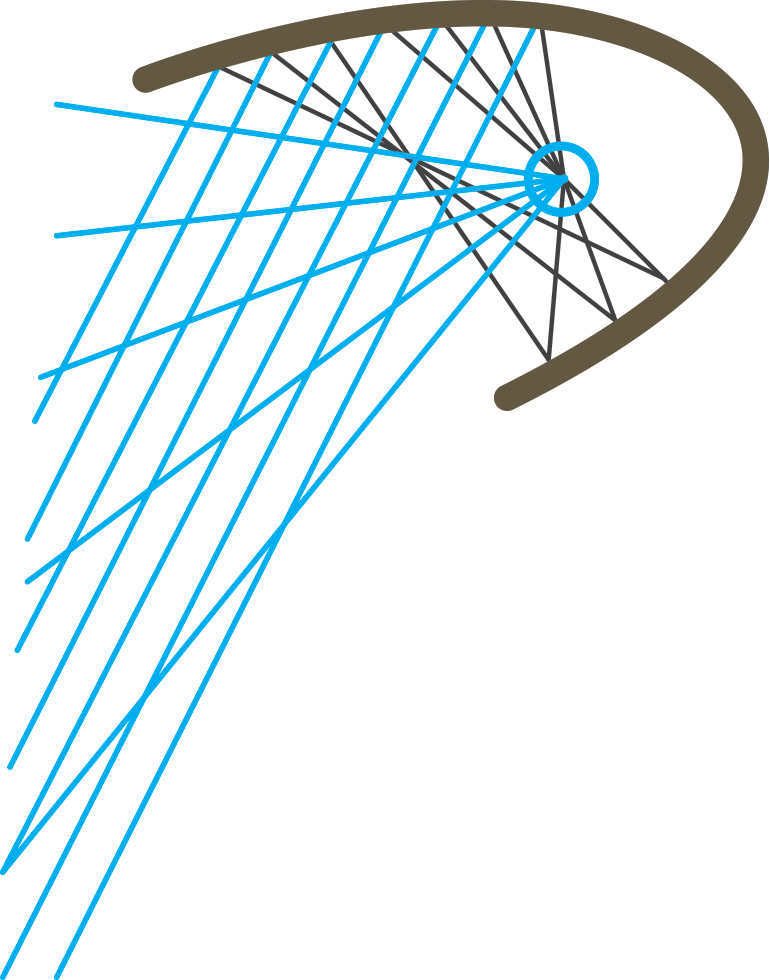
The asymmetric reflector system is both a lighting technique and a technology that has been incorporated into luminaires. It was developed by Sylvan (Sy) Shemitz, who, as a young lighting designer, could not find the market-ready fixtures he needed for his lighting design projects. So Shemitz, along with colleague Ben Stahlheber, began to develop the luminaires they needed and that incorporated an asymmetric distribution of light with tight beam control. They experimented with different reflector shapes and came up with a design made of an ellipse and two parabolas that could illuminate a surface or a plane more efficiently and effectively than anything on the market at the time. Unable to find a manufacturing partner who was interested in producing his fixtures, Shemitz started his own company, Elliptipar, in 1976.
The beauty of Shemitz’s concept for the asymmetric reflector design is that it allows light to create a luminous surface from a minimal setback. Depending on the reflector orientations, the luminaire can wallwash, uplight, or downlight. The contours of the parabolas drive light down or across the illuminated surface from one edge. The shape of the elliptical section (from which the company name was derived) shields the lamp from viewing angles and reshapes the light into a parabola. The lamp placement at the optical center of the reflector prevents the light rays from re-entering the lamp source.
Explore all 30 Moments in Lighting from our 30th Anniversary Issue here.