In the Orangery area of the garden’s Grand Conservatory, Munro…
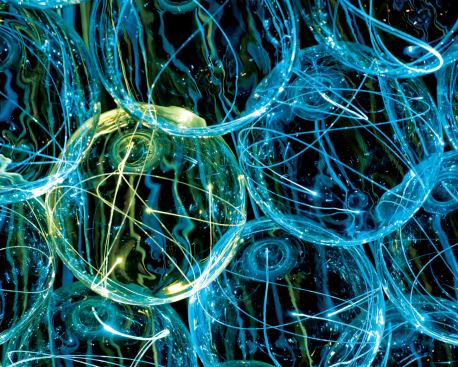
In the Orangery area of the garden’s Grand Conservatory, Munro’s installation Snowballs comprises six chandeliers—grouped in threes—that hang above the lawns to each side of the main conservatory walkway. Each chandelier measures more than 9 feet in diameter and is composed of 127 individually hand-blown glass spheres.
Hank Davis
During the day, the glass reflects and refracts the surrounding …
During the day, the glass reflects and refracts the surrounding natural light. At night, the glass balls, illuminated by fiber-optic strands carefully laced inside, come to life. The chandeliers change color in unison, sweeping through a subtle palette of white, blue, green, magenta, red, orange, and yellow, using six RGB DMX color-changing light sources and a hand-painted color wheel.
Corriette Schoenaerts
For Arrow Spring, located just past the formal flower gardens to…
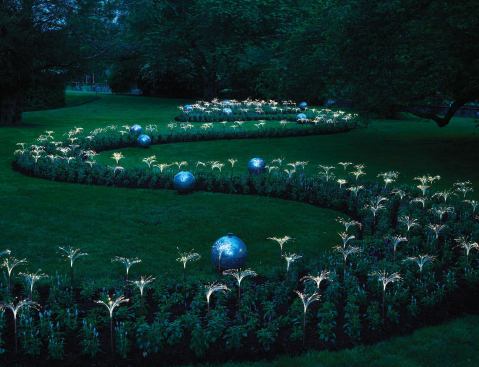
For Arrow Spring, located just past the formal flower gardens to the south of the Peirce-du Pont house, Munro has created a 300-foot-long serpentine trail of four different types of sage plants. Designed to recall the form of a flowing river stream by day, at night it transforms into a shimmery thread of greenery. Munro takes advantage of the sage's silvery-blue quality and highlights it using 16 LED flashlights, staked in the ground, along with bare optic fiber that is weaved and hidden among the plants to create the luminescent glow.
Mark Pickhold
Water Towers is located in the area of Longwood known as the Mea…
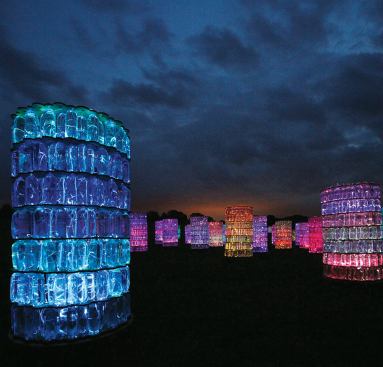
Water Towers is located in the area of Longwood known as the Meadow at Hourglass Lake. According to Munro, this piece "marks the transition between Longwood’s formal gardens and its natural landscape." The light installation is composed of 69 structures, each built out of water-filled 1-liter recyclable plastic bottles stacked on plywood boards for intermediary support. Fiber-optic strands are threaded through all 17,388 bottles and connected to an LED projector with a hand-painted color wheel. During the day, the combination of plastic and water has the appearance of glass, and the towers take on different levels of transparency in the natural light. At night, in the darkness of the summer sky, the towers take on a completely different personality and resemble vertical haystacks of colored light. The experience is further enhanced with a sound track of choral music.
Hank Davis
A detail of one of the light orbs in the Forest of Light install…
A detail of one of the light orbs in the Forest of Light installation
Mark Pickhold
Forest of Light is composed of 20,000 illuminated glass spheres …
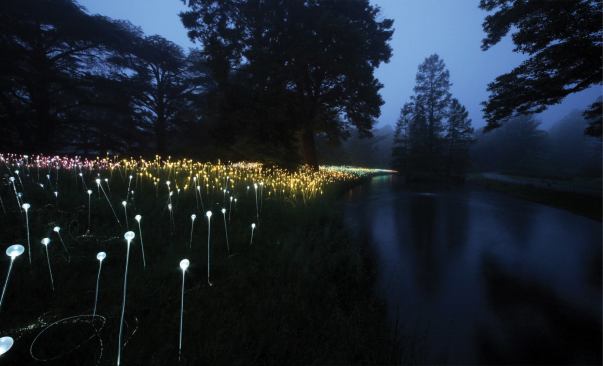
Forest of Light is composed of 20,000 illuminated glass spheres and rods that weave themselves through the part of the gardens known as Forest Walk, a forest of tulip trees, white oaks, and sugar maples. The strands of bare optic fiber that illuminate the glass spheres total 86.9 miles in length, and they carpet the forest floor as they run up and over rocks, ground cover, foliage, and other plantings. As with all of the installations that are part of this celebration of light, the piece has one persona during the day and another at night. By day, the light rods read like a plant species all their own, popping up randomly from the forest floor. At night, when illuminated by 80 halogen light sources with hand-painted color wheels, the rods and spheres gently pulsate in a rainbow of colors that makes it feel as if the forest has come alive. The experience pays tribute to the inherent beauty found in nature and the play of light.
From June through September of this year, Longwood Gardens in Kennett Square, Pa., was transformed into a magical lightscape due to the creative imaginings of artist Bruce Munro, who is known for his inventive explorations of light. At Longwood, which was originally purchased by Pierre S. du Pont in 1906, a full range of Munro’s work was on display. Nine installations of various scales and materials including Field of Light, celebrated different areas within the 1,077-acre site that is home to 20 indoor and 20 outdoor gardens, meadows, and woodlands. Munro, long intrigued by the play of light and shadow, first saw how light could be a medium of artistic expression after graduating from art school in the United Kingdom and moving to Australia in the mid-1980s for work. “For me, light is an aesthetic medium to express ideas,” Munro says. “I see spaces for what they are and try to apply the appropriate lighting aesthetic to make the space sing.” And sing the work does at Longwood. “It’s enabled people to see Longwood in a whole new way,” garden director Paul Redman says. “The work is about storytelling and uncovering the different layers of the garden.” The overall project, Light: Installations by Bruce Munro, took 14 months to plan and prototype and another two months to install. (Dismantling will take about two weeks and most of the materials will be recycled or reused for future projects.) Each of the installations has its own interaction with the landscape and creates a different viewing experience for the visitor, which is further enhanced depending on the time of day and the weather conditions. Surrounded by the summer heat and a symphony of crickets providing their own sound track, Munro’s work is meditative as it transcends the boundaries of time.
Elizabeth Donoff is Editor-at-Large of Architectural Lighting (AL). She served as Editor-in-Chief from 2006 to 2017. She joined the editorial team in 2003 and is a leading voice in the lighting community speaking at industry events such as Lightfair and the International Association of Lighting Designers Annual Enlighten Conference, and has twice served as a judge for the Illuminating Engineering Society New York City Section’s (IESNYC) Lumen Award program. In 2009, she received the Brilliance Award from the IESNYC for dedicated service and contribution to the New York City lighting community. Over the past 11 years, under her editorial direction, Architectural Lighting has received a number of prestigious B2B journalism awards. In 2017, Architectural Lighting was a Top Ten Finalist for Magazine of the Year from the American Society of Business Publication Editors' AZBEE Awards. In 2016, Donoff received the Jesse H. Neal Award for her Editor’s Comments in the category of Best Commentary/Blog, and in 2015, AL received a Jesse H. Neal Award for Best Media Brand (Overall Editorial Excellence).Prior to her entry into design journalism, Donoff worked in New York City architectural offices including FXFowle where she was part of the project teams for the Reuters Building at Three Times Square and the New York Times Headquarters. She is a graduate of Bates College in Lewiston, Me., and she earned her Master of Architecture degree from the School of Architecture at Washington University in St. Louis.