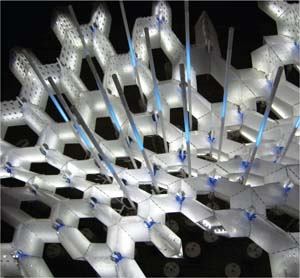
The Aurora Project, an exploration of the intersection between energy and ecology, is the work of 2009 Van Alen Institute New York Prize Fellowship recipients Jason K. Johnson and Nataly Gattegno. Johnson and Gattegno are co-founders of the San Francisco–based design and research collaborative Future Cities Lab. During summer 2009, the duo researched the changing Arctic landscape and the effects of global warming on this region. Their findings offer “a speculative vision for a massive new energy infrastructure and settlement pattern,” and find form in a series of three installations, which were on view at the Van Alen Institute from Sept. 16 to Oct. 15.
The first installation, “Aurora,” is a crystalline structure, pierced by vertical cold cathode tubes and supported by cast plaster footings and delicate metal framework. Viewers trigger infrared sensors connected to the tubes and blue LEDs, causing them to pulse and filter through translucent planes of PETG, the material with which water bottles are made. The ephemeral lighting of “Aurora” mimics the shifting ice shelves of the Arctic.
The second installation, “Terra Incognita,” is composed of LED-backlit maps, drawings, diagrams, and other materials found by Johnson and Gattegno that examine “how the Arctic region has been represented, claimed, and mythologized in the past and present.” Finally, the third section of the exhibit creates an immersive visitor experience manipulating ice from solid to liquid. The echo of water drops draws viewers toward a dark corner occupied by “The Glaciarium,” an instrument that contains a cylindrical ice core enclosed in a plastic outer shell and mounted on a tripod. Sensor-triggered computer-operated LED arrays intensify as a viewer peeks through the small opening on the side of the luminous object. The ice melts and drips—the sound is amplified by a speaker—into a steel cylinder positioned underneath. It is then recycled and refrozen. While the core typically melts in nine hours, viewer interaction can accelerate the process by as much as 300 percent.
Through the manipulation of light, The Aurora Project reminds us that our seemingly trivial actions can affect environments thousands of miles away.