
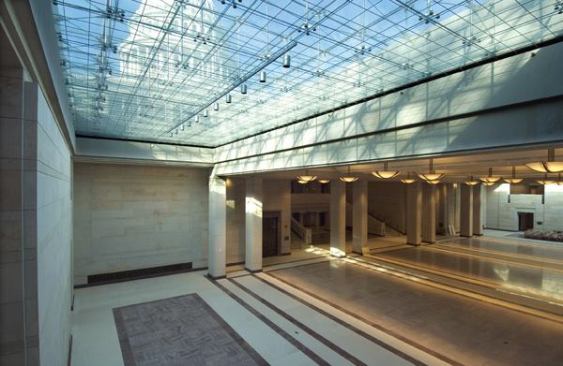
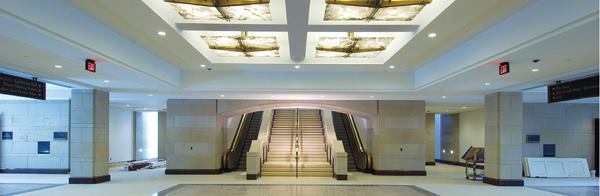
The Capitol Visitor Center's two 70-foot-by-30-foot skylights br…
In March 2007, Speaker Nancy Pelosi started the “Green the Capitol” initiative, striving to make the House of Representatives more environmentally responsible. A message from House Chief Administrative Officer Dan Beard on the Green the Capitol website states, “Energy saving technologies like changing all the light bulbs is not ‘rocket science,’ but in the U.S. Capitol, where many of the lamps and chandeliers are antiques, it can be daunting.” While that might be true of the original luminaires in the Capitol, one would think the situation would be different in the brand-new visitor center. But with delay after delay, the ability to enact change became harder and harder. “With a project of this scale, once you start the process, it’s extremely difficult to change course,” Matthews notes. He adds that during construction, sources such as ceramic metal halide lamps and LEDs came of age. “These sources, they existed, but not in the variety and in the usable sizes that we have now.” As a result, the majority of the center’s lighting is fluorescent, compact fluorescent, and, where the designers needed a long-throw focused beam, incandescent.
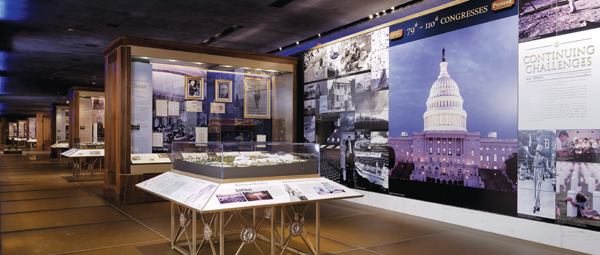
One area of the building that uses an up-to-date light source is Exhibition Hall, which is noticeably darker than the rest of the center to protect the delicate artifacts on display. It’s primarily lit with LEDs, achieving a 5-footcandle environment. Matthews explains that the space incorporates the latest lighting technology because its lighting design was contracted separately from the rest of the center.
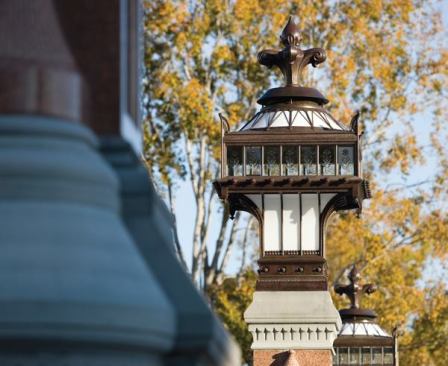
The project, Matthews says, is “unusual in the sense that we needed to make the spaces underground relatively bright but also make reference to this historic context that the visitors find themselves in.” While the luminaires in the center—many of them custom-made—were designed with the historic Capitol’s aesthetic in mind, they are modern interpretations.
Working on a project of this scale is no easy task, especially considering that decisions had to pass through not only the typical channels but also be approved by members of Congress. “We could all write a book on getting this project done,” RTKL’s Henderer says. “It was a tough experience, but it was fulfilling. The project’s been very controversial, but I think it will stand the test of time and endure.” While the lighting in the center is successful enough and achieves the designers’ visions, it’s likely only a matter of time until the current antiquated light sources undergo a retrofit and are replaced by more energy-efficient technology.
