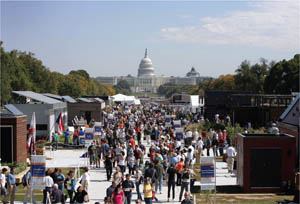
The Solar Decathlon—the U.S. Department of Energy’s (DOE) biennial student competition for the design and construction of energy-efficient homes—has made significant strides in reaching a wide audience and spreading the sustainability message the past five years. The program is modeled using the decathlon format of 10 individual competitions, and lighting has always been one of those—until now.
The 2011 draft rules have eliminated lighting as a separate contest and incorporated qualitative and quantitative lighting evaluations in four other contests: architecture, engineering, market appeal, and home entertainment. When asked about the change, competition manager Michael Wassmer explained that at the end of each Solar Decathlon the DOE evaluates the program in order to make improvements to the event. For the 2009 competition, for instance, given the economic conditions, the student teams were asked to consider issues of affordability.
The DOE is committed to continuing this theme in 2011. “In the past the houses have been more experimental,” Wassmer says. “Going forward, the DOE wants to incentivize teams to build more market-ready homes.” As a result, for 2011 the Decathlon has introduced an “affordability” competition. And because the decathlon structure is based on 10 competitions, not 11, lighting is out as one of the stand-alone evaluations. Wassmer acknowledges that it was a difficult decision and indicates that every effort has been made to integrate lighting evaluations into other areas of the competition criteria. The competition managers incorporated feedback from the 2009 lighting contest jury—lighting professionals Nancy Clanton, Ron Kurtz, and Naomi Miller—in making the assessment.
To ensure that lighting issues will not be overlooked in the 2011 Solar Decathlon, the architecture contest jury will now include a lighting designer. Lighting also will contribute to one-third of the points scored in the architecture contest. Additionally, architecture jury members will now visit the houses both during the day and at night. The lighting contest previously was the only competition in which the jury visited the houses at two different times of the day. Finally, quantitative lighting control items will be evaluated in the engineering contest.
The competition managers are committed to making sure that lighting discussions remain central to the Solar Decathlon evaluations. The draft of the 2011 rules are just that—a draft—and Wassmer indicated that the competition is open to suggestions to ensure that the competition literature appropriately acknowledges lighting in the contest criteria and that decathlon participants are versed in the 2011 updates. For more information about the Solar Decathlon go to solardecathlon.org.