1
of 5
Courtesy Spohn Ranch Skateparks
After four years of remediation followed by a decade of site res…

Courtesy Spohn Ranch Skateparks
After four years of remediation followed by a decade of site res…
Finding Beauty in Brownfields
While architects have little to do with devising remediation strategies, their input can be invaluable to determining the logical and potential uses for the site. “The first thing that architects bring to the table is the notion of planning,” says Edmund Klimek, AIA, a partner at Princeton, N.J.–based KSS Architects, which has worked on many brownfield redevelopments. “We don’t design the remediation, but we can give it a sense of purpose and a sense of hierarchy so that the remediation supports the project’s larger goals” and makes economic sense, he says.
Unfortunately, architects often aren’t brought into the project until the remediation measures have already been implemented. “The remediation becomes a technical question that is handled by the environmental engineer,” says Matt Urbanski, a principal in the Brooklyn, N.Y., office of the landscape architecture firm Michael Van Valkenburgh Associates (MVVA). “Designers have to work around whatever technical solution has been put into place.”
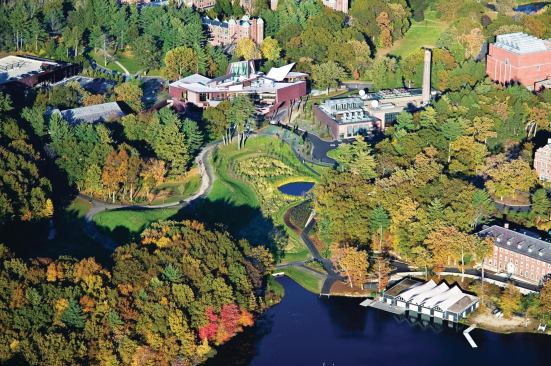
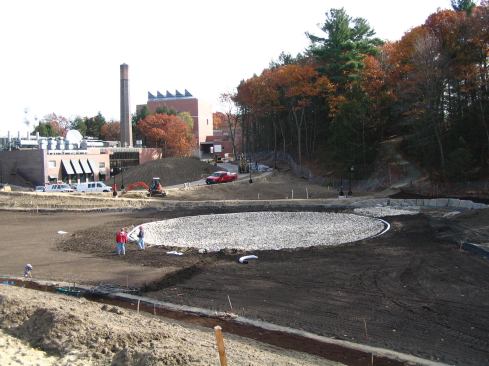
Landscape design and remediation strategies played off each other in the restoration of Wellesley College’s Alumnae Valley. MVVA was brought in early to design the 13.5-acre landscape while environmental engineering firm Haley & Aldrich characterized the site’s contaminants and developed remediation solutions.
In the 1920s, Wellesley built a coal-gasification plant in Alumnae Valley, which abuts the campus’s cherished Lake Waban, and later replaced it with a parking lot. MVVA originally proposed cutting out the parking lot, excavating the earth, and bringing the shore of the lake closer to the nearby student center. However, Haley & Aldrich discovered three different contaminants on the site: heavy metals, including lead chromate, found in low levels in excavated earth saved from the student-center construction for landscaping; spilled fuel oil; and, deeper down, a layer of DNAPLs—basically tar.
Haley & Aldrich remediated each contaminant differently. The fuel-oil-contaminated soil was excavated and appropriately discarded, while the earth containing heavy metals was consigned to a cap-and-cover treatment. For the low-viscosity DNAPLs, which were about 20 feet below grade, engineers had to set up a series of extraction wells in which the gooey liquid would pool over time before being pumped to the surface, barreled, and taken to an appropriate disposal location.
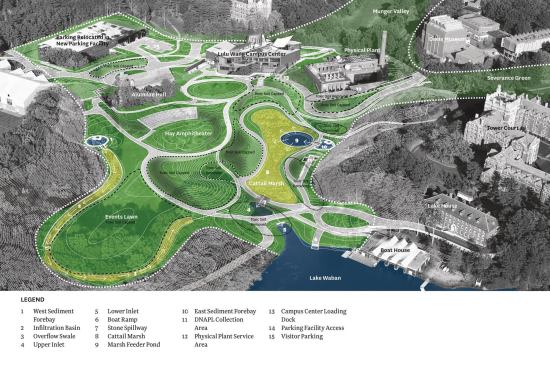
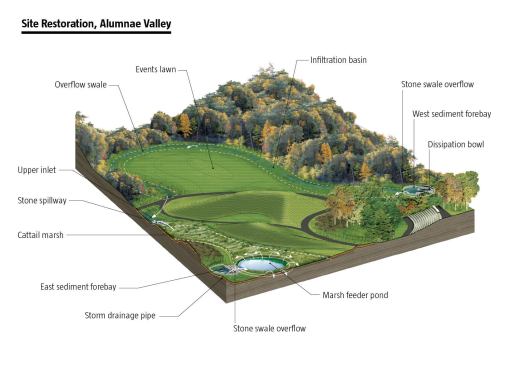
Bringing the lake shore closer to the student center created a concern that the DNAPLs might migrate into the water, MVVA went back to the drawing board. “The environmental condition forced us to be more creative about our design,” says Andrew Gutterman, an associate principal at MVVA. The firm proposed a raised wetland that would sit above the below-grade contaminated area and also function as the campus’s stormwater-management system.
MVVA also added several sculptural landforms: large, grass-covered berms built up with the contaminated excavation material, mixed with clean soil, and capped with clean soil. “The larger campus is characterized by its hilly topography,” Gutterman says. “We built upon that character with our sculptural berms, which also allowed the contaminated fill to remain on site. It’s an example of design and environmental goals working hand in hand.” Altogether, remediating the site and completing MVVA’s design took four years to complete, from 2001 to 2005. Today, Alumnae Valley’s sculpted wetlands teem with plant and animal life, and are enjoyed by students and staff: a testament to the success that an integrated remediation-and-design strategy can bring.
Make the Change
To earn credit and obtain a certificate of completion, visit go.hw.net/archceu and complete the online quiz for free. Follow the “Click here to start this course” link to launch the quiz for this story. If you are new to Hanley Wood University, create a free learner account; returning users log in as usual.
Though designers are not regularly involved with the nitty-gritty details of brownfield remediation, their planning expertise, when closely integrated with cleanup logistics, can create quite elegant solutions. Beyond the site, architects can help the process by engaging the local community. “A lot of brownfields involve newer industrial uses on older industrial land,” Klimek says. “When you reintroduce new industry into an urban environment, you have to go to the town and help them understand how it can be brought back into the urban fabric in a healthy way.”
Designers armed with a broad base of knowledge about brownfields will be better equipped to steer redevelopment projects on a sustainable path. Knowing the ins and outs of the regulatory and remediation processes will only improve the chances that an architect will have more say in the direction and planning of brownfield redevelopments, and help ensure that past mistakes are cleaned up.
No recommended contents to display.