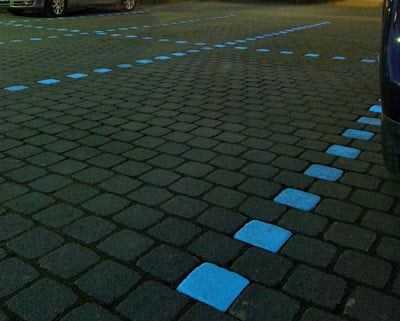
Charged with sunlight by day, pavers with embedded lights deliver safe pathway illumination at night without added electricity. This is a practical—and increasingly popular—application for outdoor circulation spaces. But what if the paving material itself could illuminate? Enter glow-in-the-dark concrete.
German-based manufacturer Kann has developed luminous concrete pavers called NightTec Leuchtsteine. Phosphorescent crystals embedded in the concrete surface capture diurnal energy and emit light every evening for about ten hours. Although the pavers appear white in sunlight, their nocturnal glow is either green or blue—depending on the selected coating.
The Leuchtsteine are part of a series of NightTec products that represent the company’s mission of “light cycling,” or recycling light. According to the manufacturer, the technology has an annual energy savings potential of 212 million megawatt-hours in Germany, based on an estimate of future building renovations that use illuminating materials. Although the pavers can only emit low-level illumination, this can be more than adequate for ground plane visibility in dark environments.
Blaine Brownell is a regularly featured columnist whose stories appear on this website each week. His views and conclusions are not necessarily those of ARCHITECT magazine nor of the American Institute of Architects.