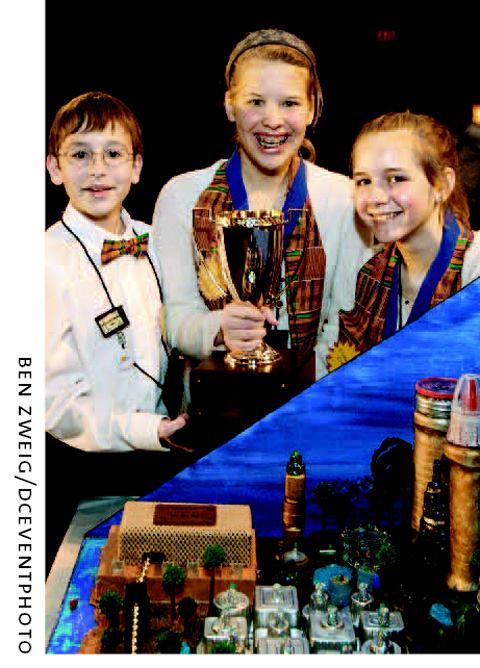
Middle school is a great time to start learning about engineering. That’s the philosophy behind the Future City Competition, a 15-year-old contest that asks seventh- and eighth-graders across the nation to design a city of the future. Working in teams—with oversight from a teacher and an engineer mentor—students first compete in regional contests. The winning teams then go to the finals at National Engineers Week, a consortium of more than 100 engineering societies and corporations. The 2007 finals took place Feb. 19–22 in Washington, D.C.
“The goal is to provide students an opportunity to learn about engineering in a fun and practical way,” says Carol Rieg, national director of the Future City Competition and one of its creators.
Each iteration of the competition poses a different challenge; this year’s focus was on using fuel cell systems to power a metropolis. The contest had four parts: developing the city in SimCity 3000, a video game; writing an essay on how the city’s engineering solves the challenge; creating a tabletop model; and presenting the city to the judges.
When the competition debuted, says Rieg, about 675 students from 175 schools in five cities competed. This year, some 30,000 students from more than 1,000 schools in 40 regions participated.
At the 2007 finals, 35 teams presented their cities. The winning city, “Mwinda,” was created by Jake Bowers, 12, Emily Ponti, 14, and Krisha Sherburne, 12, from St. Thomas More School in Baton Rouge, La. Mwinda means “light” in Lingala, a dialect of the Republic of Congo, where the city is located. Mwinda makes use of phosphoric acid fuel cells (powered with hydrogen from enhanced algal cultures and solar collector hydrogen generators), massive lightning-containment capacitors, and raw uranium (mined robotically) to power itself.
This year’s finals were hosted by Bentley Systems, an engineering software company and chair of the competition’s leadership council. Bentley also provided the first prize award: a trip to U.S. Space Camp in Huntsville, Ala.