
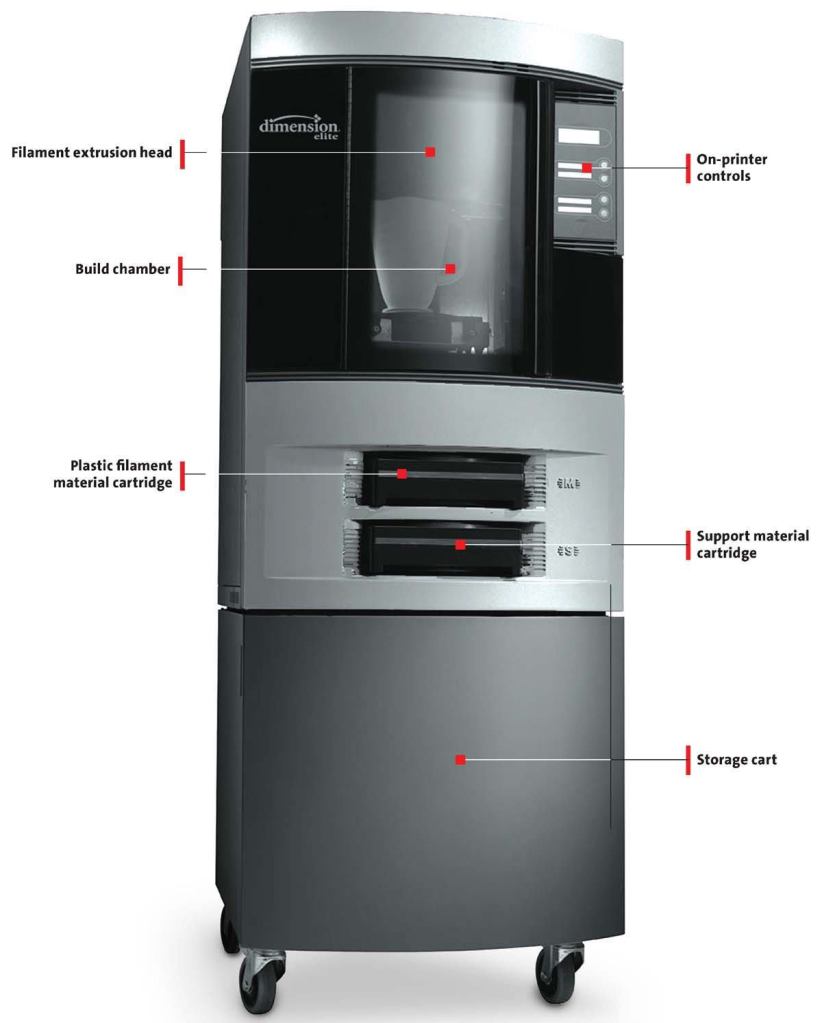
In fused deposition modeling (FDM), which is the process used in the new Dimension Elite printer, a printer driver parses out the layers of each .stl . le, and each layer is built up in a plastic material. A thin “filament” of plastic feeds into the machine, is liquefied by a print head, and then extruded out—in a process similar to that in a glue gun—in a layer the thickness of a human hair. As each layer builds up, it fuses to the cooling plastic of the previous layer, forming a sturdy object. This technology requires the buildup of support braces, which can be made out of either the same plastic and broken off, or a soluble material that can be dissolved in a soap-and-water bath. Each printer features a different support option. But the new software systems build in the supports, so those don’t have to be included in the original drawing. The filament comes in seven standard colors and cannot be changed during the printing process, so each model ends up being single-color.
This technology was primarily developed for industrial and mechanical industries to prototype machine parts, but there has been a renaissance, and people are beginning to use it for architectural modeling as well. “We attended several shows in the AEC market four or five years ago, not really knowing what to expect,” says Jonathan Cobb, vice president and general manager for Dimension. “And there was a lot of interest. The market really came to us.”
