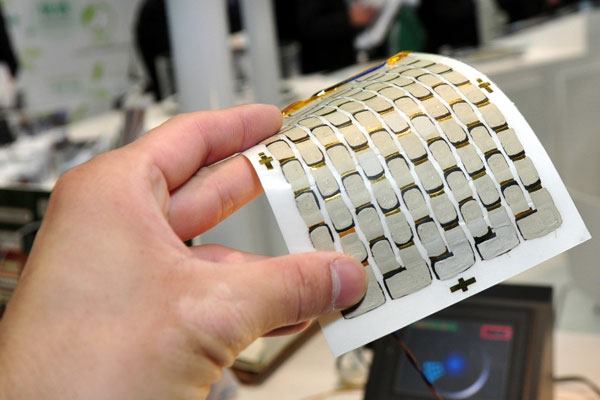
The desire to harness more-diverse, low-grade sources of renewable power has resulted in a curious new technology: a thermoelectric material that produces electricity from body heat. Earlier this month, Fujifilm Corp. announced its development of an organic polymer module that boasts the highest conversion efficiency to date. The module can produce several milliwatts of power, and from a source that is a mere 1 degree C above the device temperature.
Developed in partnership with Japan’s National Institute of Advanced Industrial Science and Technology, the module is capable of being mass-produced using organic materials and printing technologies. Proposed applications include anatomical wraps that derive power—and monitor vital signs—from the human body, in addition to heat-recapturing surfaces that can be attached to high-temperature equipment such as solar panels.
Blaine Brownell is a regularly featured columnist whose stories appear on this website each week. His views and conclusions are not necessarily those of ARCHITECT magazine nor of the American Institute of Architects.