A sheet of resin is placed over the last interlayer, and then a metal plate is applied to the top. The assembly is placed into an oven where it’s pressed and heated to fuse the sheets together. After cooling, the sheets are quality checked and edges are trimmed. Finally, the finished sheets end up in the fulfillment department, where they’re matched to the rest of their purchaser’s order for shipping.
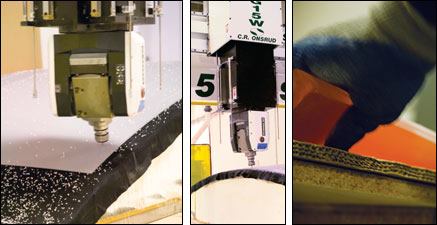
Beyond sheets of material, 3form’s fabrication department is increasingly involved in producing complex shapes and forms according to architect’s and designer’s specifications. A CNC cutter is used to cut specific shapes from sheets. Trickier forms are created by draping and bending the material before placing it in another oven. Even more complex shapes are vacuum-formed in a two-sided mold.
The designers at 3form are always looking for new ideas. “It’s now common that a material can have different—almost opposing—characteristics,” says Canales. “People look for this surprise or unexpected quality in materials.” But her staff works within tight parameters. The standard product thickness ranges from 1/16 of an inch to 1 inch, depending on both the designer’s needs and the material that’s encapsulated within the sheet. While custom applications are possible, the typical object is no more than 1/16 of an inch in thickness—the dimension of a single interlayer. Beyond thickness, the ability of the lay-up staff to achieve a particular position within the material is another key constraint.
Despite those constraints, custom clients get creative. One client encapsulated shredded money for a bank. A jeans manufacturer placed clothing rivets within panels. “We pay close attention to what our customers are doing with our product because they have so many great ideas,” Canales says.
The company’s offerings are expanding beyond just plastics, with pressed and poured glass products now available. These present different optical characteristics than 3form’s solely resin products, with total clarity a possibility. They also offer greater strength and stiffness, which can be preferable for some design installations.
The pressed glass is similar to Varia in its preparation and fabrication. An interlayer of specified color and pattern is placed between two sheets of glass. Poured—a more expensive option—offers greater creative possibilities. Liquid resin is poured onto the base layer of glass with its encapsulated materials laid within the liquid. The most intriguing option here is “bubble glass,” which encapsulates air bubbles within the resin. The lay-up staff injects air into the liquid resin with a syringe. Since the bubbles can move as long as the material remains liquid, it’s important that the technicians work quickly and that the sheet remains perfectly level throughout the process. Explaining the final look, Canales jokes, “We tell people it’s recycled air.”
In The Graduate, Mr. McGuire was giving Dustin Hoffman good career advice for the 1960s. Today, it’s easy to be skeptical about plastics becoming an environmentally sound product for the 21st century. But give 3form credit for trying. Every sheet of eco-resin leaves the plant with stickers the installer can place in a discreet location, so that when the panels are dissembled at the end of life, the demolition folks know where to send the material for its next round of recycling.
Not content with its current 40 percent recycled content, 3form is continuing to make advances. A new opaque product is called 100 Percent because it is composed of completely recycled content. They company recently announced the goal of achieving 90 percent recycled content in its products by 2017. Given that it took 3form’s founder the better part of a decade to formulate the original eco-resin, it seems an achievable benchmark.
“If it’s recycled, that’s good, but it has to look good for people to want it,” says Canales. “You don’t have to sacrifice one for the other.” With 3form’s products, perhaps you can have it both ways.