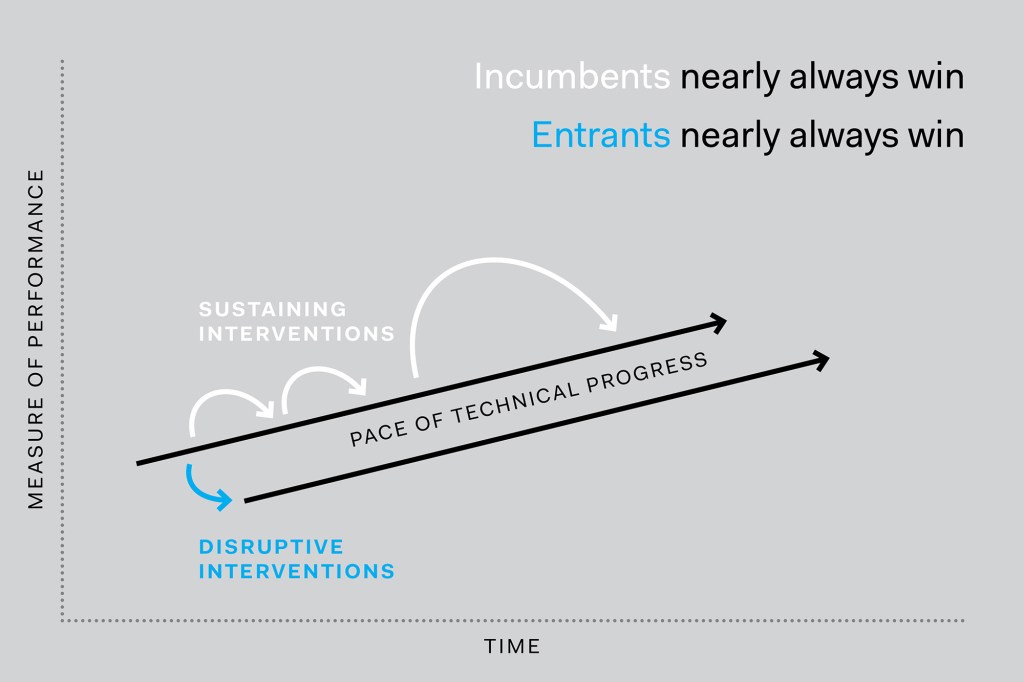
On Jan. 23, the world lost a pioneering thinker on innovation. Clayton Christiansen, the Harvard Business School professor and consultant who coined the phrase “disruptive innovation,” died from leukemia-related complications. He was 67. Dubbed by the Economist as “the most influential management thinker of his time,” Christiansen had sent shock waves through the business community with his theory that the same practices that make companies successful could also expose them to failure. In his book The Innovator’s Dilemma: When New Technologies Cause Great Firms to Fail (Harvard Business School Publishing, 1997), Christiansen challenged the convention that prioritizing the needs of key customers and advancing technologies incrementally was a pathway to success. Instead, Christiansen saw companies at risk of missing unpredictable waves of innovation and ultimately undermining consumer bases.
Although Christiansen did not focus on building construction, applying his theory to building products is not difficult. This begs the question, how applicable is “disruptive innovation” to architecture and how might architects participate in this phenomenon?
Simply defined, disruptive technologies are emerging approaches that are initially not desired by mainstream consumers nor viewed as profitable for established companies, but do eventually develop a significant foothold in the mainstream market. It is precisely these technologies’ initial lack of commercial appeal that provides an eventual competitive advantage. At first, corporate leadership might dismiss these upstart offerings as irrelevant and focus on so-called sustaining, or incremental, innovations. Only when it’s too late do leaders realize that these fringe technologies have poached their consumer base. In The Innovator’s Dilemma and other writings, Christiansen provides examples of disruptive innovations: the personal computer, the iPhone, consumer-accessible copying, and discount retail. In each instance, a seemingly harmless offering eventually out-competed entrenched ones.
The history of building is rife with disruptive innovations. Light-frame wood construction, which superseded traditional log or timber framing in the early- to mid-19th century, is the dominant form of residential building in North America today. According to the Christensen theory, this technology (first offered as balloon framing, then platform framing) was disruptive because it began as an inferior, less expensive approach with initial appeal “to low-end or unserved consumers,” later migrating to a broad market. According to architectural historian David Monteyne, “The moderately industrialized, [19th]-century balloon frame came to be associated with inventive, pragmatic, independent citizens who could produce their own livelihood in spite of skilled labor shortages on the frontier.”
Asphalt shingles, first developed and applied by American builder Henry Reynolds in 1903, offer another example of disruption. Now a primary roofing choice for residential architecture, these shingles were initially marketed as a more convenient alternative to inexpensive waterproof roofing made from fabric or heavy paper coated with pine or coal tar. While the asphalt-impregnated shingles allowed for more predictable quality control and easier field construction than the other versions, it was ultimately their modular dimensions and lapped application that solidified their dominance over more expensive, high quality roofing materials in the marketplace. In the 1920s, a National Board of Fire Underwriters’ campaign to discourage wood shingle roofing further popularized asphalt shingles beyond “low-end” consumers, and they can be seen on a broad spectrum of housing today.
Applying Christiansen’s theory to architecture has limits, however. Building construction is a tightly regulated and risk-averse industry with little tolerance for untested products—particularly ones of inferior quality. If anything, many emerging materials exhibit higher quality and cost when compared to established counterparts, and are not explicitly targeted to “low-end” consumers. (No doubt, more innovative offerings developed for low-income consumers would be welcomed.) Yet these products may still represent significant, advantageous transformations for standard building practices. Environmental sustainability is also a consideration: Does disruptive innovation represent a path to increased consumption and convenience, or can it be a vehicle for improving planetary health?
Despite these restrictions, architecture generally invites broader interpretations of Christensen’s model. By framing disruptive innovation as a desirable phenomenon that undermines a problematic status quo, we could apply the concept as a goal in a variety of architectural circumstances. For example, smart windows that harness solar power, roofing assemblies that collect and filter stormwater, or façade modules that sequester carbon might not fit the original definition of disruptive innovations. However, if it were possible for such products to become common in new construction, they could be said to disrupt conventional practices in positive ways. In my book Material Strategies (Princeton Architectural Press, 2012), I call this kind of approach “disruptive application”; that is, “an unexpected replacement of a conventional design or construction practice with a new one.” The emphasis on the way materials are used— and for reasons in addition to economics, such as environmental, cultural, aesthetic—suggests a link between Christiansen’s theory and design thinking.
Despite the initial focus on business management, the concept of disruptive innovation has broad conceptual applicability. In the Harvard Business Review article “How Will You Measure Your Life?”, Christiansen champions the thinking of American psychologist Frederick Herzberg, who argues that the crucial motivator in our lives is not money, but the chance to learn, grow, and contribute to society. This perspective points to the ultimate potential of disruptive innovation theory: a comprehensive framework for understanding the positive function of change in human creative endeavors.