
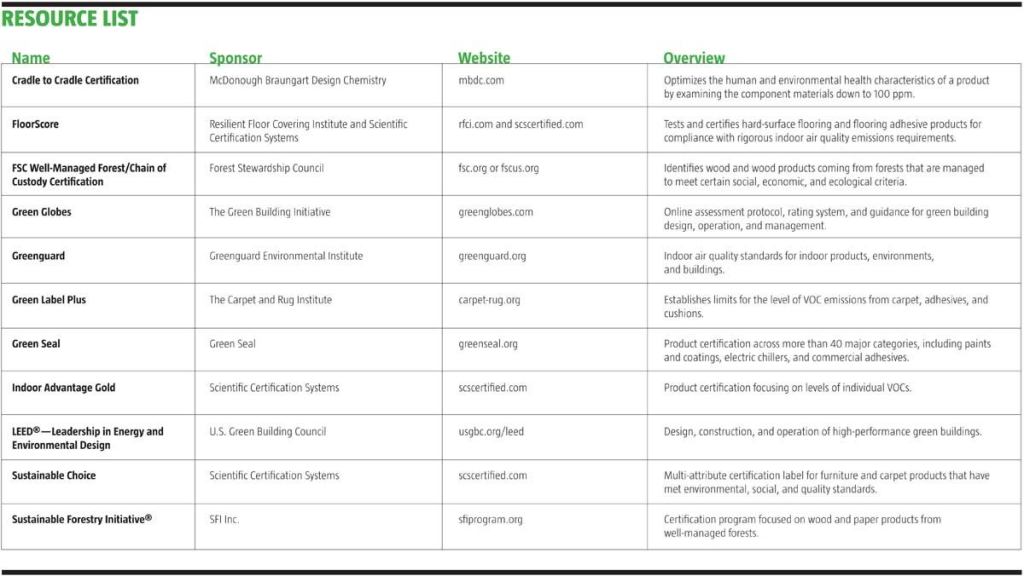
Certified Wood The Germany-based Forest Stewardship Council (FSC) is an independent, nongovernmental, not-for-profit organization established to promote responsible management of the world’s forests. The FSC establishes standards and provides trademark assurance while accrediting others to certify on its behalf. In the United States, SCS and Vermont-based SmartWood are two accredited bodies that certify using FSC standards.
Products carrying the FSC label are independently certified to ensure that they come from forests that are managed to meet certain social, economic, and ecological criteria. Each step in the delivery process, from forest to mill to wholesaler, must be certified to ensure a credible chain of custody. FSC-certified forests represent the equivalent of 7 percent of the world’s productive forests—more than 2.4 billion acres of forest distributed over 79 countries worldwide.
In addition to verifying the source of wood, SCS and SmartWood also authenticate claims that materials are recycled, reclaimed, or formed from bio-based materials.
Sustainable Choice Sustainable Choice is a multi-attribute certification program from SCS for products that meet environmental, social, and quality standards. Such standards currently exist for both business and institutional furniture and carpet. For furniture, SCS auditors assess a product’s entire supply chain to ensure that it meets environmental and social criteria set forth in the Business and Institutional Furniture Manufacturer’s Association Sustainability Standard. For carpet, products must meet the California Gold Sustainable Carpet Standard of the California Department of General Services or NSF 140-2005, Sustainable Carpet Assessment. SCS Sustainable Choice offers three levels of certification: Silver, Gold, and Platinum.
LIFECYCLE BASED EVALUATIONS While some certifications examine a single product attribute (for example, recycled content), others seek to examine the entire product’s lifecycle, from raw material extraction to end of life. Cradle to Cradle Certification—offered by Charlottesville, Va.–based McDonough Braungart Design Chemistry—focuses on optimizing the human and environmental health effects of a product by examining all materials down to the level of 100 parts per million and replacing problem ingredients.
Familiarizing oneself with the various product certification programs available today is a good first step in greening the environmental profile of a firm’s portfolio. Independent, third-party certification programs help architects separate fact from fiction, and while it’s not possible to understand every nuance of every certification program, it is possible to understand when and how to apply certification criteria.