1
of 9



John Edward Linden
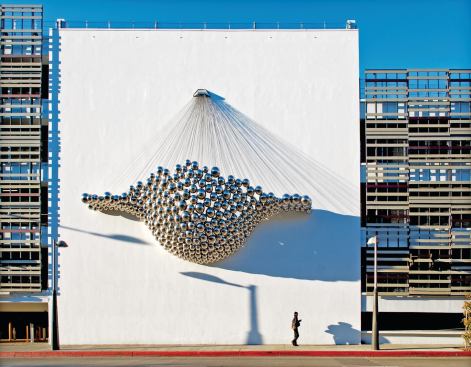
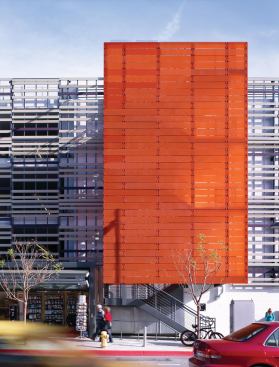
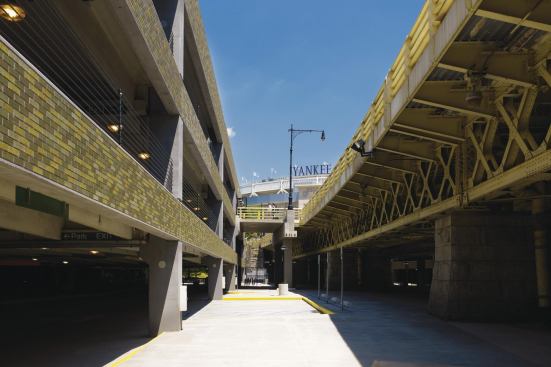
In Santa Monica, Calif., Brooks + Scarpa renovated eight parking…

John Edward Linden
In Santa Monica, Calif., Brooks + Scarpa renovated eight parking…
Faceless but Functional
Architects can contribute significantly to integrating parking garages into the community fabric, improving the user experience, and supporting the urban continuum. However, a renewed trend of parking garages exhibiting for-vehicles-only functionalism is emerging in the form of automated mechanical facilities.
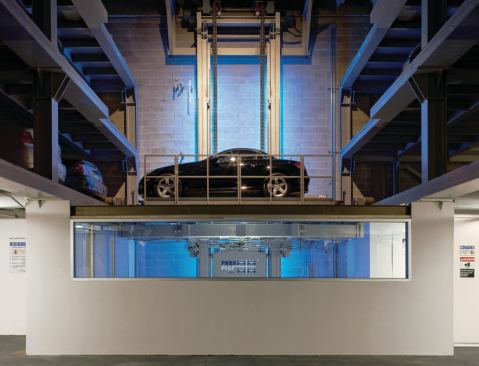
Mechanical car storing systems have been around since at least the 1920s, but recent innovations in computing and robotics have opened up new possibilities for advanced parking garages that no longer require operations personnel. Users simply drive their vehicle onto a steel pallet, exit the car, and swipe a card through a reader. The system does the rest, carrying the vehicle horizontally and vertically to a designated storage cubby.
Automated systems are more expensive to build, but several factors mitigate this up-front cost. Their primary advantage is that they need less space to store the same number of cars than a conventional parking garage does since space for roadways, ramps, and pedestrians is unnecessary. This space savings can be a real boon, particularly where zoning codes mandate a set number of parking spaces for developments that otherwise couldn’t accommodate that number of spaces on site.
For underground parking structures, this saved space translates to cost savings: Automated systems require less excavation. Finally, and perhaps an ancillary point, project developers can write-off automated systems on their taxes. “It’s like a computer, and not a building,” says Shannon Sanders McDonald, AIA, an assistant professor of architecture at Southern Illinois University and the author of The Parking Garage: Design and Evolution of a Modern Urban Form. “In terms of your business model,” she says, “when you buy machinery, it has a different financial structure: It’s deductible.”
Automated parking facilities have long been popular in the space-starved and highly populated regions of Europe and Asia, and they are now catching on in the United States; companies such as Park Plus and Automotion are manufacturing and selling systems here. Many high-density cities such as New York have a few in place, while other cities, including Los Angeles, have them in the pipeline. Though these systems do not call upon the skills of architects, they are yet another tool architects can use when planning parking for a project.
Unlocking the Future
The next innovation in parking will likely stem from innovations in the vehicles we drive, McDonald says. The increasing popularity of the electric car, as well as the diminishing size of the automobile, will influence the designs of the structures that architects build to house them, in terms of both physical size and function.
The way we interact with our vehicles will also change. Whether we all start riding Segways or sit back as our cars drive themselves will affect how architects design the spaces we inhabit. Just as the advent of the automobile led to the need for parking structures in cities and to garages in single-family residences, the evolution of motor vehicle technology will also influence the built environment.
“We’re going to have vehicles in buildings,” McDonald says. “Think about the airport [where vehicles navigate through corridors]. You’ve already got electric cars. We’re going to have to start training architects and urban designers how to design for these new technologies.”
From facilities with minimal design thought to crowd-pleasing attractions and expressions of automobile technology, parking garages have gone from formulaic to futuristic. Once the ugly duckling of building typologies, they have emerged as multifaceted, multipurpose structures with immense potential.
Despite the recent project exemplars, McDonald predicts that parking structures won’t universally meet their design and technology potential anytime soon. But she is optimistic for the future generations, she says: “The kids I’m teaching are going to get to see an exciting new world.”
No recommended contents to display.