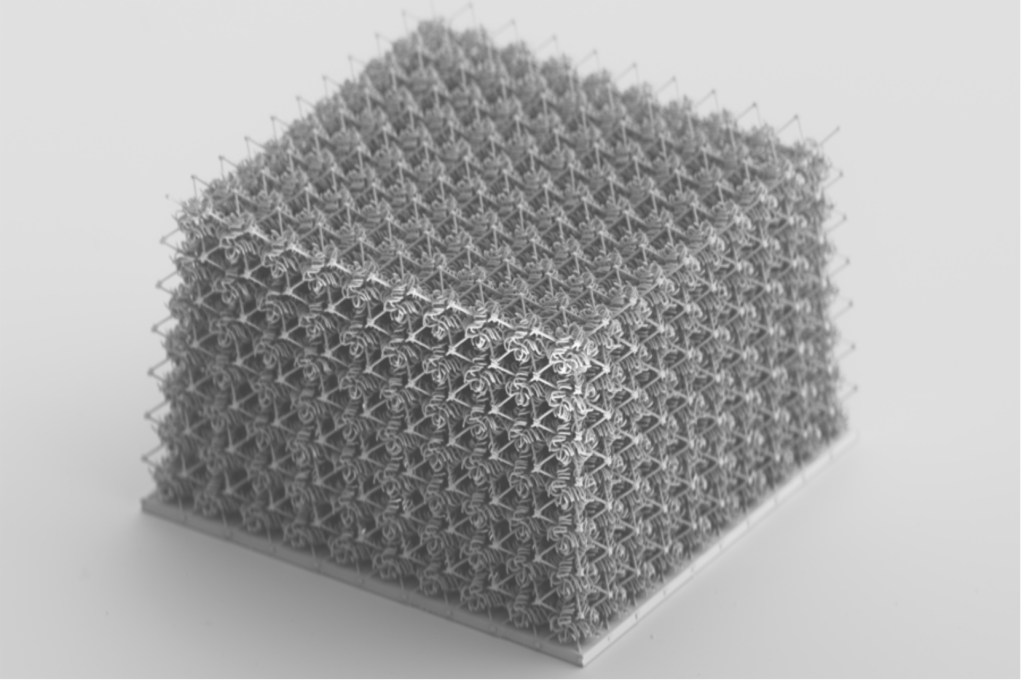
Metamaterials are substances that exhibit novel mechanical, acoustic, or electromagnetic properties. The first recorded metamaterial was created in 1995 by Sir John Pendry in collaboration with the Marconi company.
The new material exhibited negative permeability and permittivity, which means it defied natural logic by pushing back on electrical fields and bending magnetic fields against the grain. Making electromagnetic waves perform against their inherent tendencies is akin to teaching water to flow uphill. This remarkable discovery opened the door to opportunities previously considered impossible, such as bending light around objects via cloaking devices.
Metamaterials in the Built Environment: An Emerging Frontier
Although much of the subsequent research on metamaterials has focused on optical and communications technologies like lenses and antennas, scientists have also been quietly exploring applications for design and construction. Although these early explorations mainly focus on small-scale attributes and include a high degree of simulation, they nonetheless reveal intriguing new possibilities for buildings and products.
Acoustic Innovation with Clay metaBricks
A multinational research team from France, Morocco, and the UK explored an unexpected vehicle for metamaterial research in the humble brick. The scientists sought to enhance the acoustic and thermal properties of hollow brick masonry by taking inspiration from Helmholtz Resonators (HRs)—acoustic devices that dampen noise via the dissipation of sound energy.
Pursuing a straightforward approach, the team added slits at the top and bottom hollow cores, increasing the bricks’ insulating capacity. Experimental tests revealed a sound attenuation of about 20 dB across a 50-2500 Hz spectrum, and a thermal resistance improvement of about eight percent over typical bricks. Although the slits reduce the modules’ compressive strength, the team notes that the bricks remain structurally compliant.
Sound-Focusing Structures: Quantal Metamaterial Bricks
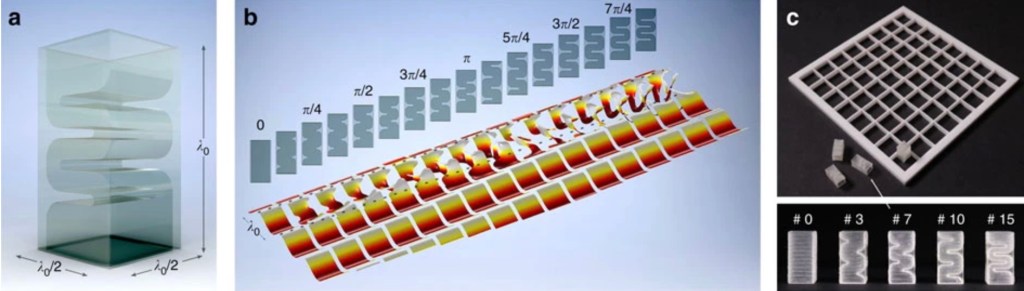
Researchers are exploring acoustic control via brick-like modules at a variety of scales. Engineers from the Universities of Sussex and Bristol have developed microscaled 3D blocks called metamaterial bricks to fabricate metasurfaces with highly controlled sound-focusing properties.
These multidimensional surfaces resemble an acoustic digitized raster, as seen in analog-to-digital audio file conversion. Assembled from many premanufactured units, each of which exhibits individual acoustic phase delay properties, the metasurface thus resembles Minecraft-esque pixelated terrain. The primary building application for this wave-field shaping technology is constructing quantal metasurfaces for highly tuned acoustic control.
Kirigami-Inspired Surfaces for Electromagnetic Control
A team from Seattle, Beijing, and Columbia, Missouri, is exploring the manipulation of electromagnetic waves via the folding and cutting of thin metal plates. The inspiration for the idea came from the Japanese craft of kirigami, a form of origami paper-folding that also includes cutting. By attaching the manipulated metal plates to a solid surface, the kirigami structures impart wave-influencing properties without further changes to the original surface.
For example, the folded and cut elements can absorb acoustic energy in lieu of perforations in the original material that provide the same function, hence maintaining the integrity of the substrate. Potential applications include expansive surfaces, such as exterior-grade walls, that allow tailored vibration dampening and low-frequency sound control without impairing weathertightness.
Optimizing Thermal Insulation with Layered Zigzag Geometries
Researchers from the University of Chicago are experimenting with metamaterial geometries to optimize thermal management. After testing various potential stacking arrangements of cellular units, the team determined that “a zigzag internal geometry, analogous to rhombohedral graphene stacking,” is ideal for maximizing insulation properties while maintaining high strength.
The researchers predict that this superior internal structure will impart a metal like zirconia with an ultralow thermal conductivity of 0.0125 W/(m·K), comparing favorably to top-tier ceramic aerogels, which are highly insulating, without jeopardizing mechanical rigidity. The approach is suitable for lightweight structures exposed to extreme environments, such as aerospace applications.
A New Era of Simulation: DIY Metamaterial Design Tools
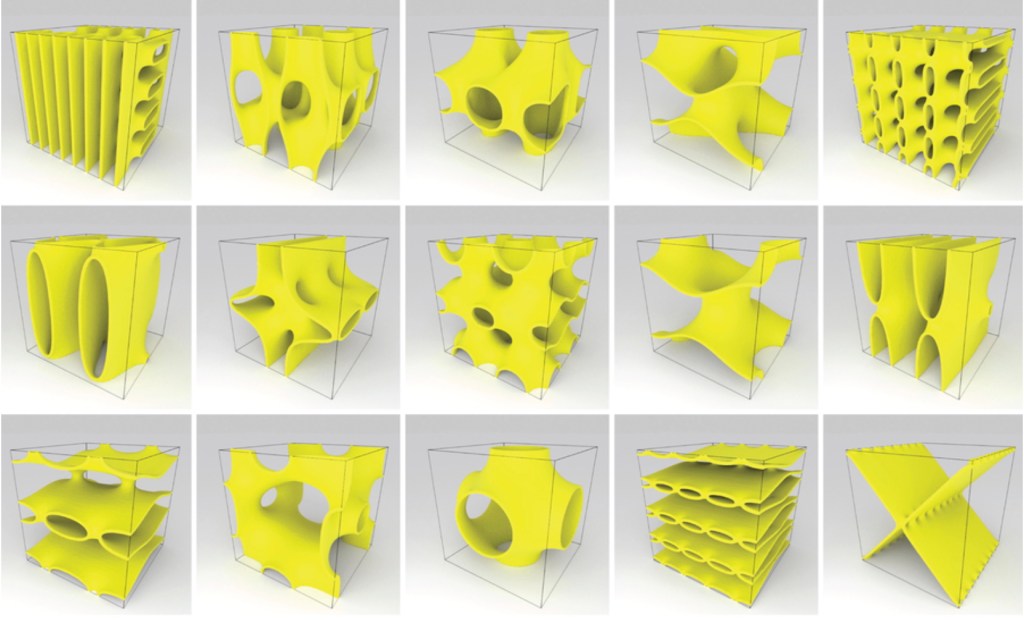
Simulating metamaterial performance is time-intensive and carries a dimension of uncertainty because the resulting properties can be sufficiently novel. To make metamaterial simulation more streamlined and accurate, a team from MIT and the Institute of Science and Technology Austria has created a computational tool that allows users to customize individual building blocks and predict the resulting material’s behavior.
The software is similar to CAD, enabling complex 3D modeling within an easily navigable interface. Automation is supplied by “solvers” and “exploration algorithms” that generate entire structures from initial cellular geometries.
The new tool demonstrates the mutual advantages of technology transfer. For these scientists, the new software takes a direct cue from the AEC industry. Meanwhile, architects’ CAD tools could become increasingly capable of predicting the physical behaviors of building geometries like this metamaterial design program.
Shifting Paradigms: What Happens When Materials Shape Form?
These examples demonstrate that form is performance. It is typical for architects to assume that materials have their own immutable logic, and that a material’s properties will govern the overall form it is intended to generate—as in Louis Kahn’s famous parable of the brick.
However, metamaterials invert this logic. The internal geometry of a material governs its properties and, subsequently, the collective forms that are possible based on these characteristics. And in an intriguing twist, metamaterial scientists are employing tools similar to CAD to design these very materials.
Thus, it stands to reason that a closer collaboration between the AEC and materials science communities could unleash unprecedented opportunities for metamaterials and applications in the built environment.