
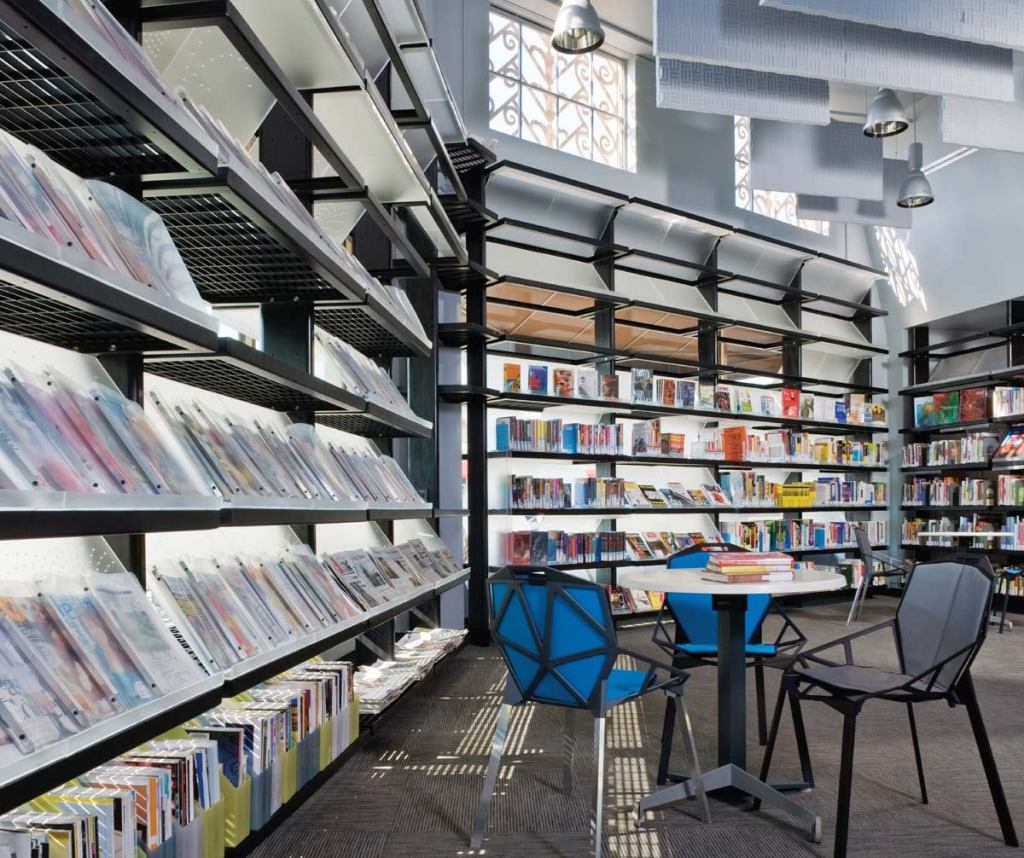
Brace yourself, bookworms, this is no ordinary branch library. Designed by Osborn Architects, the 2,100-square-foot Glendale Satellite Library in Glendale, Calif.’s Adams Square neighborhood has almost no permanent collection. All the books, magazines, and DVDs change weekly according to the circulation desires of local patrons and librarians’ interests. Both the hottest best-sellers and dustiest tomes are available to be shipped over from the main branch in downtown Glendale, which begs the question: How to design stacks that are not storage?
“The design celebrates a changing collection. We took the shelf and dematerialized it for alternative benefits,” Osborn Architects design principal Michael Pinto says of the custom-fabricated steel-and-acrylic system. The 11-foot-high translucent shelving follows the inside curve of the library’s glass storefront. Steel sections are placed every 4 feet, and sandblasted quarter-inch-thick acrylic panels allow diffuse natural light to flood the reading room. Current magazines, which rest on the angled shelves, seem to float when backlit by the sun. Laser-cut patterns in the shelves nod to the decorative motifs of the existing Art Deco building and put emphasis on the custom fabrication process—without adding greatly to the overall expense.
Osborn Architects, a local firm, is at work on an overhaul of the main Glendale library, and the satellite branch doubles as a test bed of ideas for that project. Because some of the acrylic panels fold to face the exterior, parts of the library’s rotating collection are displayed to the general public. It is a way for the librarians to curate the façade and a link between the library’s resources and the community.
