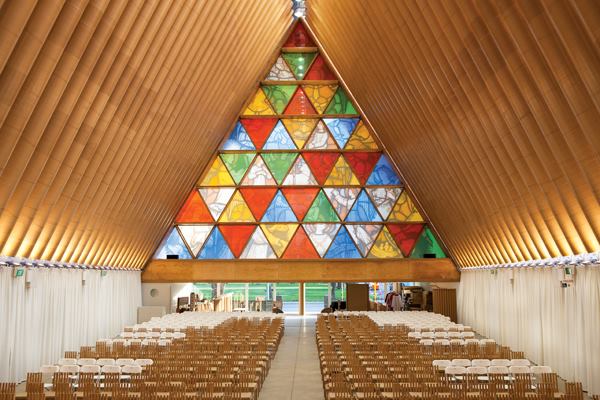
The deadly earthquake that hit Christchurch, New Zealand, in February 2011 also destroyed the city’s most recognizable architectural landmark: a 19th-century Gothic Revival stone cathedral. Desperate for worship space, the church leaders at Christchurch Cathedral contacted Shigeru Ban Architects at the suggestion of a congregant familiar with a paper-tube church that Ban, Hon. FAIA, designed after the 1995 earthquake in Kobe, Japan. Working pro bono, the firm designed a transitional cathedral that opened in August 2013.
From the outset, visitors understand the cathedral’s ephemerality from the A-frame structure of rafters wrapped in paper Sonotube concrete forms and anchored into a foundation of decommissioned steel shipping containers.
Called an “accidental environmentalist” by The New York Times‘ Michael Kimmelman, Ban conceived the idea of building with paper in 1986 after becoming engrossed with the rigidity of fax paper rolls. He began subjecting industrial cardboard tubes to a battery of stress tests. Satisfied with the results, he designed a cardboard-tube pavilion for the 1989 World Design Expo in Nagoya, Japan. Paper—lightweight, economical, renewable, adaptable, and capable of resisting water and fire once it is coated—has since become as much a part of the architect’s visual vocabulary as wood or masonry. Ban believes that as society becomes more nomadic, some buildings should become disposable or recyclable as long as demolition doesn’t require more energy than construction.
The cathedral is the first of Ban’s paper structures to feature the tubes at an angle. The steep, six-story-tall roof caps a trapezoidal floor plan that seats up to 700 people and retains most of original nave, central transept, and altar geometries.
Ban’s original design called for paper tubes sturdy enough to structurally support the A-frame. Unfortunately, the tubes manufactured by the Sonotube plant in Christchurch couldn’t provide the stiffness to withstand New Zealand’s high winds. Concluding that it would be more cost effective and socially responsible to source local materials, Ban and his project team added locally sourced laminated veneer lumber (LVL) rafters inside each of the 98, 610-millimeter-diameter (2-foot-diameter) cardboard tubes comprising the A-frame.
As the cardboard-and-shipping-container cathedral took shape, bloggers and members of the local media criticized Ban’s design. But since its opening, the building has been embraced by members and nonmembers, who attend public events and concerts there. The regional tourism board is marketing the cardboard cathedral, the largest of Ban’s “emergency structure” designs, as a symbol of the city’s resilience.
Though originally envisioned as an emergency and, therefore, temporary structure, the $5.9 million church meets New Zealand’s 50-year seismic codes. “This was the first public building built after the earthquake,” Ban says. “I hope it will help to revitalize the city.”