It only took a matter of minutes for a tsunami wave to reduce Onagawa
Station to a pile of rubble. The one-story, tile-roofed train station in Miyagi
Prefecture, Japan, was just 50 miles from the epicenter of the magnitude-8.9 earthquake
that sent a series of 10- to 20-foot-high waves crashing into Japan’s main
island of Honshu on March 11, 2011. The structure was one of 127,000 buildings
that were completely destroyed, with another 1 million reporting some damage.
More than 15,000 people lost their lives.
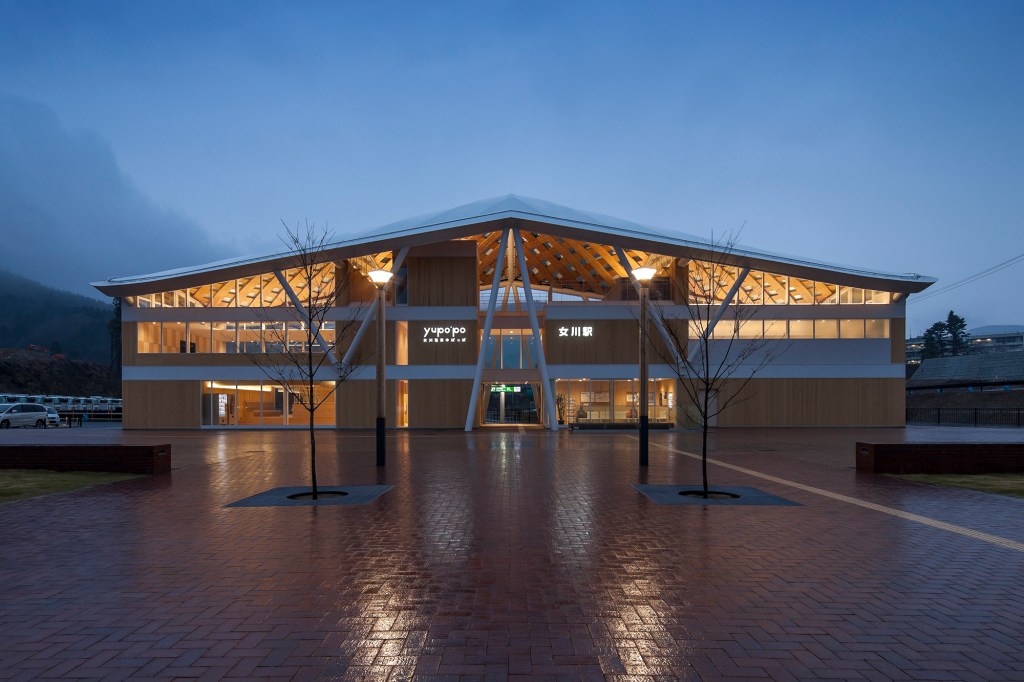
Four years later, almost to the date, a new train station stands in Onagawa, this one designed by Shigeru Ban, Hon. FAIA. The airy three-story, 900-square-meter
(9,682-square-foot) structure—the eastern terminus of the Ishinomaki Line, which
runs from Kogota Station, in Misato, to Onagawa on the east coast—was sited about
500 feet inland from the original building footprint.
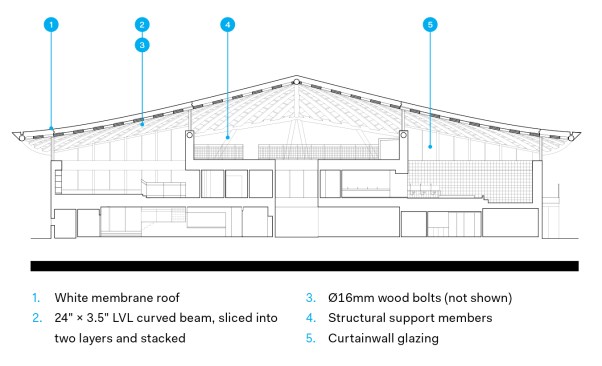
Roof section
Topped with a gently sloped, tensile-membrane roof inspired by the outstretched wings of a seabird, the cedar-and-steel-pipe-beam
structure serves as a symbol of the community’s resilience. At night, the illuminated
station casts a warm glow through the translucent white membrane, “symbolizing a reconstruction of the town from the
disaster,” says Yasunori Harano, project architect for Shigeru Ban Architects.
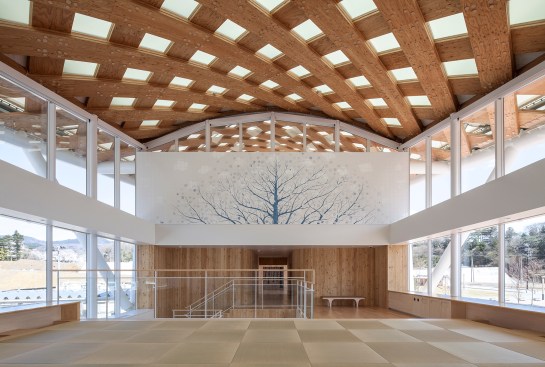
Hiroyuki Hirai
The underside of the lattice structure is visible from the public plaza and esplanade that have been added to the station, which also features white tile painted with wilderness scenes in the spa.
The taut roof form is supported by a wooden lattice, a
signature of Ban’s work. The lattice members are left exposed in the station’s
interior spaces, which include a public bathhouse that had been originally housed
in a separate facility that was also destroyed by the tsunami, as well as a
public plaza and esplanade.
The lattice is made of laminated veneer lumber (LVL) arches constructed from Japanese larch (Larix kaempferi),
which is native to the country and appears in everything from furniture to
boats to utility poles. Harano and the project team needed to warp the 2-foot-wide LVL beams to
achieve the desired curvature and roof height, but at 90 millimeters (3.5 inches)
thick, the lumber wasn’t bending properly. The designers worked with local
timber subcontractor Key-Tec Co. to slice the LVL lengthwise and warp each half separately before layering them back together during
the construction.
This created a new challenge. The stacked LVL layers needed to be connected with custom wooden
bolts, but to drill the bolt holes after the wood was warped would “take time
and lack in accuracy,” Ban says. Subsequently Harano’s team created a 3D model
of the lattice structure that included the final location of each bolt in the curved
LVL beams to determine where to drill the 16-millimeter-diameter holes in the
pre-bent wood. The arches were then transported to the construction site, where
they were assembled by the contractor.
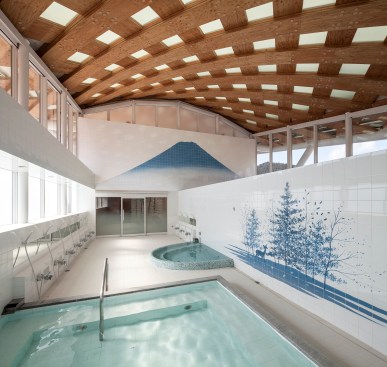
Hiroyuki Hirai
The wooden bolt heads are arranged in alternating geometric patterns—specifically an eight-studded circle and a square with inverted corners.
The final roof structure features 76 crisscrossing arches, with
many spanning more than 55 feet. Each arch intersection in the lattice is secured
with the same custom bolts that connect the stacked LVL layers. The wooden bolt
heads, which are left visible and slightly paler in tone than the LVL, are
arranged in alternating geometric patterns—specifically an eight-studded circle
and a square with inverted corners.
The building’s completion earlier this year coincided with the
reopening of the Inishomaki Line, reconnecting the seaside town to the rest of
the country. By combining the train terminal, a bathhouse, retail spaces, and a
third-floor platform from which visitors can admire Onagawa Bay, Ban hopes the
station will serve as a gathering place for the community and a symbol of its resilience and recovery.