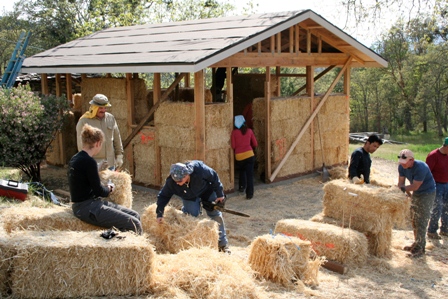
Tiny houses, built for affordable and sustainable living in under 500 square feet, are popping up worldwide as ways to create new communities, reduce homelessness, and as sustainable options for second homes. One method of tiny house construction is using bales of hay, which are 75 percent more energy-efficient than common drywall and offer additional protection with limited combustibility.
A tiny house built of hay starts with the post and beam construction of the typical small home. On top of a cement footing, bales of hay are used to fill in the open space. To prevent movement of the hay bales, iron scrapings are set in the cement foundation provide purchase for the first layer of straw.
A lower outer wall made of brick or stone is added to prevent rainwater from seeping into the exterior and gaps between bales are filled in with loose straw. Finally, a skim coating of cement or lime wash is added to the exterior and soaked to bond the outer wall. The result is a simple and highly sustainable straw home easily capable of going off the grid.
Read more about the tiny house made from hay from Green Building Elements and check out a quick step-by-step construction guide from Click Green.