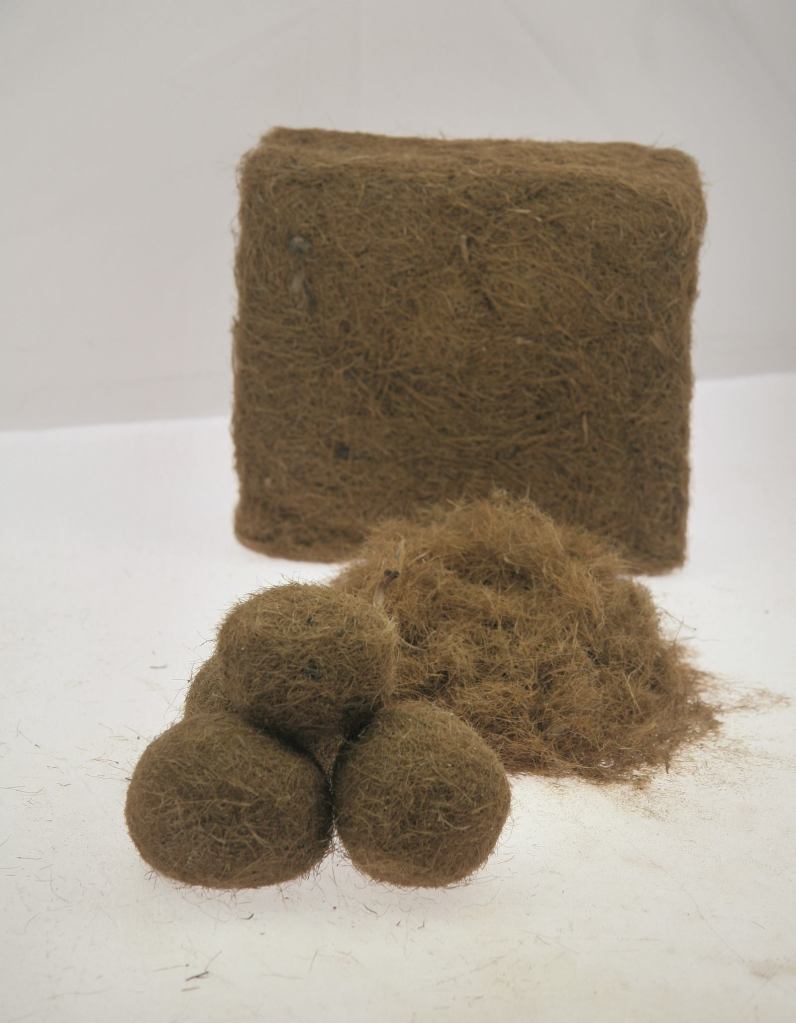
A variety of organic wastes have found their way into new product applications, ranging from wheat straw-reinforced biocomposites to macadamia nut shell lacquerware. Researchers at Germany’s Fraunhofer Institute have recently become interested in a non-agricultural type of waste: seaweed that washes up on beaches in seemingly limitless quantities.
In the Mediterranean, the Posidonia oceanica plant—or Neptune grass, as it is commonly known—covers the shores in the form of small spheres of fibrous material. Although the seaweed has been regarded as waste and landfilled, scientists are now cultivating it for use in building insulation. The material has several positive attributes that make it suitable for this application, including a natural air-entrained microstructure, mold-resistance, non-flammability, and decay-resistance.
In collaboration with manufacturers NeptuTherm, X-Floc Dämmtechnik-Maschinen, Fiber Engineering, and RMC, the Fraunhofer Institute in Munich has developed a method for transforming clumps of the material into loose insulating fill that may be easily blown into building cavities. Since the material is naturally resistant to decay, no chemical additives are required. Moreover, very little energy is needed to prepare the seaweed for use in building applications, thus yielding a negligible carbon footprint.
If cultivation of the material were to reach industrial quantities, seaweed farming might be a more suitable cultivation method to meet demand while maintaining balance in local ecosystems. In the meantime, a truly green material appears to be on its way from littering beaches to filling wall cavities—and replacing less environmentally friendly insulation in the process.
Blaine Brownell, AIA, is a regularly featured columnist whose stories appear on this website each week. His views and conclusions are not necessarily those of ARCHITECT magazine nor of the American Institute of Architects.