1
of 4
Diego Delso / Courtesy Wikimedia Commons
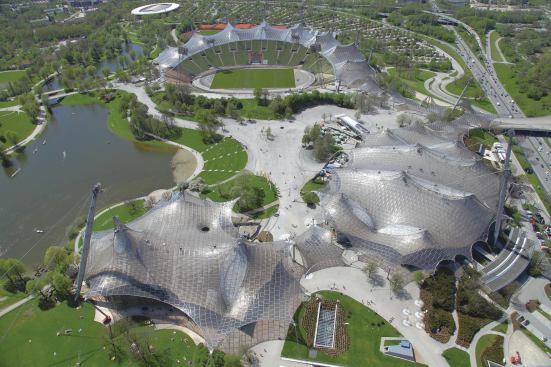
Aerial of the 1972 Olympic Stadium in Munich, Germany


Sposored by: Birdair
Diego Delso / Courtesy Wikimedia Commons
Aerial of the 1972 Olympic Stadium in Munich, Germany
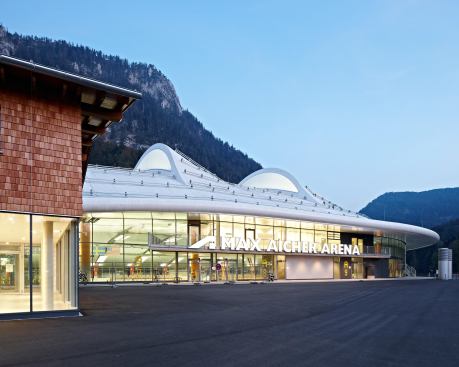
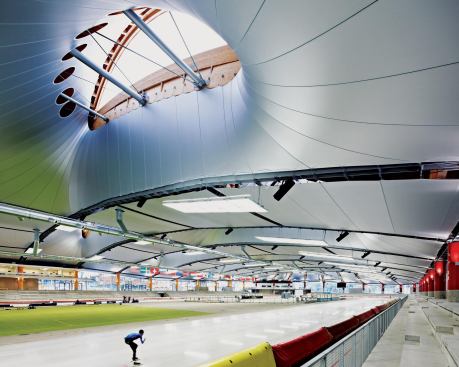
Fabric structures can also become a part of the games they house. Topping a competitive speed-skating arena in Inzell, Germany, designed by Stuttgart-based Behnisch Architekten, is an undulating, wooden roof structure wrapped in a white tensile fabric that, like a rolling snow bank, nicely complements the Bavarian Alps backdrop. Firm partner Stefan Behnisch, Hon. FAIA, is quick to point out that the roof is not a tensile membrane structure in the classical sense. “It’s a wooden structure with foil over it,” he notes. “Under the roof are tensile … foils or fabrics.”
Rather than leave the wooden trellis exposed, Behnisch swaddled it in a low-emissivity, highly insulating membrane made from polyethylene and aluminum, held taut above the rink in “tensile fashion,” he says. The reason was simple: In order to preserve the optimal consistency of the skating surface, the arena’s temperature and humidity conditions needed to be closely regulated. The reflective fabric made by Serge Ferrari helps maintain the conditions that lead to firmer ice and thus faster skaters.
Yet beyond providing clear spans for sports fans and the odd exhibition hall, tensile structures have taken on a number of other, more eccentric, and playful roles in recent years due to their inherent light weight and portability. For U2’s global 360o Tour, which wound down last year, Stufish Entertainment Architects in London created the Claw, a looming, steel-girder tarantula that stood athwart the stage and structurally supported speakers, screens, and a radio mast. Tensile fabric cladding wrapped the structure, forming its spiny contours as it projected from the metallic skeleton. “It had mushrooms and polyps designed so they could be jacked out from the steelwork manually, to tension the skin,” explains Mark Fisher, principal of Stufish, which has designed concert stages for the likes of Tina Turner and the Rolling Stones. As the tour moved from city to city, the Claw’s lightweight construction allowed easy transportation, disassembly and reassembly, going from a bag of bones to puffed-out set piece in just 24 man-hours.
The Steilneset Memorial, completed last summer in Vardø, Norway, also exemplifies the versatility of tension fabric structures. The tensile fabric fuselage, by German designer Peter Zumthor, contains within it a permanent exhibition in honor of 17th-century-witch-trial victims. The exhibition space hangs suspended on cables within a wooden superstructure, producing the effect of a free-floating cocoon, hewn in a PTFE-coated fiberglass fabric drawn taut.
Significant advances in computational design are facilitating the growing formal diversity in tensile fabric structures. Engineering office Buro Happold, based in the U.K., has even created a proprietary software, Tensyl, to make complex tensile structures easier and faster to design. All of which is to say that advances in tensile are moving at a remarkably fast pace. That may not be altogether surprising, however. Compared to other structural systems—steel and certainly masonry—tensile fabric construction is remarkably young.
To earn credit and obtain a certificate of completion, visit go.hw.net/archceu and complete the online quiz for free. Follow the “Click here to start this course” link to launch the quiz for this story. If you are new to Hanley Wood University, create a free learner account; returning users log in as usual.
The inherent tenuousness of tensile-fabric structures, in fact, may be the source of their unique architectural charge. “Tensile structures are progressive,” Nordenson says. “They represent an optimistic notion of absolute, minimal structure.”
In the four decades since its entrée into the architectural mainstream, tensile has attracted the interest of designers and engineers captivated by a desire to do the improbable: to create, in the words of critic Reyner Banham, une architecture autre—“an other architecture”—that defies the rules of design and seemingly of gravity itself.
Whether it’s an instant rock ’n’ roll road festival, a soap bubble, or—as in Werner Sobek’s case—a love of “precision … of treating materials carefully,” tensile fabric is malleable enough to fit almost any of the countless architectural agendas at large in the profession today. Geiger Engineers’s Campbell also sees tensile membranes as an adaptable standby that any designer should have in their repertoire. “We look at fabric as just another building material,” he says. “It creates opportunities.”
No recommended contents to display.