




Project Description
From the May 2019 Issue of ARCHITECT:
A housing complex increases density in urban New Orleans, fitting a dozen units where three were zoned.
New Orleans–based OJT (Office of Jonathan Tate) has developed a laser-focused urbanist practice, capable of taking on challenging sites, byzantine code processes, and lean budgetary conditions, and transforming all of these seeming obstacles into positive advantages by dint of incisive form-making. How it does this is borne out in its No. 4-15, Saint Thomas/Ninth development in New Orleans’ Irish Channel neighborhood: Hard by the banks of the Mississippi River, in a residential area interspersed with light industrial buildings, the project is an attempt to build affordable housing that breaks the mold—without breaking the bank.
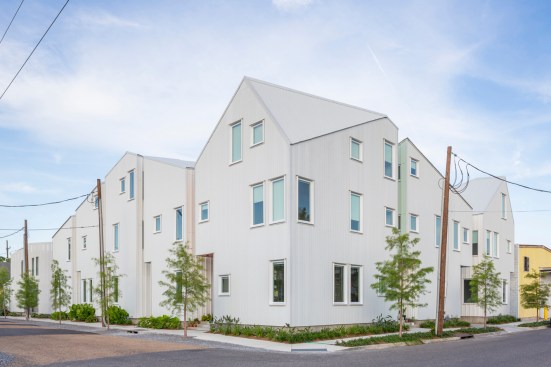
OJT began with the regulatory givens of the site—in a low-density area, largely zoned for single-family homes on big lots—and then turned those rules upside down, exploiting multifamily zoning allowances while still opting for detached houses. The result is a series of 11 structures—all but one is single-family—packed remarkably close together, making for a distinctly communal environment that still preserves individual ownership and a degree of privacy for all inhabitants.
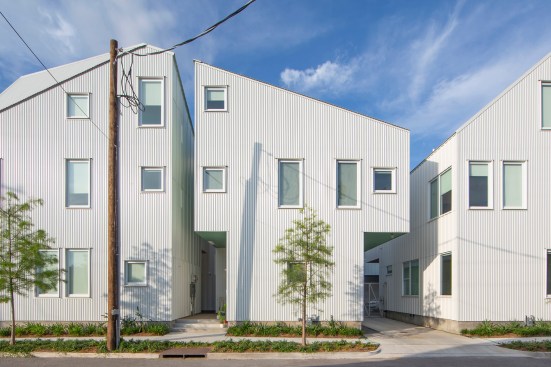
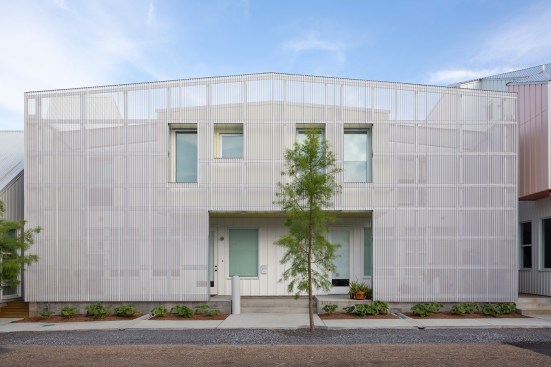
The formal device that helps to facilitate this is a continuously shifting roofline, jumping from house to house and giving the whole block a zigzag profile, with each unit distinct yet part of a cogent visual whole. Combined with the buildings’ ribbed-siding-clad exteriors and relative height (at three stories, they are taller than most houses in the area), the rooflines help establish a relationship between the complex and the nearby warehouses, creating a silhouette that seems a perfect mix of the customary domestic and industrial typologies.
The product of intense study into local history, demographics, and economics, the Saint Thomas/Ninth project marks yet another step forward in OJT’s ongoing Starter Home initiative, a promising new model for residential construction that’s as practical as it is ambitious.
Project Credits
Project: Starter Home* No. 4-15, Saint Thomas & Ninth, New Orleans
Client: St. Thomas
Development Partners: Jonathan Tate (OJT); Charles Rutledge, Pierre Stouse (Edifice Builders)
Architect: Office of Jonathan Tate (OJT), New Orleans . Jonathan Tate, Lauren Hickman, Sabeen Hasan, Rob Baddour, Jess O’Dell (design Team)
Structural Engineer: Walter Zehner & Associates
General Contractor: Edifice Builders
Landscape Architect: Spackman Mossop Michaels
Size: 12,800 square feet (site); units range from 919 square feet to 1,538 square feet
Cost: $2.5 million
Materials and Sources
Exterior Wall Systems: Corrugated Industries (metal siding); James Hardie (cementitious panel and batten siding)
Flooring: Golvabia (wood flooring)
Paints/Finishes: Sherwin-Williams (paints, stains, and coatings)
Roofing: Corrugated Industries (metal roofing panels)
Windows/Curtainwall/Doors: Anderson Windows (vinyl fixed and operable windows)
This project won a 2019 AIA Institute Honor Award for Architecture.
The continuation of the architect’s Starter Home* initiative, which delivers entry-level homes to historic urban neighborhoods that are quickly gentrifying, Saint Thomas/Ninth renegotiates existing site conditions in New Orleans to maximize residential density. The project levels the playing field for homebuyers in the city’s Irish Channel neighborhood by adapting to the difficult, irregular fabric found there.
Historically, Irish Channel has consisted of a mix of industry and low-density residential where it’s not uncommon to find warehouses and homes on the same block. The context of intimacy between strange neighbors was critical for the team when it added 12 homes—10 single-family and one two-family—through the reuse of an existing warehouse and by building on an adjacent vacant lot. Embracing the unappreciated warehouse form was the basis for the team’s exploration of the site, and the gradual roof pitch across the development furthers the neighborhood’s industrial language.
Zoning in the transitional neighborhood calls for abnormally large lot minimums for single-family homes. The project required an innovative tactic that leveraged the density allowed for multifamily developments but organized the site as a collection of detached condos. Reconfiguring the existing parcels grew the number of units on the site from three to 12. The adjustment required the team to subvert the general condo legal structure, resulting in the creation of provisional lots that promotes autonomous homeownership.
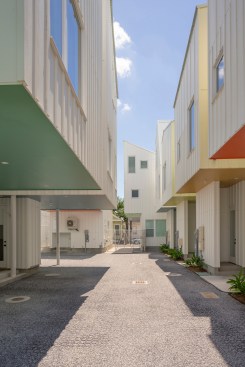
In a city where proximity to neighbors is the norm, the architects swapped long, flat dwellings for tall, skinny ones. Seeking maximum density, every square foot of the site is active and accounted for. To provide one parking space per unit, each house touches down lightly in order to free up the ground plane. Due to the revised legal boundaries on the site, the spaces between buildings have become implied side yards. Often ignored by the city’s shotgun dwellings, those spaces are claimed as front porches, instilling a greater sense of entry and ownership.
FROM THE ARCHITECTS:
Another expanded site for the Starter Home* thesis, the 9th Street development is comprised of 12 homes, with 10 single-family and one two-family, occupying an existing warehouse and vacant parcel. The zoning for this transitioning industrial edge required abnormally large lot minimums for single-family structures. This mandated a tactic that leveraged the density allowed under multi-family developments but organized the site as single-family assemblage. The approach required a subversion of the conventional legal structure, which usually applies individual ownership to the interior of one unit, but in this case creates provisional lots and realizes autonomous ownership as espoused by the Starter Home* agenda.
Historically a neighborhood home to both industry and low-density residential, the Irish Channel has precedent for the adjacencies created with the 9th Street scheme i.e. homes and industry occupying the same city block. Though each home spans three stories, the height of the buildings align with the industrial building context. Adjacencies not only appear natural, but are entirely relevant.