



Project Description
The “Romberg Center for Ecology and Resilience” project, honored with the 2020 AIA COTE Top Ten for Students award, exemplifies a harmonious blend of historic renovation and sustainable design. This prestigious award, given by the American Institute of Architects Committee on the Environment (AIA COTE), recognizes exceptional projects that adeptly integrate design excellence with environmental performance.
The investigation goal of the current situation of San Francisco State University, Romberg, Tiburon campus, is to use the analytical information as a base data to support the proposal of the site renovation. The investigation takes on multiple aspects that are considered to be most relevant to the site, ranging from the historical features within the area, the transit and access, daylight and shaded area, the bathymetry, water path/watershed, projected sea-level rise and the possible effected area, and vegetation type. Included in this part of the research is the initial proposal for a different option for the existing building between demolition, renovation, and retain. The result was considered base on the building element, such as its historical value, structural integrity, and its flexibility of transformation.
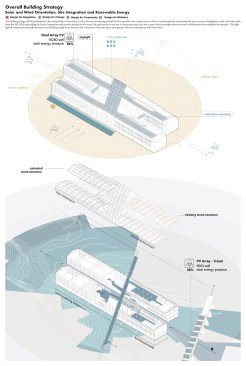
The High-Performance Historical Renovation of the Romberg Center for Ecology and Resilience is a design project that focuses on creating specific trails for different user groups, thereby activating the entire campus as a unified entity. The paths converge at a central mixed-use research building, facilitating interaction among various campus users. The design incorporates multiple passive and active sustainable strategies, including optimal building orientation, narrow floor plates, earth-sheltered structures, and extensive use of PV panels on rooftops to achieve a net-zero design.
The project unfolds in two phases: the master plan design and individual building development. The master plan introduces a new waterfront access point in addition to the original north and south gates. This approach is designed to integrate community residents and researchers fully, utilizing the entire site. The existing water tank is converted into a viewpoint, connected to research areas, with adjacent buildings transformed into community spaces like cafés and exhibits.
The design includes detailed studies of local vegetation and wildlife, leading to the creation of two distinct plant zones for public and research purposes. In areas near the southern general labs, stepped farms are used to manage heavy rainwater drainage, while the northern higher terrain is planned for planting tall local trees to provide wind protection. The diverse plantings also aim to attract a variety of local animals, enhancing the natural habitat.
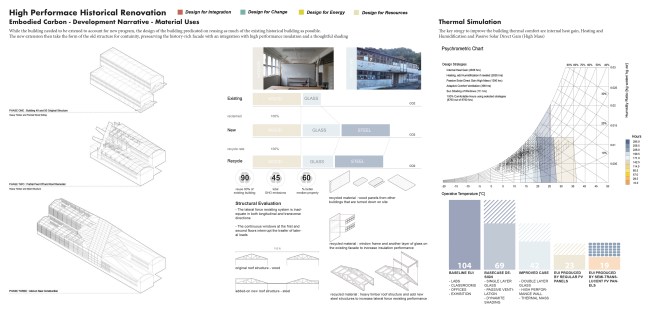
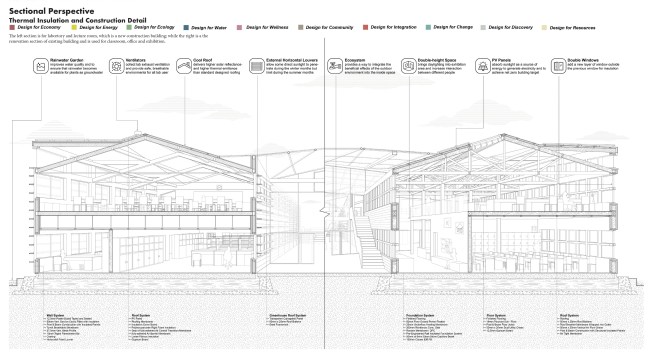
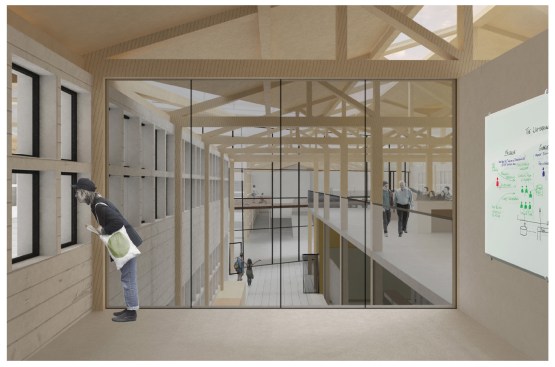
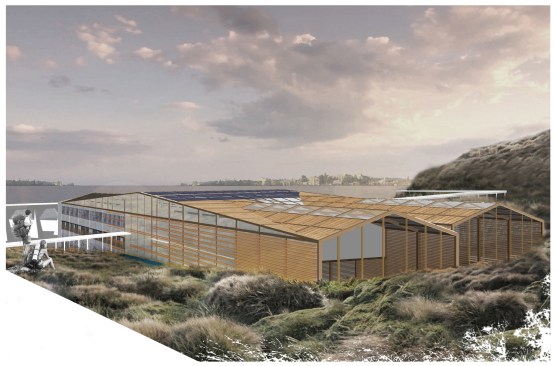
For the central building, Education Center, the project emphasizes high-performance historical preservation. The design minimizes intervention on the original building structures, reducing costs and CO2 emissions. Two new steel-structured volumes extend into the hillside as research spaces, and the original heavy timber roof structure is reinforced with steel trusses, repurposed for exhibitions and classrooms. A connecting greenhouse serves as a communal space, protecting against high-speed winds and fostering interaction among researchers, the public, and local residents.
To address the predicted 66 feet sea level rise in the Bay Area over the next century, the design includes a tidal pool with varying height levels as a visual indicator of water levels. A rainwater garden is integrated around the structure for water collection, channeling it through various campus features. This collected water is also reused for irrigation in stepped farms, reducing freshwater consumption and preparing for potential water shortages.
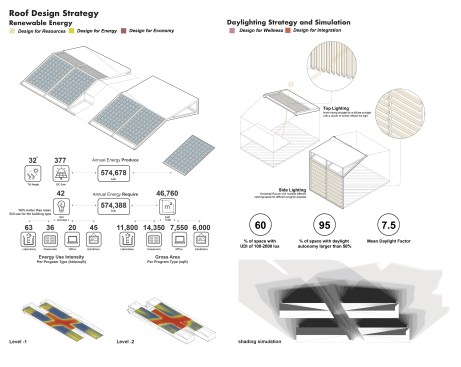
In the early design phase, building orientation and narrow floor plates were optimized to maximize natural light, improving building performance and visual comfort. Skylights and sidelights are strategically placed, and double-height spaces are designed for increased daylight and visual connectivity. Exterior horizontal louvers vary in density based on lighting requirements, with over 95% of spaces achieving a daylight autonomy greater than 50% and a mean daylight factor of 7.5. Additional high-performance glass is added to existing windows for improved insulation, while the greenhouse and thermal mass in the floor system aid in winter heat gain.
These sustainable design strategies have successfully reduced the building’s Energy Use Intensity (EUI) to 42, which is 60% better than the mean EUI for the building type. With PV panels of 377 DC size installed on south-facing rooftops at a 32-degree tilt angle, and translucent PV panels on the greenhouse roof, the project generates 574,678 kWh annually, further reducing the building’s EUI to 23.
The Romberg Center project meticulously crafts a curated experience for its users, ensuring each group has the opportunity to engage with the site’s diverse ecological features, learn about its history, and connect with nature.