
Project Description
FROM THE AIA INDIANA:
The primary project goals included:
• Preserve the distinctive character of the building and capture its spirit.
• Transform this jewel of a building into a modern office facility for the IU School of Medicine.
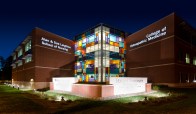
• Make the building a distinctive campus asset in its setting among the new Eskenazi Hospital, Riley Children’s Hospital, and the restored gardens.
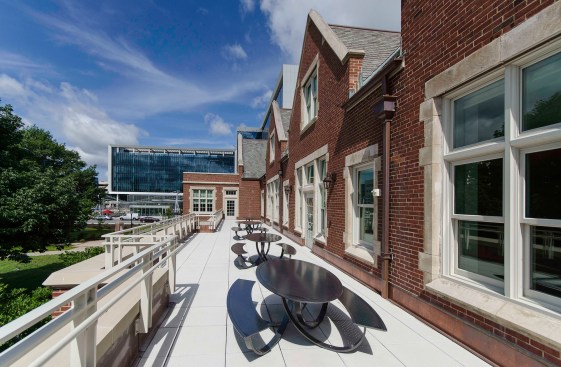
The look and feel of the original windows—including re-creating the window frame face profiles while integrating vision glass into the upper frames—helped make the historically sensitive renovation possible and brought natural daylight deeper into each floor plate. Other exterior strategies included the replacement of failing exterior metals with historically correct metal profiles and colors, and the restoration of the brick and limestone masonry to a fully watertight condition.
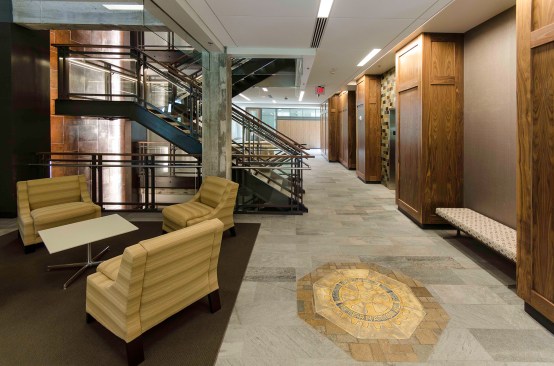
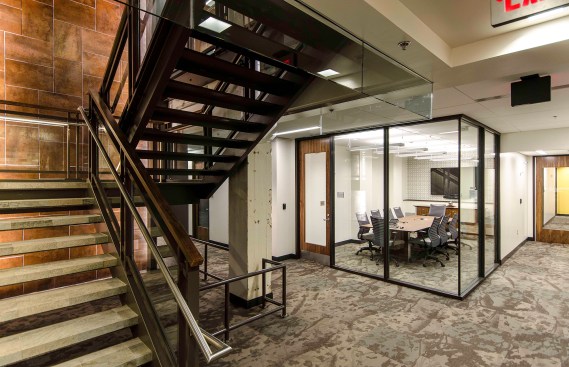
Interior space planning was challenged by the need to meet multiple program needs for a variety of users in the School of Medicine. The new layout has creative open office solutions and enclosed offices within the existing building framework. A new communicating stair is a focal element, and assists with wayfinding. The third floor ceilings were opened up to express the rooflines within the workspace.
Other interior strategies included preserving the historic Rotary emblem and reincorporating it into the floor tile of the public space; pulling colors, materials, and textures from the building’s exterior, specifically the copper, through the project’s modern interior space; and historic windows were integral in creating an open office concept with incidental seating around natural light sources.
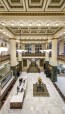
The new building interior features a timeless, modern environment with a sophisticated material palette to enhance the existing historical character. The railing on the new communicating stair takes its cues from the rail design of the existing egress stair. Existing wood stain color and detailing informed new wall paneling in public areas. When existing interior wood windows were uncovered during selective demolition work, the design was adjusted and the windows were refinished. Plaster ceiling coffers and crown mouldings were also restored.
Utility routing for multiple campus structures runs through and around the building. The Team worked closely with campus facilities directors to pre-plan all current and future routing and to design the project phasing and shut-off switchover schedule. With no room to expand, crawl spaces under and adjacent to the basement were utilized to relocate utilities and create lower level occupiable space. Energy usage was optimized through the integration of a highly efficient, active chilled beam system supported by campus utilities, helping to achieve LEED Silver Certification or higher while meeting a project goal. The high-efficiency heating and cooling systems were designed to outperform the ASHRAE 90.1 baseline for existing buildings by 40%. Approximately 90% of the building lighting is from an LED source and 98% of the building is equipped with motion sensor-controlled lighting.
Creating a new home for the School of Medicine to relocate offices for the Center for Global Health, the Office of Medical Education and the Department of Medicine Divisions of Pulmonary, Gastroenterology and Hepatology, fulfills the third goal of making the Rotary Building a distinctive campus asset — because these professionals will be at the new crossroads of an exciting and expanded medical campus.
In the end, the School of Medicine has a technology-forward facility with new, modern interior functionality for faculty and students, while maintaining its historic character.