
Project Description
Located in the Summit development overlooking the Las Vegas strip, Fort 137 is the newest luxury property built by Forté Specialty Contractors. Design by architect Daniel Joseph Chenin, it is set against the breathtaking backdrop of Red Rock Canyon Park and property designated by the Bureau of Land Management, this American Institute of Architects (AIA) Nevada Merit Award Winning home intentionally showcases nature and appeals to the senses at every point.
The clients requested full-service design for a house with a direct relationship to its site, functioning as a base camp for family gatherings and an active lifestyle. Concerned with the environmental impact, the clients requested an environmentally conscious design, with as much locally and regionally sourced materials as possible.
In response, the house is an open structure, organized into three layers, which radiate from a communal nucleus of indoor and outdoor areas, to a periphery of more intimate and private zones. The layout is designed to be both compact and spread out making the program readable as a series of rock masses emerging from the earth. Each single-story volume was carefully placed to maximize views of the surrounding untouched land, while controlling the harsh effects of the sun, wind, and light. The building pays homage to the old fort structures found on the fringe in the early settlement days of Las Vegas, which relied upon site-sourced materials and tried-and-true techniques of building in an arid climate.
The overall design centers around the use of earth elements such as wood paneling with rubbed bronze accents and stone flooring to bring the local elements into the home. This takes advantage of its environmental impact through design strategies, such as, passive cooling, day-lighting, thermal mass, living roofs, photovoltaic panels, radiant heating, rain water harvesting, and native and regionally sourced, robust, no maintenance, and long life-cycle building materials that will complement and evolve with the site as they age and patina over time. All of these offset the home’s carbon footprint, reducing its dependence on the grid, all while providing good stewardship for the land.
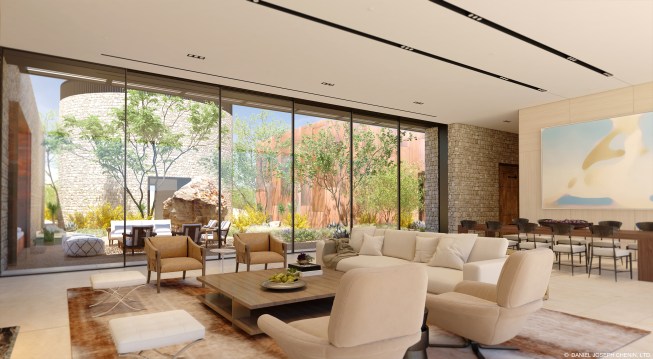
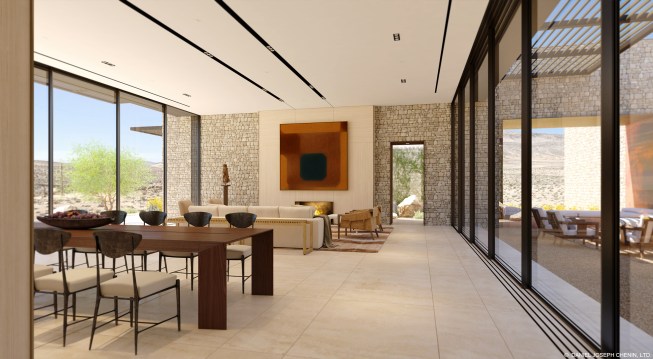
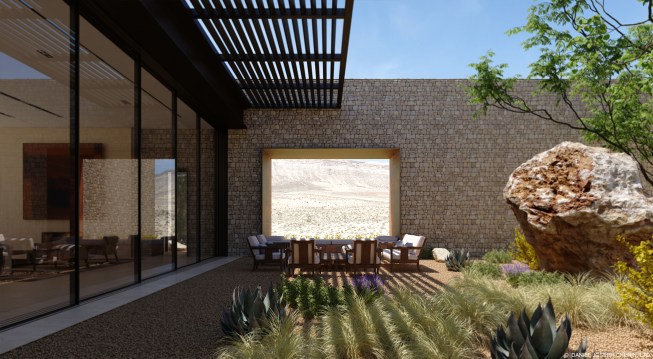
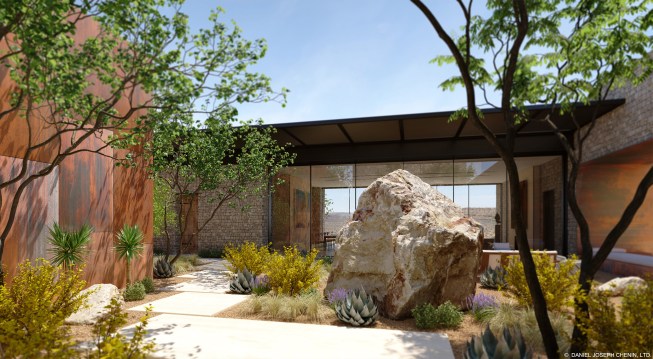
Collapsible 13-foot-high windows sourced from Portugal complement the main living space, providing a view directly through the house and the continued illusion that the desert landscape extends indoors. The heavy use of materials like steel and Italian stone means this property looks and lives like a fort, while maintaining surprising elements with portal windows framing the expansive Nevada horizon.
The Fort gets its name, in part, from the towering steel gates that “guard” the courtyard. The front door is marked with distressed fort doors which visually mark the entrance. The only access points to the property are through the garage or the main entrance which includes a two-story rotunda with stairs leading all the way to an epicenter for entertainment, complete with a fireplace that extends around the conical and a water feature at the bottom. As they climb the tower, guests will encounter a wet-bar landing at the halfway point.
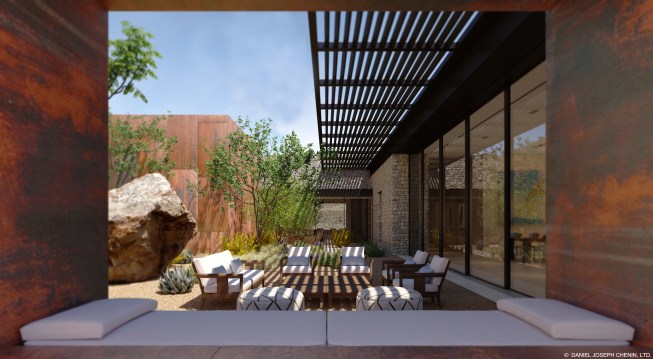
Continuing the emphasis on natural materials, the 75,000 lb. boulder that graces the entrance to the courtyard was sourced from a rock quarry five blocks away and carried in by a crawler crane to serve as a focal point at the entrance.
Giant pieces of Corten steel – defined by its vibrant orange coloring, which will settle to a rustic, dark red after years of weather exposure – surrounds the home at strategic points. Energy and view corridors were a prime consideration. Sun studies were completed to ensure placement would minimize energy needs. Forte created mock walls of various design to make sure sound and temperature elements were maximized. Three levels of waterproofing and a variety of insulation types on top of the actual sheathing provide the superior quality that was needed to achieve the desired result.
Every window has been strategically placed to secure the optimum view corridors with every window sited to frame the available views.
Upon full completion in April 2021, the one-story main house will have 3 bedrooms, each with an en suite, one additional powder room, and a number of outdoor living spaces sprawling an area of almost one acre. The additional casita includes two bedrooms, two baths, an entertainment area and a kitchenette.
As part of the design process, sun studies allowed the team to prioritize energy needs with the inclusion of trellises, landscaping and additional structural features that allow for optimal shade throughout the day.
Architect Daniel Joseph Chenin employs robust, layered walls that keep the space easily 20 degrees cooler than the outside, even without air conditioners. These energy-conserving methods combined with the use of earth tones throughout the home highlight an appeal to the senses that is paramount in this design.
As a result, the overall design and construction of the structure anchors into the landscape, standing alone; a fort along the fringe, immersed in its tranquil landscape.