
Project Description
This project is a winner in the 2018 COTE Top Ten for Students awards program, sponsored by the AIA and ACSA.
Student: Nicholas Scribner, Clare Hačko
School: California College of the Arts
Faculty Sponsor: Evan Jones
From the Submission:
Designing for integration
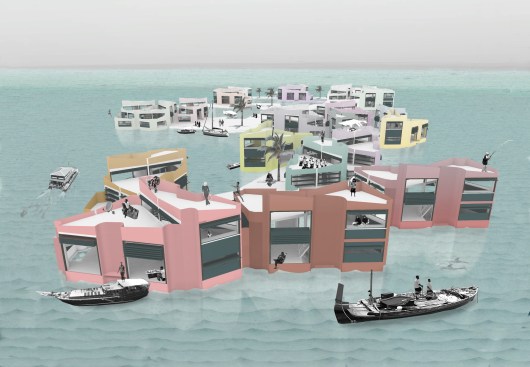
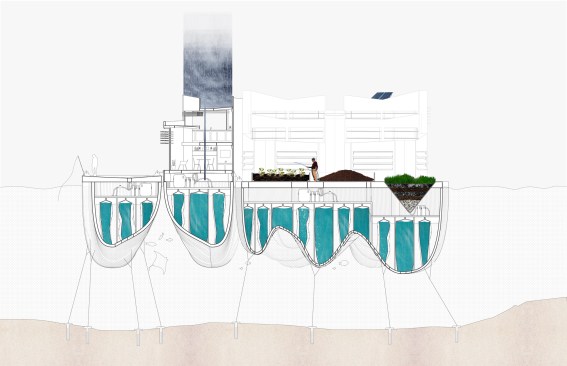
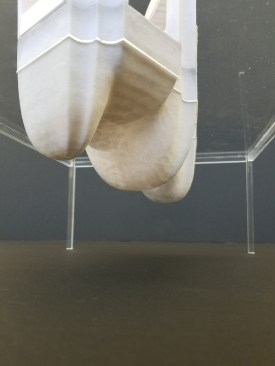
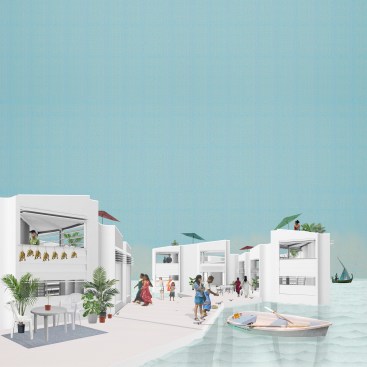
Dis/Placement constructs a terrain upon which its inhabitants explore a life in the act of translation from ground to water. Climate change poses an imminent threat not only to the low lying and quickly eroding land of the Maldives, but also to its drinking water supply. The existing water supply has become precarious due to saltwater contamination, rising sea levels, the increasing unpredictability of the monsoon seasons, and the lack of redundancy in the systems which often results in the expensive and wasteful import of bottled water. Through the construction of an offshore community, designed to leverage water catchment and storage, this water farm will provide clean drinking water not only to its inhabitants, but also to the entire adjacent island of Dhangethi.
Designing for Water
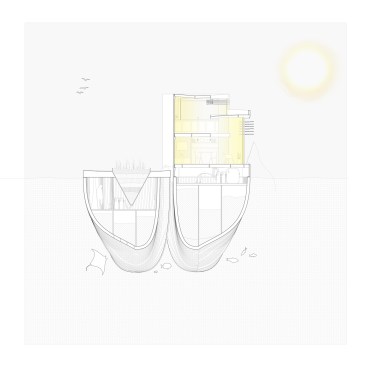
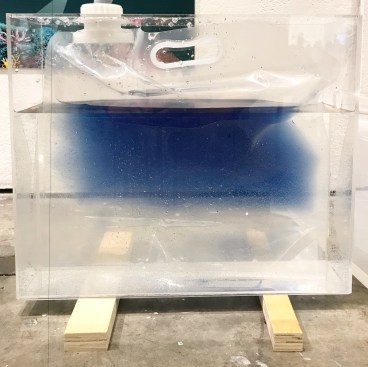
Rainwater is collected at each rooftop and stored in the hull below, where water storage bladders are suspended in saltwater chambers. As the bladders fill with freshwater, saltwater is displaced from the chamber, maintaining an equilibrium for ballasting the module. Clean drinking water is pumped above for use in the module’s kitchen and bathroom. After its initial use, the water is sent to a “Greywater ground module” for filtration through a wetland column. At each greywater ground, used water can be filtered, stored, and reused for agriculture.
INTEGRATIVE METRIC:
Occupants remain comfortable using passive systems for 100% of the year
WATER METRIC:
100% of Stormwater managed onsite through rainwater collection for drinking water supply
Designing for Community
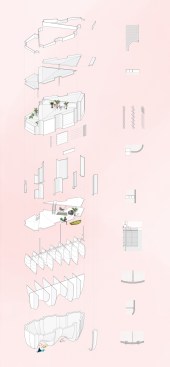
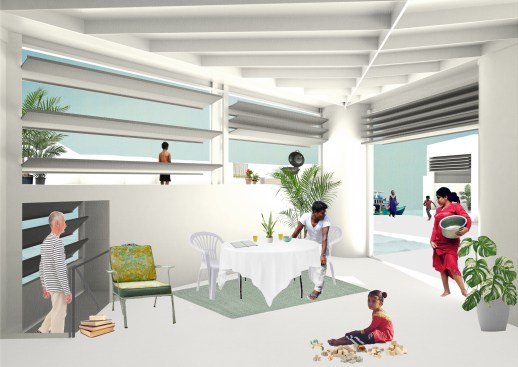
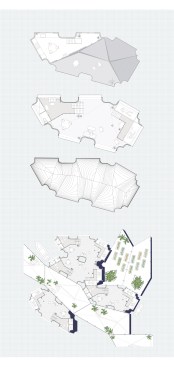
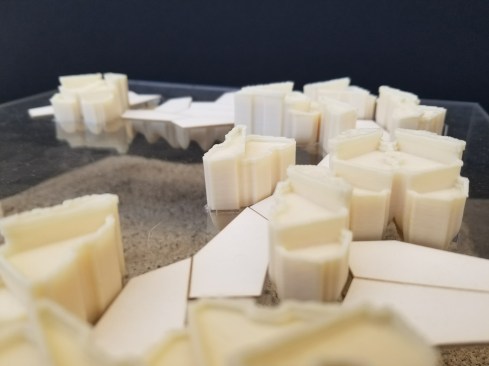
While each module is scaled to the individual family, public and private space within the units is divided to privilege the collective. Sleeping quarters are bunks in the lowest volume of the module, leaving the entire first floor for the collective and the second floor as an elevated kitchen. The adjustable panel walls allow for the boundaries between the public space of the unit and the public space of the site, the “grounds”, to be completely dissolved at will in order to cultivate larger collectives and invite the blurring of traditional ownership boundaries. Terraced roofs extend the collective space of the units to the site, creating opportunities for the construction of a collective at the scale of several families.
Designing for Wellness
The mental and physical wellness of the inhabitants of our community depends on thoughtful integration of thermal, visual, and acoustic demands. The module’s minimal cross sectional dimension allows for maximum passive airflow, the most effective strategy for passive cooling in the hot, humid Maldivian climate. Daylighting is moderated by the panel infill walls which can be completely rotated and retracted to maximize the occupant’s connection to the outside. The translucent panels can be easily adjusted to provide ample passive ventilation and natural daylighting, while blocking direct solar heat gain, keeping the interior comfortable and well lit.
Designing for Energy
Each module is designed for maximum airflow in order to combat the warm and humid climate. Air is drawn from the lower areas up through to the highest volume. Adjustable wall panels allow maximum cross ventilation for passive cooling. When opened, the rotated panels perform as a shading device to reduce solar heat gain. A photovoltaic array provides energy to the site which is constructed as a micro-grid. This allows for maximum efficiency in energy production and eliminates the need for fossil fuel run generators.
ENERGY GENERATION SITE
2,700 sq. ft. of photovoltaic solar panels
Sufficient for standard energy use of 135 users
Anticipated site occupant load: 60 users
Designed energy surplus to adjust for additional energy use at research lab
ENERGY CONSUMPTION SITE
23,400 sq. ft. occupiable space
ENERGY NEUTRAL SITE
Grounds serve as circulation and cultivation space, minimal energy use anticipated at these sites
WELLNESS METRIC:
100% of floor area is within 15’-0” of an operable window
COMMUNITY METRIC:
Walk Score: not available
Occupants may swim, boat, or stroll about their community!
Designing for Ecology
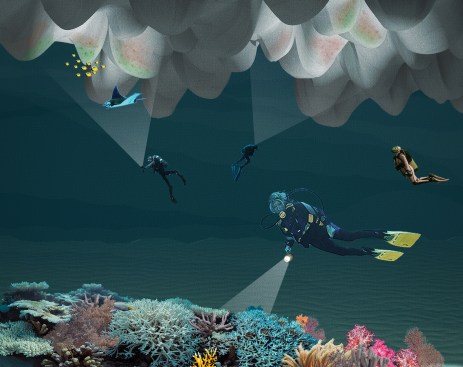
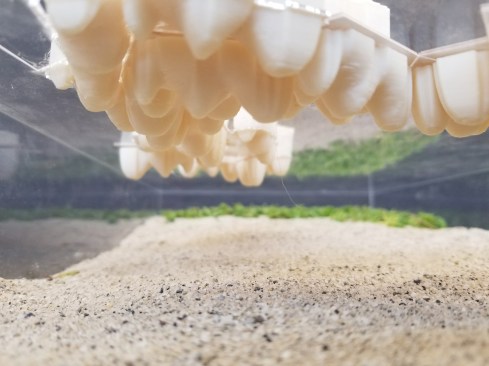
Unlike traditional sea crafts, Dis/Placement invites the growth of sea life
through its geometry and surface rugosity. These precursor species are
the foundations for healthy ocean ecologies, and will ultimately support
human life at sea by maintaining a healthy and diverse ecosystem. Dis/
Placement constructs a closed loop, self-sustaining system which protects
and fosters the surrounding ecology through the onsite filtration and
reuse of greywater and the onsite composting and reuse of both solid and
liquid waste from composting toilets. The undersides of the modules form
a terrain of curvature which creates maximum substrate surface
area to encourage the development of biodiverse microecosystems.
Designing for Discovery
Dis/Placement developed out of the expertise of a unique set of consultants,
from structural engineers to marine biologists, naval architects,
and fabricators. This unconventional grouping of experts allowed us to
discover unlikely methods for addressing the needs of the community.
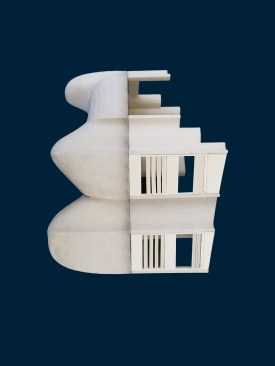
The form of Dis/Placements allow for stability, especially through aggregation,
in the water. This form however, required significant ballasting
in order to maintain that stability. Dis/Placements was able to leverage
that space for fresh water storage through the design of its water chamber
system. Diverse expertise has proved an invaluable part of our creative
Process.
Designing for Change
The residents of the Maldives must preserve their national identity as
they lose the physical land which defines its borders. Maldivians must
become independent from the ground. Each module in our project is
designed to tile together, allowing for future expansion and aggregation
at the scale of the site. As more land is lost to the rising sea, more floating
housing and ground modules can be permanently joined or temporarily
connected to strengthen the collective. Since each aggregation functions
as a micro-grid, and power and drinking water are generated on site, the
community is insulated from possible failures of larger-scale land-based
Infrastructures.
RAINWATER COLLECTION AND STORAGE
4,682 sq. meters of water collection
surface
Collection capacity: 1,170 persons
Storage Capacity at Site: 50%
Storage Capacity at Dhangethi: 50%
ECOLOGY METRIC:
85% Site surface area
designed to support
vegetation:
-Terraced roofs
-”Grounds”
-Hull Underside
Designing for Resources
FRP composites have been recognized by LEED as cost effective, energy efficient, and environmentally friendly construction material for their extreme durability and lifespan. This makes them ideally suited to marine environments. Minimal material is required by leveraging a form-active structural design. Each panel is produced from reusable molds which can be shipped to the Maldives for fabrication at the island’s existing boat building facilities. Curved stoppers and inserts are used to construct 13 different columns from a single mold.
Designing for Economy
Dis/Placement is constructed entirely from Fiber-Reinforced Polymer. What this innovative and developing material lacks in initial construction affordability, it makes up for in material longevity. The FRP modules are durable at sea and can be constructed on site at Dhangethi from a series of reusable molds. The site blurs traditional ownership boundaries, in order to extend the personal domain into the public, privileging collective over private ownership. This site strategy allows the individual to gain access to larger, flexible public spaces which can accomodate a much larger variety of programming than any individual unit.