
Project Description
FROM THE ARCHITECTS:
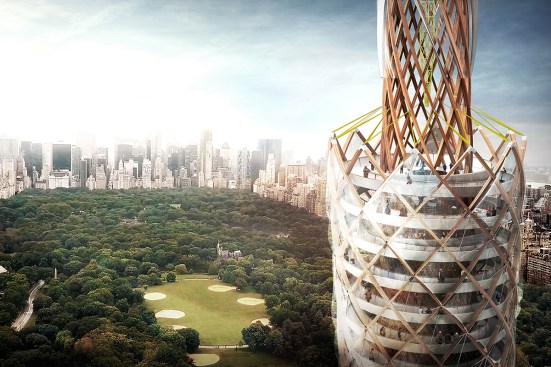
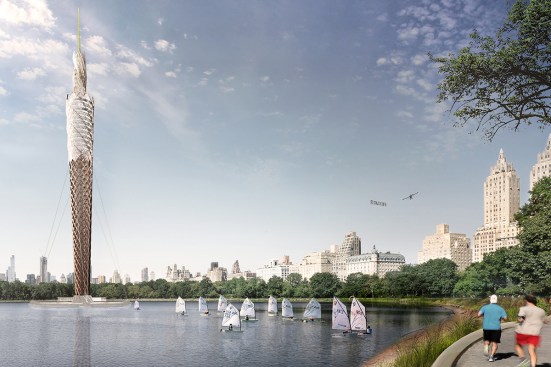
In response to growing demand for public bird’s eye views in the world’s tallest cities and an increasing need for innovative environmental cleanup strategies, DFA has revealed the design of a temporary prefabricated structure that doubles as a sustainable filtration system to transform the Jacqueline Kennedy Onassis Reservoir into a non-toxic useable freshwater pond and an observation tower offering unprecedented views of the city to all.
Located in the heart of Central Park, near some of New York’s most important cultural institutions, the underutilized 106-acre body of water occupies one-eighth of the park’s total area and is 40-feet deep, with approximately 1 billion gallons of contaminated water. Aside from supplying water to the pool and Harlem Meer, the Reservoir sits stagnant and fenced off due to its current state as a health threat to millions of New Yorkers, tourists and animals. DFA’s innovative design proposes a smart, unconventional approach to addressing hazardous and potentially calamitous situations while also seeing it as an opportunity to elevate everyday life for millions of people.
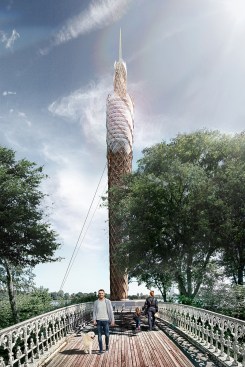
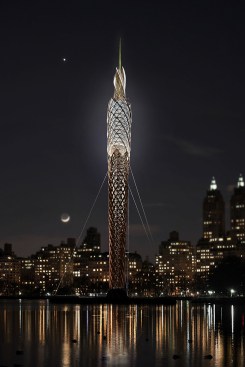
Utilizing highly advanced Glulam (glue-laminated timber) technology, the 712-foot structure can be manufactured offsite and constructed in less than six months, and is designed to cast minimum shadow on the park and nearby buildings. A vertical axis wind turbine offer the necessary power for filtering the water and moving people without drawing from the grid. The result is newly created public space and amenities on the ground and in the air, taking full advantage of the space and views that make New York one of the most desirable and most beautiful cities in the world.
Quote from Laith Sayigh, founder of DFA:
“DFA envisions a temporary landmark that is remarkably of its time to creatively transform the Reservoir into one of New York’s boldest urban amenities. This conceptual project pushes the boundaries of what we perceive is possible in a city as dense, historic and environmentally vulnerable as ours. The Central Park Tower has the potential to be a model project for other cities aiming to fix existing infrastructure, build tall to capture views and elevate the urban public realm.”
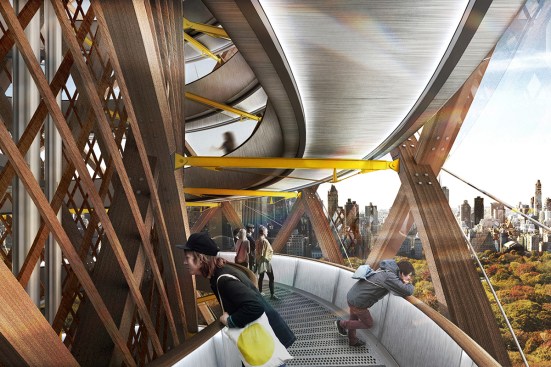
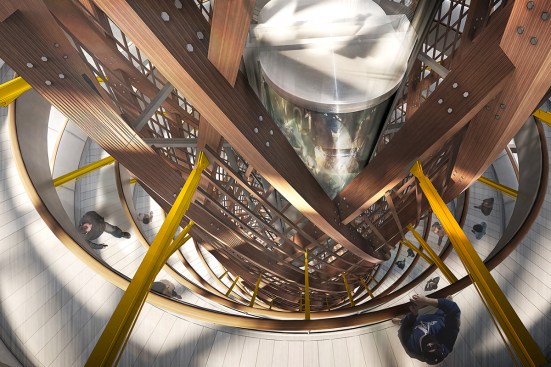
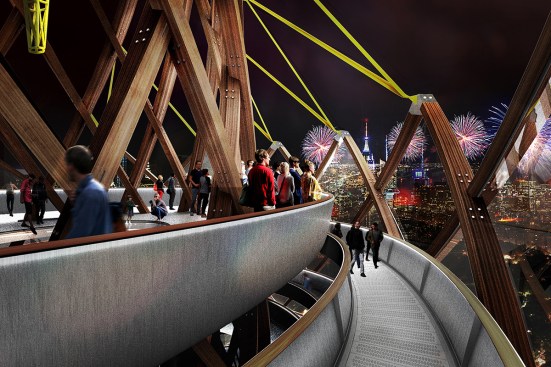
Anchored to a base structure of pre-cast concrete elements the tower is stabilized by tensile cables. The first element of the Central Park Tower houses a steel core and a water filtration system. From 475-feet to 600-feet the densely configured jointed interlocking woven wood helix continues forming the primary tower. A steel ramp equidistant to a New York City perimeter block, or .42-mile, wraps the interior core from the 375-foot to 500-foot mark of the tower. Wrapping the ramp is a more open, expanded exterior wood helix and skin that stands 500-feet into the air as a single gesture. The porosity of the exoskeleton opens up visibility of the ramp and people from the ground as well as of the city, rivers and park from above. The main attractions are a 56-foot wide viewing platform that gives 360-degree panoramic views and a glass oculus that showcases the functional elements of the tower, with views both up and down. Rising above the ramp and visitor realm is a wind turbine circling around the top 100-feet of the interior wood helix. Atop this, a 112-foot tall lightning rod/spire completes the iconic 712-foot tall structure.
In addition to being the world’s tallest timber structure, the Central Park Tower would also being among the fifty tallest buildings in all of New York City.