

Project Description
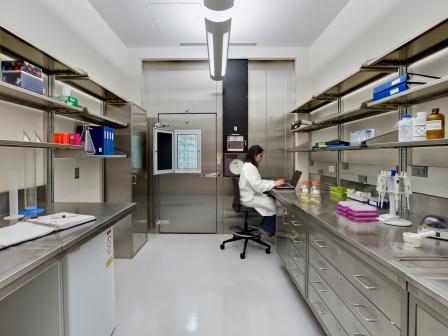
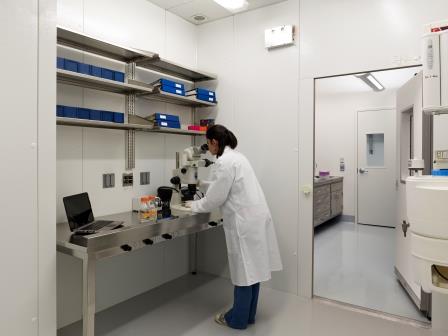
The laboratory is located on the 9th floor of the Translational Research Center part of the University of Pennsylvania Perelman Center for Advanced Medicine. The laboratory, designed by the architects at Studio of Metropolitan Design, is biologically secure and constructed specifically to study arthropods, in particular Carpenter ants Camponotus floridanus and Camponotus tortuganus and the Indian jumping ant Harpegnathos saltator.
Major objectives and activities (arthropods, plant pathogens, noxious weeds, biological control agents, etc.)
The facility will be used for research into the epigenetic basis of the behavior and aging of ants. For example, we will measure and compare aspects of chromatin structure along with gene expression levels among ants grouped by caste, behavioral repertoire, age, etc. We will also deliver drugs to ants orally or by injection to attempt to manipulate behavior and lifespan.
The carpenter ants Camponotus floridanus and Camponotus tortuganus are relatively large (5-10mm) arboreal ant species that are endemic throughout the state of Florida, USA. They prefer habitating in decomposing wood found in moist environments, such as coastal drift wood. The jumping ant Harpegnathos saltator is a large (~20mm) carnivorous ant found in India, Sri Lanka, and Southeast Asia.
This species belongs to a subfamily in which caste specialization, in particular reproductive division of labor, is limited. Consequently, non-reproductive workers can transition into a reproductive developmental state following death or removal of an existing reproductive queen from the colony.
The epigenetics of behavior and longevity in ants:
The laboratory of Shelley Berger focuses on mechanisms that regulate gene expression with a special emphasis on how the DNA-packaging structure of chromatin is manipulated during genomic processes. The lab has recently begun to investigate how chromatin structure regulates complex phenotypes at the whole-organism level using ants as a model. Ants provide an excellent study system because individuals within a colony are highly related genetically but exhibit striking differences in morphology, behavior, and longevity.