


Project Description
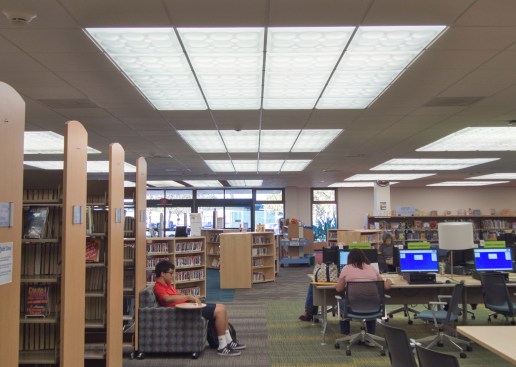
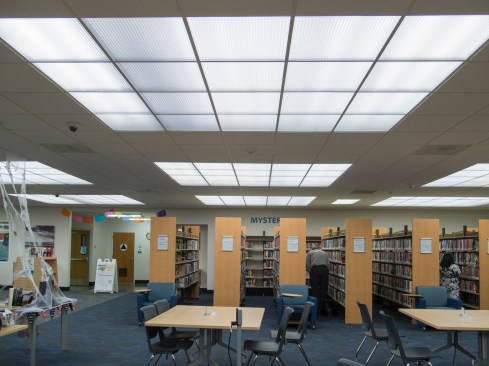
When the Anaheim Public Library renovated two of its branch facilities, one of the most impactful upgrades was restoring the luminous ceilings. By simply replacing the yellowed prismatic lenses with decorative, light-transmitting ceiling panels, they were able to bring illumination up to contemporary standards and add an element of visual interest. In addition, replacing the existing fluorescent tubes with more energy-efficient LEDs improved light levels even further while lowering energy consumption. A third, unexpected, benefit of the retrofit was that it restored a distinctive feature of the buildings’ original Mid-Century Modern architecture, a style closely linked to the community’s history.
The Euclid and Sunkist Branches are in residential neighborhoods of Anaheim, CA, a city best known as the location of Disneyland. Built in 1976, the branches were designed for smaller local populations with very different needs than today’s library users.
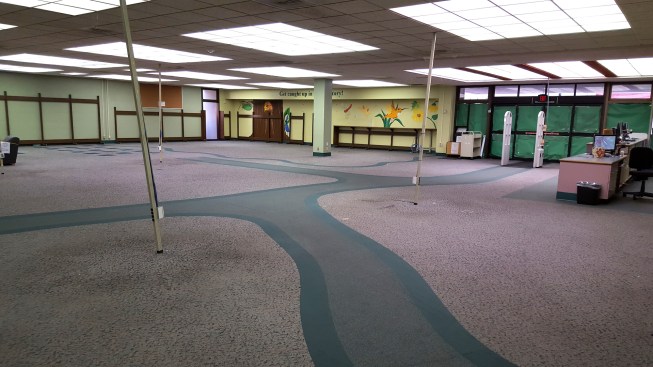
The renovation of the branches provided a chance to update their service model, as Euclid Branch Principal Librarian Tasneem Watts puts it, “to better serve the numbers and ages of the people who use the library now.” They needed more places for people to use computers, separate reading areas for adults and children, and a more inviting, engaging ambiance.
Group 4 Architecture of South San Francisco, CA, a design firm that specializes in libraries, presented Anaheim with a range of design options at different cost levels. Budgets, however, dictated that the Library could not substantially alter its buildings, but could afford to refresh the interior layout, finishes, furniture, and lighting.
Each branch was allowed to customize the design to fit its neighborhood. Furniture was replaced to provide more seating and more computer access. The old built-in staff desks – which more resembled barriers than service points – were replaced with modest but approachable and moveable help-desks. The library staff also had a say in aesthetic details such as carpet patterns, upholstery, and ceiling styles.
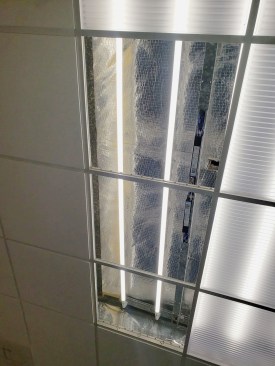
The luminous ceilings had light-transmitting acrylic prismatic sheets laid in a suspended T-bar ceiling grid and installed beneath a reflective light box containing fluorescent tubes. The acrylic sheets had not aged well, according to Andrea Gifford, Group 4 Architecture principal and director of interiors. “The lenses had discolored – and some had been replaced not in-kind,” explains Gifford, “so there was a variety of lenses. They had yellowed over time, and one of the big concerns the library had was that the lighting levels had decreased. Obviously, a library space is very dependent on the right amount of light.”
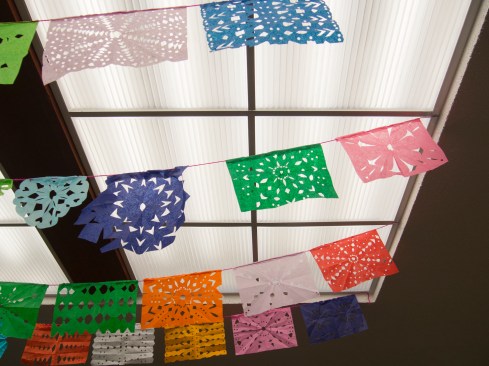
Through product research, Group 4 discovered Ceilume thermoformed ceiling panels are available in three light-transmitting grades – Clear, Frosted, and Translucent. The librarians were able to select their own ceiling-styles from among 40 different 3-dimensional patterns ranging from traditional to contemporary. Each branch chose two patterns, one for the general public areas and another for the smaller meeting rooms that host speaking events. The Euclid Branch got two linear styles, Polyline for the main reading room, and Southland for the meeting room; the panels used the Frosted material which accentuates the highlights and shadows created by the overhead lighting tubes. The Sunkist Branch features the playful Roman Circles pattern in the main room and the jazzy Dart style in the meeting room; it uses the Translucent material that obscures the overhead lamps and creates a more uniformly diffused illumination.
The new panels are lightweight, washable, easy to handle, and Greenguard Gold certified for indoor air quality. They also contribute to the acoustics required in the reading rooms.
The libraries held a grand re-opening after the major renovations were completed, “Everyone was really thrilled that the library felt brighter and bigger,” Gifford recalls. “Some people thought, ‘Did you add space? How does it feel so much bigger and brighter when we didn’t add any windows, or increase the square footage at all?’ That’s the impact you can make just by refreshing a space, improving the light levels, and revamping the furniture and re-laying it out. The community was really impressed with the outcome.”
The following year, the Library was able to replace the fluorescent tubes with energy-saving LED tubes and high-efficiency ballasts. The combination with the new luminous ceiling panels increases the overall light level even more, and achieves broad, evenly-spread illumination, according to Librarian Watts. “It’s really amazing,” she says. “We’re thrilled. The customers are thrilled, too.”
Yet another thrill occurred while preparing for the installation of the LEDs; it was discovered that the reflective light boxes over the luminous ceiling panels had been manufactured by Cepco, Inc., the company that patented some of the first luminous ceiling systems and a pioneering producer of thermoformed panels. This was a happy coincidence, since Ceilume is the corporate descendent of Cepco and still thermoforms many of Cepco’s original panel styles. The same type of decorative panels that had been used in the original design of the buildings have now been restored to their rightful place in the branches. Despite updated interiors, the luminous ceilings renew an important feature of the libraries’ architectural heritage.