

Project Description
FROM THE YALE TEAM:
Sustainable design for living
is often approached as a collection of technologies, isolating the
home from its occupant and the environment instead of working with natural
climatic conditions. This attitude assumes the home and outdoors should be
completely separate, that the interior always requires mechanical conditioning,
and that the house itself is a sealed bubble in a hostile environment.
Y-House seeks to approach sustainable design from a
holistic mindset, creating a space that is fully integrated with exterior
spaces, community, and climatic conditions.
Our rapid and agile lifestyles demand a house that is also able to respond to
our changing needs. Specifically targeted at young professionals, Y-House
provides adaptability, multi-functionality and freedom of movement beyond the
walls of a house. Simple, electricity-free measures provide the first means to
maintain a comfortable living environment: a linear configuration optimizes
natural ventilation so that most of the time, opening a window provides
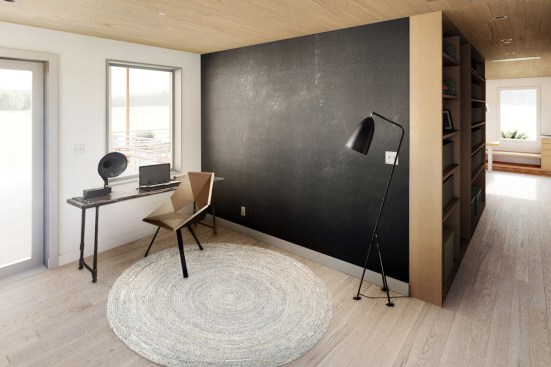
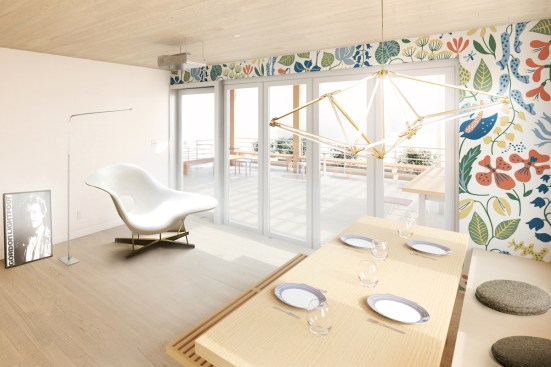
sufficient air flow; open interior spaces provide abundant natural day lighting
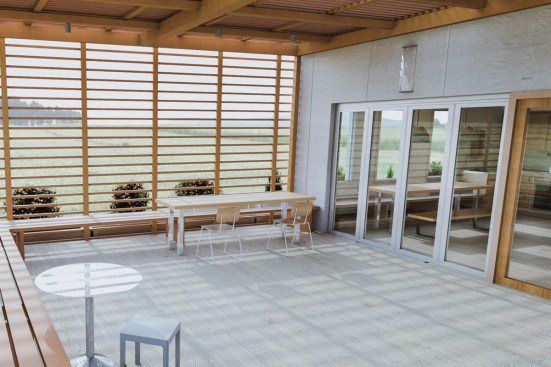
so that electrical lighting is rarely required; a large patio doubles
the living space so that when occupants want to socialize, they have a space to
do so. When these measures are not sufficient, Y-House is prepared. Adequate
building science and construction techniques assure that energy transfer is
minimal when desired. Use of energy-efficient mechanical equipment provides for
the needs of the house at a minimum energy penalty, and mechanical
equipment monitors air quality so that measures such as opening a window do not
interfere with heating or cooling. Furthermore, the modular structure can be
easily retrofitted for future technologies so Y-House remains relevant as
systems continue to improve.
Through Y-House, it is our aim to inspire
social and environmental change by making sustainable housing desirable and
marketable to a new generation. By implementing a design-based,
multi-disciplinary approach, Y-House allows for simpler solutions that make
this change possible.
MINIMAL FOOTPRINT: Through a
square footage of just under 750 square feet, our design achieves reduced
material costs and energy loads while still enabling the impression of
spaciousness through outdoor integration. An exterior deck draws people
outdoors while minimizing preconditioned space.
NATURAL VENTILATION: With its
linear configuration, natural ventilation is maximized across the north-south
axis of the house. The central room additionally creates a pressure
differential that pushes this air through interior spaces. Operable vents above
the kitchen and bathroom areas allow for hot air to escape, lowering mechanical
cooling loads.
AIR QUALITY: Although the
competition does not measure air quality, Team Yale felt that this was a key
component in making a house a comfortable. The demand-based energy recovery
ventilator paired with two membrane layers enable the walls to breathe and
release moisture, preventing mold and sick house syndrome.
OUTER ENVELOPE SCREEN: The
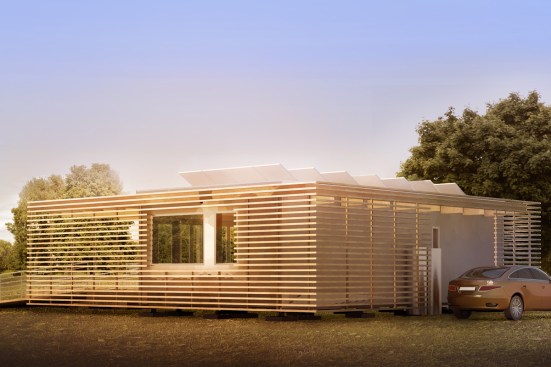
outer louvered screens serves two key purposes in the Y-House design: the louvers
are specifically matched to the house’s facade orientation to minimize solar
heat gain, and the extension of the screens beyond the house connect interior
spaces to the outside.
HEAT RECOVERY: To account for
the 12% of the time when CA temperature falls outside ideal conditions, Team
Yale is featuring demand-based energy recovery. When the house is full of
people and running appliances, the ERV removes this excess heat to cool the
house while a heat pump hot water system uses this heat for hot water.
MODULAR CONSTRUCTION:
Efficiency lies not only in the house itself, but in the process of building
it. Standard construction takes months of manpower, large amounts of fuel in
shipping materials, and excess waste. By designing the Y-House to break down into
two standard-sized modules for modular construction assembly, the Y-House will
take only one month to construct.
COMMUNAL GARDEN: The home of
the future is not an isolated, enclosed shell, but rather an open environment
that incorporates the outside world. The Y-House is part of this larger
community, and has been designed to maximize social spaces and shared
resources. The communal garden incorporates a variety of drought-tolerant
plants the minimize water usage while providing a natural aesthetic.
ADAPTABILITY: Team Yale
understands that in order for the Y-House to remain relevant, it has to be
adaptable. A double wall and drop ceiling enable piping, wiring and ductwork to
be swapped out without penetrating the envelope of the house. A modular
mechanical core can actually be plugged into the house to allow easy changes
for future systems.