
A firm like Skidmore, Owings & Merrill, Mau’s team realized, has tremendous brand equity, built on the combined advantages of size, depth of experience, and pedigree. As the country’s third-largest firm, with eight offices and approximately $240 million in revenue, it has no trouble attracting big clients, and with 70 years of iconic structures in its portfolio, its reputation is tremendous. But as Mau wrote in his recommendations to the firm, “SOM is respected for what it has done, but expected to do more.”
The key to representing SOM well is not to reflect only its massiveness or its age, Mau pointed out. It’s to offer quick and complete access to the extraordinary amount of knowledge the firm has accumulated and continues to accumulate.
BMD created a comparative analysis of other firms’ sites. Some, like Renzo Piano and Richard Rogers, scored high for intuitive design and the straightforward presentation of a great deal of information. Others, like Frank Gehry and Tadao Ando, barely have a site. SOM, as a collection of partners, rather than a single leader, needed a site that reflected an entire institution.
“We had visited their offices in New York, Chicago, and San Francisco,” says Tobias Lau, BMD creative lead on the website for SOM. “And what struck us was the number of people in their 20s leading the charge on massive projects all over the world. Many architecture firms are organized around a central icon, but here we were seeing a very positive group dynamic between younger and older designers. A modern, minimalist site couldn’t possibly communicate the amount of creativity and activity going on at the firm.”
In an effort to focus thinking about the site’s audience, BMD conducted interviews of typical SOM.com users. The team then constructed six hypothetical users: a potential client from the United Arab Emirates, the editor of a major architecture magazine, a Danish design student, a professor in China, an SOM employee, and an architect at a partner firm. Each archetype represented a different set of needs the website had to fill, and making the six categories into distinctive characters brought home the urgency of meeting their requirements. Nothing terrifies a partner like the prospect of inadvertently turning away a potential client, and the hypothetical UAE client—highly placed in the Ministry of Finance and Industry, pressed for time, looking to build a training facility for senior government officials—was someone SOM wouldn’t want to disappoint.
Then, in a shrewd piece of client management, Mau showed the partners a clearly delineated set of options for what their site might look like. At one end of the spectrum, he showed them the Chanel website, as polished and singular as a handbag. At the other, he displayed Yahoo’s endless torrent of news headlines and competing pieces of information.
With hundreds of SOM architects constantly studying subjects from airport security to communism, the site should be, in effect, a newsroom, complete with up-to-the-minute reports, op-eds, and event announcements from all over the firm. As a profession, the ongoing education involved in architecture is matched only by journalism. Architects are constantly learning about new subjects, and Mau recognized that this aspect of the job had tremendous brand value. To be a thought leader in architecture, SOM needed to be thinking out loud.
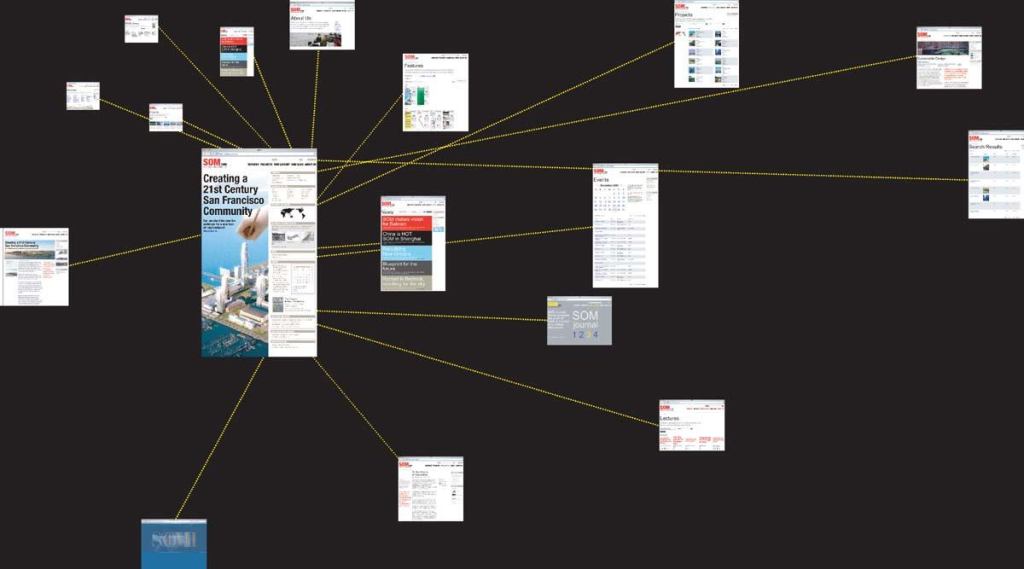
Although it hadn’t been revealing it on the web, the firm is extremely sophisticated internally about refining its collective knowledge: the SOM Journal, for example, an annual critique of the firm’s work written by external critics, engineers, and designers, shows off the firm’s spirit of self-improvement, the depth of its experience, and its commitment to learning. BMD determined that the Journal, along with a dynamic calendar of events, news headlines, feature stories about ongoing projects, and projects listed by region and type, should be a fixture of the new site.
By requiring fresh content, the site demanded to be directly and deeply connected to the firm’s internal processes. RSS—a way of subscribing to content from preferred sources on the web—would keep subscribers in constant touch with change at the firm. Blogging of research and development within the company’s internal site would keep all parts of the firm intellectually interconnected. And on the public site, publishing the best voices from the internal blogs would keep interested observers constantly informed about the firm’s latest research. As one SOM client put it, “SOM is a tremendous intellectual network” that had not yet been married to effective communications technology. According to another, “the whole basis of the website should be to give a snapshot of where the firm is and how it’s deployed at this time.”
In order to embody SOM’s brand, the site had to encompass the firm’s long and storied history (a significant chunk of those who come to the site, Mau learned, were architecture students trying to learn the firm’s place in history). But it needed to also be global, current, and supportive of evolving business goals. “When I go to London to pitch a project,” Wimer explained to Mau in an early meeting, “they want to know how we’re going to bring our experiences designing for Shanghai and Dubai to bear there.”
In the end, Mau’s team decided that the site should be three things: an evolving story, a campus for learning, and a cultural player. It should be a reflection of what Mau called “design excellence”—a 60-year legacy of 10,000 projects coupled with forward-looking initiatives like SOM Journal, hundreds of education programs, and in-studio learning. The site needed to take possession of architectural discourse by constantly publishing perspectives on architecture and planning. “SOM is already practicing design excellence,” Mau wrote to the partners. “The activities just need to be captured and shared.”
Content on the site, which goes live at the end of the year, is updated by a dedicated web editor, hired exclusively to curate SOM.com in consultation with the partners. Interviews, a blog-style column, transcripts and video of lectures and appearances, case studies, and features are all edited and presented as an ongoing publication, much as newspapers and magazines generate content for the web. As a result, SOM’s site, like its brand, is no longer a static thing. It’s an active, spontaneous entity, full of future promise—not just a beautiful bulwark against decay.