

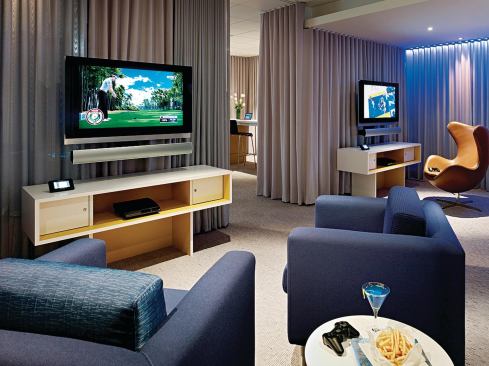
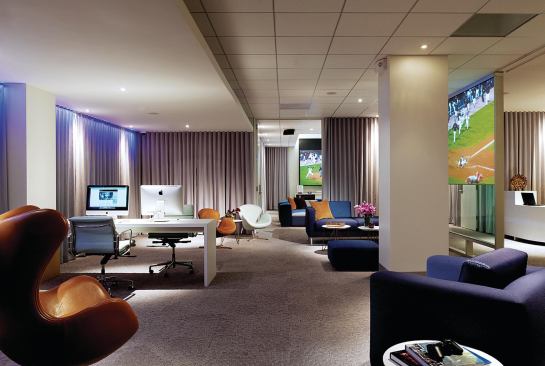
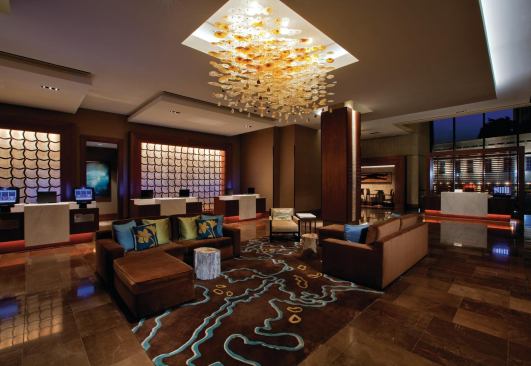
Design by WATG; photograph by Bruce Buck
St. Regis Princeville Resort Kauai, Hawaii WATG WATG trans…
Let’s Make a Deal
Hotels are rife with risk and opportunity, and the opportunity to purchase underperforming assets and improve their performance has driven a lot of investors in recent years, Cooper Riley’s Erickson says.
Sales can trigger renovations, but HVS’s Payne points out that a deal might simply represent a recapitalization. “It’s all on a case-by-case basis, but the majority of transactions don’t involve remodeling or repositioning,” he says. In early March, Real Capital Analytics (RCA) reported a to-date 2011 hotel transaction volume of $1.6 billion. Of that, 27 percent, or $429.6 million, was a sale with a renovation or redevelopment objective.
Parker says that when a property changes hands, the owner is presented with a property or product improvement plan (PIP). Included in the PIP is any number of improvements that the owner must make to obtain or maintain the brand flag. Americans with Disabilities Act (ADA) requirements are also included in all PIPs, Parker says.
Parker-Torres was hired as part of the team restoring the Fairmont Copley Plaza following its sale to FelCor Lodging Trust in August 2010. Though rebranding was not part of the acquisition equation, the hotel did embark on a $20 million project that includes enhancements to its 383 guest rooms and the Fairmont Gold Lounge, including furniture, fixtures, and equipment (FF&E). The hotel is also adding a new outdoor deck and fitness center on the hotel’s rooftop.
When the Grand Hotel Minneapolis was acquired by Pebblebrook Hotel Trust last fall, it turned to Kimpton Hotels & Restaurants to assume operations of the nearly 100-year-old property. Though that transition did prompt some refurbishments to the interiors, Sussman says that the property was able to open as a Kimpton with minimal architectural changes.
“It felt like a men’s club to begin with in terms of its traditional nature,” Sussman says. “We made it more eclectic, amped it up a bit to give it the Kimpton feel.” Much of that Kimpton feel, he says, comes from design “surprises”—a pattern on a pillow or a graphic, for example.
Ramping up Retrofits
Everyone knows that Motel 6 will leave the light on, but these days that bulb is more likely to be a compact fluorescent lamp (CFL). In 2006, the chain began retrofitting its U.S. properties with fluorescent lighting. Today, it’s common for hotels across all service levels to employ a range of sustainable strategies, ranging from green housekeeping practices to lighting retrofits and climate-control systems to use of recycled materials.
Hotels have an incentive to operate greener, according to the Environmental Protection Agency (EPA)’s Energy Star program—it reports that U.S. hotels spend nearly $4 billion on energy annually. Reducing these costs by 10 percent is the equivalent to a $0.62 ADR increase for limited-service hotels and a $1.35 ADR increase for full-service hotels, the EPA says. Still, there are challenges to going green–real or perceived costs can be an obstacle, as well as an operator’s uncertainty regarding guest expectations and preferences.
One recent report, issued in March by the Center for Hospitality Research at Cornell University, studied hotel guests’ reactions to guest room sustainability initiatives. Only 30 percent of participants indicated that they would choose a hotel or hotel brand based on the hotel’s commitment to sustainability, but guests across the board noticed no differences when using reduced-power liquid crystal display (LCD) televisions and were equally pleased with the use of CFLs and light-emitting diodes (LEDs). The report concludes that owners and operators can confidently install reduced-power televisions and, at a minimum, replace incandescent bulbs with CFLs to save energy.
Erickson says that it’s not just a matter of switching out light bulbs, it’s also important to look at low-intensity lighting, dimmable fluorescents, and LEDs, especially in common areas, such as corridors, lobbies, and parking garages, where lights stay on 24 hours a day. “You see the results in the utility bill quickly,” he says.
Back in the guest room, Booth says that LEDs and fluorescents are making more of an impact on design, but he is quick to add that dimming issues and color technology can make them a “bedeviling” issue.
“We go through great lengths to design lampshades,” Booth says. “We line it with a garish pink shade. By using that color inside the shade, we can get the right glow—it looks incandescent.”