
This past week, we saw a bit of a spring return to the step of the market, a $2 trillion stimulus package come together (after the obligatory drama and hysterics), New York City become the U.S. front line on the COVID-19 crisis response, the second most-populous country (and the world’s largest democracy) go on lockdown, the U.S. pass China for most confirmed cases, Spain pass China for coronavirus deaths, and more. But the story that most fascinates me by at the moment is that of Vo. A small village of 3,300 people about 40 miles west of Venice, on the other side of Padua, Vo Euganeo is in the foothills of the Italian Alps. A 78-year-old man from the village was one of the first fatal victims of the virus in Italy, and Vo was one of a handful of places in the north of the country to get quarantined first.
What piqued my interest here is that the story of Vo is the first truly scientific study of the outbreak. So far, our understanding of the virus has been a frantic game of catch-up. We simply don’t know much about this bug, and we’re making a lot of quick decisions based on incomplete data. We only have the capacity to test and treat the sickest among us, which means we have no real idea of how many total people are getting infected and transmitting the virus. But when Vo went on lockdown in February, researchers at the University of Padua used it as a chance to learn more. In the first instance that I’ve seen, everyone in the village got tested—twice. In the initial round, 3% of the population tested positive, about 10 times more than was expected, as the vast majority of people showed no symptoms. Another source says that as many as 75% of the Vo villagers were asymptomatic positives, and a different report from China suggests that at least a third of infected people are “silent carriers.” Either way you slice it, while the percentages of people who react more severely to this infection are probably lower than we initially thought, the number of infected people are likely much, much higher than is being reported now. That’s, weirdly, both slightly comforting and utterly terrifying at the same time.
The follow-up tests two weeks later in Vo showed that social distancing and quarantine measures proved highly effective, bringing the infection rate down to 0.41%, a drop of nearly 90%. So physical distancing works, people. Please stay home if you can. You might even have it and not know it. And while you’re home, here are some coronavirus-related stories to keep you caught up …
The Impact on Architecture and the Built Environment
The National Council of Architectural Registration Boards (NCARB) has updated a number of its testing policies in the wake of the crisis. More than 18,600 emerging designers studying for or planning to take the Architect Registration Examination (ARE) in the coming months, but due to the closure until April 16 of Prometric—the U.S.–based testing company that operates ARE testing centers—NCARB has waived rescheduling fees through the end of April. Currently, NCARB recommends that those affected reschedule their appointments online for late-May, June, or July. [ARCHITECT]
Courtesy Morpholio
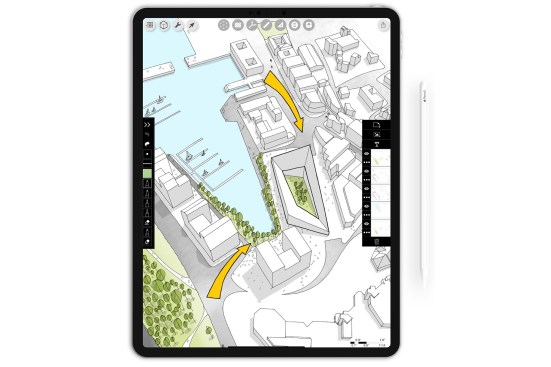
Technology editor Wanda Lau has compiled a list of software and tools that are currently available for free. Since many firms and institutions maintain licenses on specific in-house workstations, several software developers are offering free additional seats, extended trial runs, and more to help out while we’re all working from home. After all, the pandemic is stressful enough without having to worry about software licensing. [ARCHITECT]
On Thursday, AIA praised the Senate for passing the $2 trillion stimulus package, especially the aspects that address the needs of small businesses during this trying time. “We’re pleased that all of these vital businesses are rightfully recognized as a priority,” said 2020 President Jane Frederick, FAIA, in the press release. “Architects will be a critical part of economic recovery, and AIA has forcefully advocated for infrastructure investment to stimulate recovery, as well as relief for businesses and employees.” [ARCHITECT] AIA also launched a new task force “to help inform public officials, healthcare facility owners and architects on adapting buildings into temporary healthcare facilities.” [ARCHITECT]
Our building materials guru, Blaine Brownell, FAIA, analyzes how well the novel coronavirus holds up on surfaces, and what conclusions we can draw from that for how we should spec coatings and materials going forward. [ARCHITECT]
Shipping container emergency hospitals: Carlo Ratti Associati has released an open-source design for emergency COVID-19 hospitals, “plug-in” intensive care units “with biocontainment through negative pressure.” In collaboration with Italian architect Italo Rota and a team of experts, CURA (Connected Units for Respiratory Ailments) are shipping container modules that can be connected using an inflatable, airlock-like structure so that the health care facility can grow or shrink to meet the current needs. [ArchDaily]
Just some haunting drone footage of one of the biggest cities in the world during quarantine. [SFIST]
Your office might be closing, but WeWork is staying open. Reportedly, the company is deeming its services as essential and has told its employees that it is staying open for business. [Forbes]
The United States Army Corps of Engineers rides to the rescue. First up: Turning Manhattan’s Javits Center into a field hospital with more 1,000 beds. [Wired] Under the directive of New York Gov. Andrew Cuomo, the Corps is working on three other downstate sites as well. Combined with the Javits, these four sites will deliver 4,000 new temporary hospital beds to the city.
William J. Hercules, FAIA, CEO of WJH Health and a recent president of the American College of Healthcare Architects; Dr. Diana Anderson, current clinical fellow at the University of California, San Francisco; and Marc Sansom, managing director of London-based Salus Global Knowledge Exchange, have written an open letter to policymakers on how design and architecture are crucial in responding to the COVID-19 crisis as well as future pandemics. [ARCHITECT]
Makers and engineers are pitching in to design, build, and 3D print protective gear and ventilators. [The New York Times]
From frocks to face masks, fashion brands are doing their part and shifting their production from what to wear to what we need to be wearing. [Domus] On this side of the Atlantic, companies are retooling to help as well. In New York, Budweiser brewing is being shelved while hand sanitizer is produced instead. [NY Post] In Delaware, Dogfish Head is doing the same. [WHYY] Ford is working with 3M and GE to turn from cars to ventilators. [Tech Crunch] Hanes and The Gap are making N95 masks; Zara is doing the same in Spain. [Today] And Lyft will be drive-sharing for medical supplies in addition to people. [Tech Crunch] All of these companies are doing so voluntarily, as the White House has not made clear whether it will invoke the Defense Production Act to force companies to help.
Building and Construction
If construction sites are going to stay open, Builder editorial director John McManus has five ideas construction supervisors and owners can take now to lower worker risk for their workers. [BUILDER] And McManus writes that the homebuilding industry, like everyone else, is grasping for information on how to get through this public health–economic crisis: “The territory, the waters, the turf, whatever we may want to call our fields of engagement and commerce, are, all of them, uncharted. This time is different.” [BUILDER]
On Monday, Zillow announced it was pausing operations “in all 24 markets where Zillow Offers currently operates in response to local public health orders related to COVID-19 and to help protect the safety and health of its employees, customers and partners.” Last week, it put all of its open houses on hold too. [BUILDER] On Wednesday, word came down that mortgage applications dropped by nearly 30% from the week before already, and that mortgage rates were moving up. [BUILDER]
Also on Monday, the Federal Housing Finance Agency announced that Fannie Mae and Freddie Mac will give forbearance for multifamily property owners … so long as they suspend all evictions for renters unable to pay rent during the outbreak. [MULTIFAMILY EXECUTIVE] Read more stories from the multifamily industry on how they’re responding to the crisis. [MULTIFAMILY EXECUTIVE]
Video home tours are up. Way up. [BUILDER] But February home sales were down. Not nearly as down as they’re going to be in March. [BUILDER] But according to Meyers Research‘s chief economist Ali Wolf, new home contracts were up more than 16% from the previous year in February, before the crisis really hit home. [BUILDER]
Some lumberyards and other building products suppliers are staying open, but not letting customers inside. Complying with the CDC rules for social distancing can be tricky, and for many companies that means that even while they need to stay open for business, that business is moving from the showroom floor to the parking lot or a drive-thru. [PROSALES]
Losses

Aundre Larrow
We lost architect and influential critic Michael Sorkin on Thursday. [ARCHITECT]
Americans filing for unemployment this week went up by a whopping 3 million, from about 200,000 people to 3.283 million—and more will probably join the dole as additional small business go under in the coming weeks. [BUILDER] Let us here at ARCHITECT know how business is going for your firm, and how its adjusting during the crisis.
Cancellations and Postponements

The Tokyo 2020 Olympics Games are now officially the Tokyo 2021 Olympics Games. [Olympics]
Other Notables
On the more hopeful side: If we can contain the virus relatively quickly and effectively, we may have a substantial economic rebound later this year. [Bisnow]
Here’s Liz Cheney being the voice of reason and standing up to voices in her party demanding a return to business as usual. So, it may not be the End of the World, it’s definitely Bizarro World. [Twitter]
There will be no normally functioning economy if our hospitals are overwhelmed and thousands of Americans of all ages, including our doctors and nurses, lay dying because we have failed to do what’s necessary to stop the virus. https://t.co/AchwfXtuLi
— Liz Cheney (@Liz_Cheney) March 24, 2020
In this week’s “Gee, I’m Shocked” News: The data-crunching reporters over at The Wall Street Journal reported this week that executives at many companies saved themselves $1.9 billion by selling shares of their own companies before the March stock market crash. By far the biggest recipient of this market foresight was Amazon CEO Jeff Bezos, who sold $3.4 billion in Amazon shares in February, avoiding losses of $317 million if he held them this week. But the most surprising part of this story might be that the $3.4 billion in shares he sold represents a mere 3% of his Amazon holdings. Brother, can you spare a few million dimes? [WSJ]
To everyone who thought that the gun business would be a good one to be in during the apocalypse: The National Rifle Association is reportedly cutting its salaries 20% and anticipating layoffs after having to cancel its annual meeting in April and other fundraising events. [Washington Post]
Can’t find hand sanitizer on the shelves or from Amazon Fresh? If you’re a DIY type of person with extra time on your hands, try making your own. [Wired] But of course, its far more important remember to wash your hands, often, and for the minimum length of time. And if you can’t remember how long that is, here’s Charo to explain:
Hola Amigos l am Thinking of You and l know that You Also are taking lots of precautions to State Very Healthy , l Look Now Like a VItamina C. With High Hills . I love You All . Besos .#charo #cuchicuchi #healthy #healthylifestyle #clean #washyourhands #virus #cleaning #immune pic.twitter.com/7kEKK0hH60
— Charo Cuchi Cuchi (@CharoCuchiCuchi) March 13, 2020